. 2020 Jun 24;5(3):e00367-20.
doi: 10.1128/mSphere.00367-20.

COVID-19 Hyperinflammation: What about Neutrophils?

Affiliations

COVID-19 Hyperinflammation: What about Neutrophils?

Athanasios Didangelos. mSphere. .

Abstract

COVID-19 is often related to hyperinflammation that drives lung or multiorgan injury. The immunopathological mechanisms that cause excessive inflammation are under investigation and constantly updated. Here, a gene network approach was used on recently published data sets to identify possible COVID-19 inflammatory mechanisms and bioactive genes. First, network analysis of putative SARS-CoV-2 cellular receptors led to the mining of a neutrophil-response signature and relevant inflammatory genes. Second, analysis of RNA-seq data sets of lung cells infected with SARS-CoV-2 revealed that infected cells expressed neutrophil-attracting chemokines. Third, analysis of RNA-seq data sets of bronchoalveolar lavage fluid cells from COVID-19 patients identified upregulation of neutrophil genes and chemokines. Different inflammatory genes mined here, including TNFR, IL-8, CXCR1, CXCR2, ADAM10, GPR84, MME, ANPEP, and LAP3, might be druggable targets in efforts to limit SARS-CoV-2 inflammation in severe clinical cases. The possible role of neutrophils in COVID-19 inflammation needs to be studied further.

Keywords: COVID-19; SARS-CoV-2; coronavirus; inflammation; neutrophil.


Figures

FIG 1
FIG 1
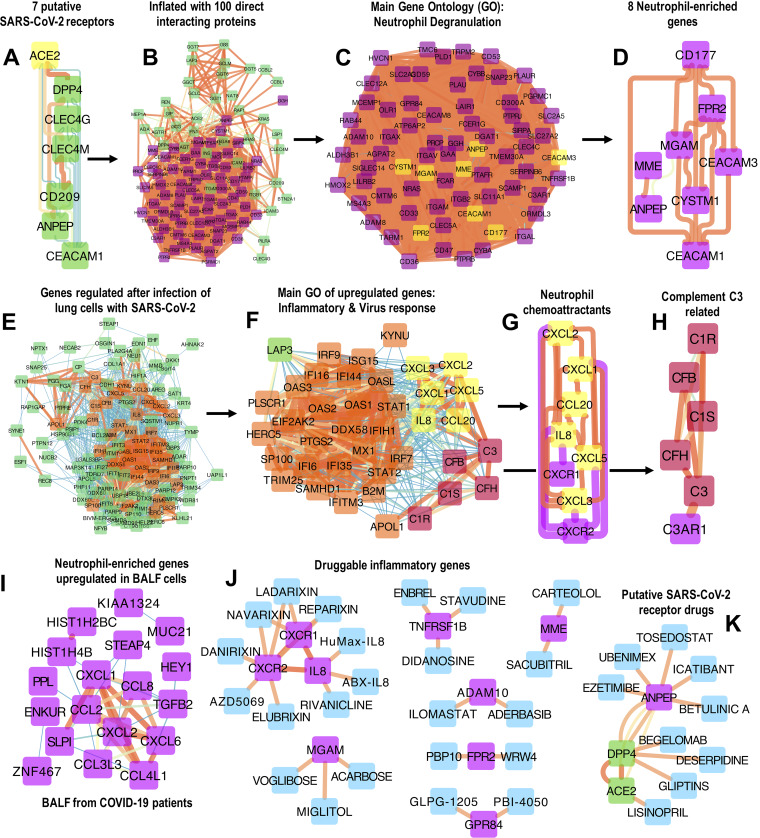
(A) ACE2 and 6 related putative SARS-CoV-2 receptors on epithelial cells. ACE2, DPP4, and ANPEP are peptidases. (B) The 7 putative SARS-CoV-2 receptors were inflated in StringDB by adding up to 100 directly interacting proteins with direct association to the 7 input proteins using 1st shell interactions and StringDB default settings. (C and D) The main gene ontology of this inflated network is “Neutrophil Degranulation” (C) (http://amigo.geneontology.org/amigo/term/GO:0043312) and includes 8 neutrophil-enriched genes isolated in panel D. The gene ontology of these proteins was examined in the Amigo database. (E) One hundred thirteen genes were differentially regulated in RNA-seq data sets of human alveolar adenocarcinoma (A549) and human bronchial epithelial cells infected with SARS-CoV-2 in vitro (study details, data sets, and statistical analysis can be found in reference 14). (F) Following virus infection, most significantly upregulated genes were related to inflammatory and interferon responses. (G and H) Six classic neutrophil chemokines were upregulated in these cells following infection with SARS-CoV-2, depicted in panel G, as well as C3 and related complement pathway genes depicted in panel H. (I) Eighteen neutrophil-enriched and neutrophil chemotaxis genes were upregulated in an RNA-seq data set of BALF cells collected from 2 COVID-19 patients versus 3 healthy BALF donors (study details, data sets, and statistical analysis can be found in reference 16). (J and K) Putative druggable targets with likely neutrophil proinflammatory function derived from the analysis. Approved and experimental drugs with validated pharmacological evidence are presented as interaction networks. Protein-drug interactions were retrieved from DGIdb (v3.02; http://www.dgidb.org/search_interactions) and were curated (DrugBank [https://www.drugbank.ca/]) to exclude nonvalidated and false-positive interactions. All protein-protein interaction networks were developed in Cytoscape with cumulative protein-protein interaction scores computed in StringDB (v11) (https://string-db.org/) using default interaction sources (experimental evidence, coexpression, gene fusion, cooccurrence, curated databases, and references in scientific literature text-mining).

References

    1. Tay MZ, Poh CM, Renia L, MacAry PA, Ng L. 2020. The trinity of COVID-19: immunity, inflammation and intervention. Nat Rev Immunol 20:363–374. doi: 10.1038/s41577-020-0311-8. - DOI - PMC - PubMed
    1. Mehta P, McAuley DF, Brown M, Sanchez E, Tattersall RS, Manson JJ, HLH Across Speciality Collaboration, UK. 2020. COVID-19: consider cytokine storm syndromes and immunosuppression. Lancet 395:1033–1034. doi: 10.1016/S0140-6736(20)30628-0. - DOI - PMC - PubMed
    1. Ritchie AI, Singanayagam A. 2020. Immunosuppression for hyperinflammation in COVID-19: a double-edged sword? Lancet 395:1111. doi: 10.1016/S0140-6736(20)30691-7. - DOI - PMC - PubMed
    1. Salome B, Magen A. 2020. Dysregulation of lung myeloid cells in COVID-19. Nat Rev Immunol 20:277. doi: 10.1038/s41577-020-0303-8. - DOI - PMC - PubMed
    1. Ou X, Liu Y, Lei X, Li P, Mi D, Ren L, Guo L, Guo R, Chen T, Hu J, Xiang Z, Mu Z, Chen X, Chen J, Hu K, Jin Q, Wang J, Qian Z. 2020. Characterization of spike glycoprotein of SARS-CoV-2 on virus entry and its immune cross-reactivity with SARS-CoV. Nat Commun 11:1620. doi: 10.1038/s41467-020-15562-9. - DOI - PMC - PubMed

Publication types

MeSH terms