


Brain Metabolite Changes After Anodal Transcranial Direct Current Stimulation in Autism Spectrum Disorder
- PMID: 32581703
- PMCID: PMC7287211
- DOI: 10.3389/fnmol.2020.00070
Brain Metabolite Changes After Anodal Transcranial Direct Current Stimulation in Autism Spectrum Disorder
Abstract
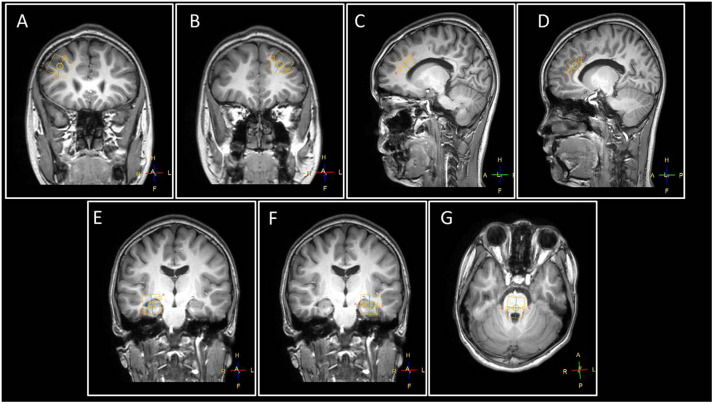
Objectives: Previous research has provided evidence that transcranial direct current stimulation (tDCS) can reduce severity of autism spectrum disorder (ASD); however, the exact mechanism of this effect is still unknown. Magnetic resonance spectroscopy has demonstrated low levels of brain metabolites in the anterior cingulate cortex (ACC), amygdala, and left dorsolateral prefrontal cortex (DLPFC) in individuals with ASD. The aim of this study was to investigate the effects of anodal tDCS on social functioning of individuals with ASD, as measured by the social subscale of the Autism Treatment Evaluation Checklist (ATEC), through correlations between pretreatment and posttreatment concentrations of brain metabolites in the areas of interest (DLPFC, ACC, amygdala, and locus coeruleus) and scores on the ATEC social subscale.
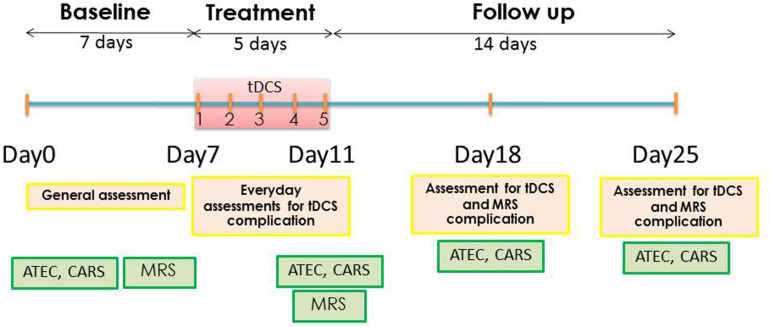
Methods: Ten participants with ASD were administered 1 mA anodal tDCS to the left DLPFC for 20 min over five consecutive days. Measures of the ATEC social subscale and the concentrations of brain metabolites were performed before and immediately after the treatment.
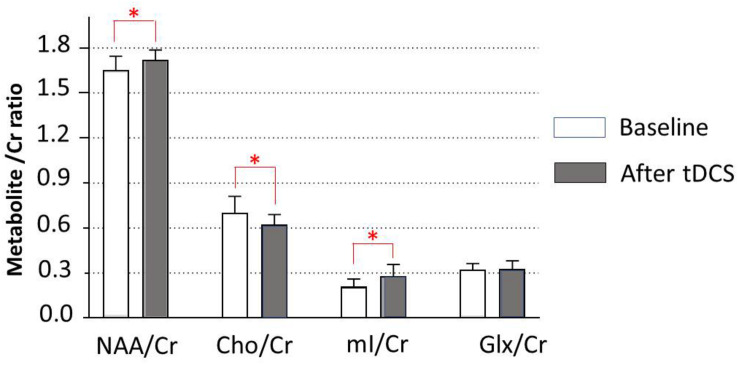
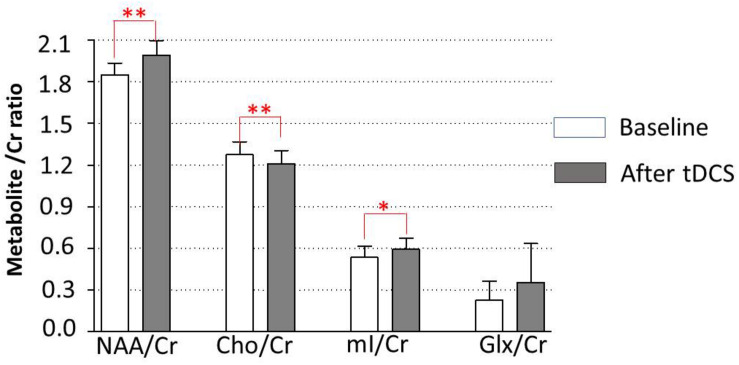
Results: The results showed a significant decrease between pretreatment and immediately posttreatment in the ATEC social subscale scores, significant increases in N-acetylaspartate (NAA)/creatine (Cr) and myoinositol (mI)/Cr concentrations, and a decrease in choline (Cho)/Cr concentrations in the left DLPFC and locus coeruleus after tDCS treatment. Significant associations between decreased ATEC social subscale scores and changed concentrations in NAA/Cr, Cho/Cr, and mI/Cr in the locus coeruleus were positive.
Conclusion: Findings suggest that beneficial effects of tDCS in ASD may be due to changes in neuronal and glia cell activity and synaptogenesis in the brain network of individuals with ASD. Further studies with larger sample sizes and control groups are warranted.
Keywords: autism spectrum disorder; brain metabolites; locus coeruleus; magnetic resonance spectroscopy; transcranial direct current stimulation.
Copyright © 2020 Auvichayapat, Patjanasoontorn, Phuttharak, Suphakunpinyo, Keeratitanont, Tunkamnerdthai, Aneksan, Klomjai, Boonphongsathian, Sinkueakunkit, Punjaruk, Tiamkao and Auvichayapat.
Figures
References
-
- Amatachaya A., Jensen M. P., Patjanasoontorn N., Auvichayapat N., Suphakunpinyo C., Janjarasjitt S., et al. (2015). The short-term effects of transcranial direct current stimulation on electroencephalography in children with autism: a randomized crossover controlled trial. Behav. Neurol. 2015:928631. 10.1155/2015/928631 - DOI - PMC - PubMed
-
- American Psychiatric Association (2013). DSM-5 Task Force. Diagnostic and Statistical Manual of Mental Disorders: DSM-5. Available online at: https://books.google.co.th/books?hl=en&lr=&id=-JivBAAAQBAJ&oi=fnd&pg=PT1... Psychiatric Association%3A Diagnostic and Statistical Manual of Mental Disorders 2013 5th ed Arlington American Psychiatric Association&f=false (accessed July 16, 2019).
-
- Auvichayapat P., Auvichayapat N. (2011). Basic knowledge of transcranial direct current stimulation. J. Med. Assoc. Thail. 94 518–527. - PubMed
LinkOut - more resources
Full Text Sources
