


Investigating the Relationship Between Creativity and Entrepreneurial Intention: The Moderating Role of Creativity in the Theory of Planned Behavior
- PMID: 32581972
- PMCID: PMC7296068
- DOI: 10.3389/fpsyg.2020.01209
Investigating the Relationship Between Creativity and Entrepreneurial Intention: The Moderating Role of Creativity in the Theory of Planned Behavior
Abstract
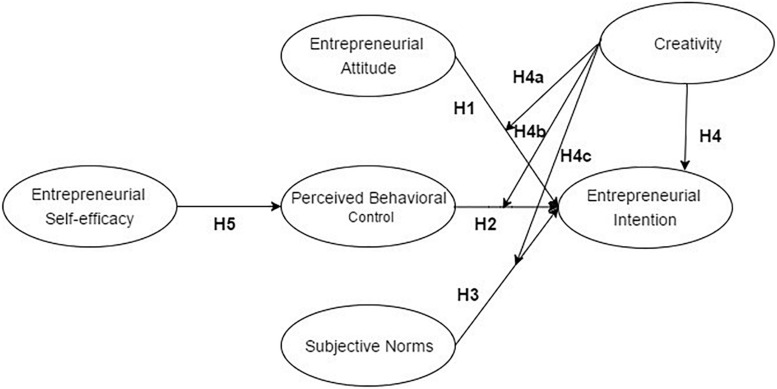
Cultivating students' creativity in entrepreneurship education at the college and university level is a key facet of entrepreneurship education in encouraging innovation in students. In this study, the influence of creativity, self-efficacy, entrepreneurial attitude, perceived control, and subjective norms, on students' entrepreneurial intention were examined through a moderated model based on Ajzen's (1985) Theory of Planned Behavior (TPB). A questionnaire survey was used to obtain the data from 523 students from different universities in China's Zhejiang province. SPSS 20.0 was used to conduct descriptive analysis and exploratory analysis of the data, and Amos 22.0 was used to conduct confirmatory factor analysis. The research concluded that creativity has a significant impact on entrepreneurial intention; entrepreneurial self-efficacy has a marked effect on perceived behavior control; and perceived behavioral control, subjective norms and entrepreneurial attitude all significantly affect entrepreneurial intention. Finally, creativity has a significant moderating effect on the roles of perceived behavioral control and subjective norms on entrepreneurial intention, but not on the attitude to entrepreneurship. These results suggest that entrepreneurship education should focus on the cultivation of students' creativity and entrepreneurial efficacy, while encouraging their entrepreneurial intention as well as developing their entrepreneurial skills and mindset.
Keywords: TPB model; creativity; entrepreneurial intention; entrepreneurship education; university students.
Copyright © 2020 Shi, Yuan, Bell and Wang.
Figures


References
-
- Ahlin B., Drnovšek M., Hisrich R. D. (2014). Entrepreneurs’ creativity and firm innovation: The moderating role of entrepreneurial self-efficacy. Small Bus. Econ. 43 101–117. 10.1007/s11187-013-9531-7 - DOI
-
- Ajzen I. (1985). “From intentions to actions: a theory of planned behavior,” in Action-Control: From Cognition to Behavior, eds Kuhi J., Beckmann J. (Heidelberg: Springer; ), 11–39. 10.1007/978-3-642-69746-3_2 - DOI
-
- Ajzen I. (1991). The theory of planned behavior. Organ. Behav. Hum. Decis. Process. 50 179–211. 10.1016/0749-5978(91)90020-T - DOI
-
- Aldrich H. E., Cliff J. E. (2003). The pervasive effects of family on entrepreneurship: toward a family embeddedness perspective. J. Bus. Venturing 18 573–596. 10.1016/S0883-9026(03)00011-9 - DOI
-
- Bell R. (2019). Predicting entrepreneurial intention across the university. Educ. Train. 61 815–831. 10.1108/ET-05-2018-0117 - DOI
LinkOut - more resources
Full Text Sources
