


Endopolyploidy is a common response to UV-B stress in natural plant populations, but its magnitude may be affected by chromosome type
- PMID: 32582956
- PMCID: PMC7750947
- DOI: 10.1093/aob/mcaa109
Endopolyploidy is a common response to UV-B stress in natural plant populations, but its magnitude may be affected by chromosome type
Abstract
Background and aims: Ultraviolet-B radiation (UV-B) radiation damages the DNA, cells and photosynthetic apparatus of plants. Plants commonly prevent this damage by synthetizing UV-B-protective compounds. Recent laboratory experiments in Arabidopsis and cucumber have indicated that plants can also respond to UV-B stress with endopolyploidy. Here we test the generality of this response in natural plant populations, considering their monocentric or holocentric chromosomal structure.
Methods: We measured the endopolyploidy index (flow cytometry) and the concentration of UV-B-protective compounds in leaves of 12 herbaceous species (1007 individuals) from forest interiors and neighbouring clearings where they were exposed to increased UV-B radiation (103 forest + clearing populations). We then analysed the data using phylogenetic mixed models.
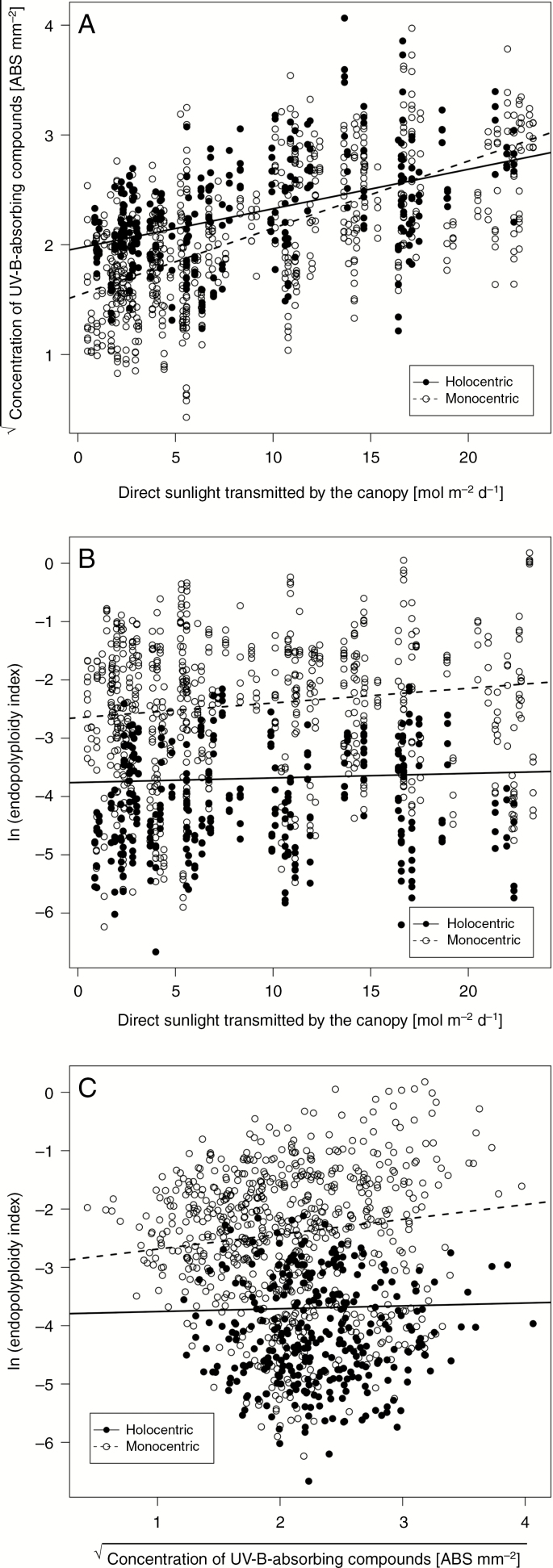
Key results: The concentration of UV-B protectives increased with UV-B doses estimated from hemispheric photographs of the sky above sample collection sites, but the increase was more rapid in species with monocentric chromosomes. Endopolyploidy index increased with UV-B doses and with concentrations of UV-B-absorbing compounds only in species with monocentric chromosomes, while holocentric species responded negligibly.
Conclusions: Endopolyploidy seems to be a common response to increased UV-B in monocentric plants. Low sensitivity to UV-B in holocentric species might relate to their success in high-UV-stressed habitats and corroborates the hypothesized role of holocentric chromosomes in plant terrestrialization.
Keywords: Endopolyploidy; UV-B-absorbing compounds; endoreduplication index; flow cytometry; holocentric chromosomes; monocentric chromosomes; natural population; ultraviolet radiation.
© The Author(s) 2020. Published by Oxford University Press on behalf of the Annals of Botany Company. All rights reserved. For permissions, please e-mail: journals.permissions@oup.com.
Figures

References
-
- Barow M. 2006. Endopolyploidy in seed plants. BioEssays 28: 271–281. - PubMed
-
- Barow M, Meister A. 2003. Endopolyploidy in seed plants is differently correlated to systematics, organ, life strategy and genome size. Plant, Cell & Environment 26: 571–584.
-
- Beckmann M, Václavík T, Manceur AM, . et al 2014. glUV: a global UV-B radiation data set for macroecological studies. Methods in Ecology and Evolution 5: 372–383
-
- Bouchenak-Khelladi Y, Muasya AM, Linder HP. 2014. A revised evolutionary history of Poales: origins and diversification. Botanical Journal of the Linnean Society 175: 4–16.
Publication types
MeSH terms
LinkOut - more resources
Full Text Sources
