


Prenatal anxiety and obstetric decisions among pregnant women in Wuhan and Chongqing during the COVID-19 outbreak: a cross-sectional study
- PMID: 32583536
- PMCID: PMC7362035
- DOI: 10.1111/1471-0528.16381
Prenatal anxiety and obstetric decisions among pregnant women in Wuhan and Chongqing during the COVID-19 outbreak: a cross-sectional study
Abstract
Objectives: To investigate the mental status of pregnant women and to determine their obstetric decisions during the COVID-19 outbreak.
Design: Cross-sectional study.
Setting: Two cities in China--Wuhan (epicentre) and Chongqing (a less affected city).
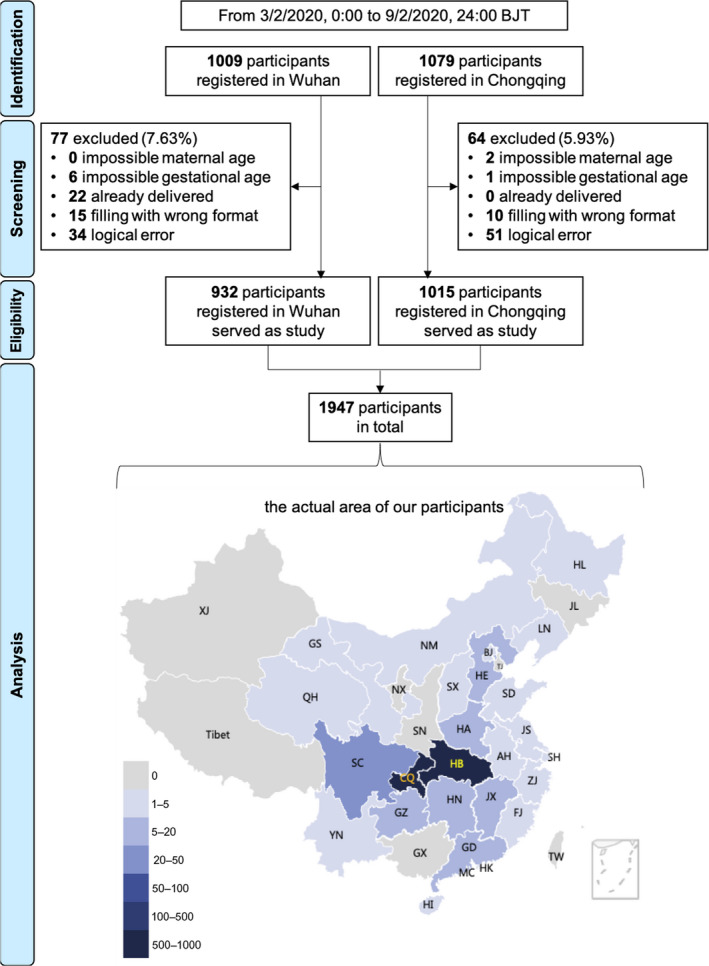
Population: A total of 1947 pregnant women.
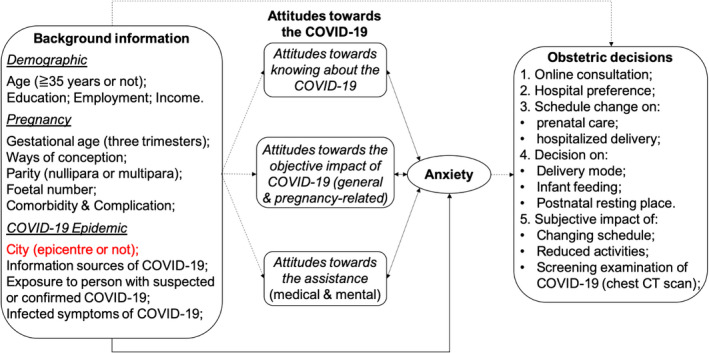
Methods: We collected demographic, pregnancy and epidemic information from our pregnant subjects, along with their attitudes towards COVID-19 (using a self-constructed five-point scale). The Self-Rating Anxiety Scale (SAS) was used to assess anxiety status. Obstetric decision-making was also evaluated. The differences between cities in all of the above factors were compared and the factors that influenced anxiety levels were identified by multivariable analysis.
Main outcome measures: Anxiety status and its influencing factors. Obstetric decision-making.
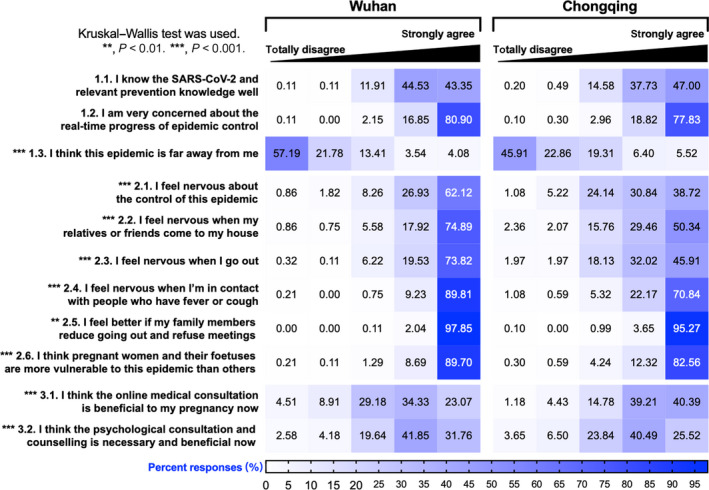
Results: Differences were observed between cities in some background characteristics and women's attitudes towards COVID-19 in Wuhan were more extreme. More women in Wuhan felt anxious (24.5 versus 10.4%). Factors that influenced anxiety also included household income, subjective symptom and attitudes. Overall, obstetric decisions also revealed city-based differences; these decisions mainly concerned hospital preference, time of prenatal care or delivery, mode of delivery and infant feeding.
Conclusions: The outbreak aggravated prenatal anxiety and the associated factors could be targets for psychological care. In parallel, key obstetric decision-making changed, emphasising the need for pertinent professional advice. Special support is essential for pregnant mothers during epidemics.
Tweetable abstract: The COVID-19 outbreak increased pregnant women's anxiety and affected their decision-making.
Keywords: COVID-19; obstetric decisions; prenatal anxiety.
© 2020 The Authors. BJOG: An International Journal of Obstetrics and Gynaecology published by John Wiley & Sons Ltd on behalf of Royal College of Obstetricians and Gynaecologists.
Figures
References
-
- Wuhan Municipal Health Commission . Report of clustering pneumonia of unknown aetiology in Wuhan City. 2019. [http://wjw.wuhan.gov.cn/xwzx_28/gsgg/202004/t20200430_1199588.shtml]. Accessed 20 January 2020 (in Chinese).
-
- Gorbalenya AE, Baker SC, Baric RS, de Groot RJ, Drosten C, Gulyaeva AA, et al. Severe acute respiratory syndrome‐related coronavirus: the species and its viruses––a statement of the Coronavirus Study Group. bioRxiv 2020. 10.1101/2020.02.07.937862 - DOI
-
- World Health Organization (WHO) . WHO Director‐General's remarks at the media briefing on 2019‐nCoV on 11 February 2020 [www.who.int/dg/speeches/detail/who‐director‐general‐s‐remarks‐at‐the‐med...]. Accessed 11 February 2020.
-
- National Health Commission of the People's Republic of China . Update on epidemic situation of novel coronavirus‐infected pneumonia (COVID‐19) by 24:00 on 2 May, 2020 [www.nhc.gov.cn/xcs/yqtb/202005/aba9ba870fed480fbc01c7d7b35eb3a7.shtml]. Accessed 3 May 2020 (in Chinese).
-
- Health Commission of Hubei Province . Situation updates of coronavirus disease 2019 (COVID‐19) in Hubei Province by 24:00 on 2 May, 2020 [http://wjw.hubei.gov.cn/bmdt/ztzl/fkxxgzbdgrfyyq/xxfb/202005/t20200503_2...]. Accessed 3 May 2020 (in Chinese).
