


Telemedicine in Chronic Wound Management: Systematic Review And Meta-Analysis
- PMID: 32584259
- PMCID: PMC7381084
- DOI: 10.2196/15574
Telemedicine in Chronic Wound Management: Systematic Review And Meta-Analysis
Abstract
Background: Chronic wounds have been a great burden to patients and the health care system. The popularity of the internet and smart devices, such as mobile phones and tablets, has made it possible to adopt telemedicine (TM) to improve the management of chronic wounds. However, studies conducted by different researchers have reported contradictory results on the effect of TM on chronic wound management.
Objective: The aim of this work was to evaluate the efficacy and safety of TM in chronic wound management.
Methods: We systematically searched multiple electronic databases (MEDLINE, EMBASE, and Cochrane Central Register of Controlled Trials [CENTRAL]) to identify eligible studies published from inception to June 12, 2019. Inclusion criteria were randomized controlled trials (RCTs) and interventional cohort studies that investigated the use of TM in chronic wound management. RCT and observational data were analyzed separately. A meta-analysis and qualitative analysis were conducted to estimate endpoints.
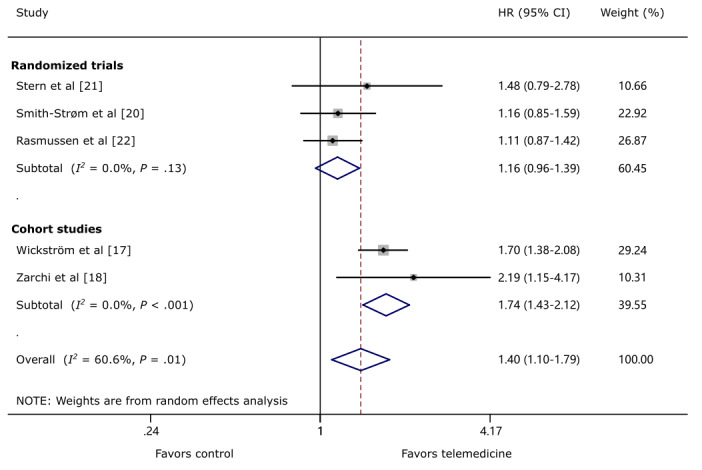
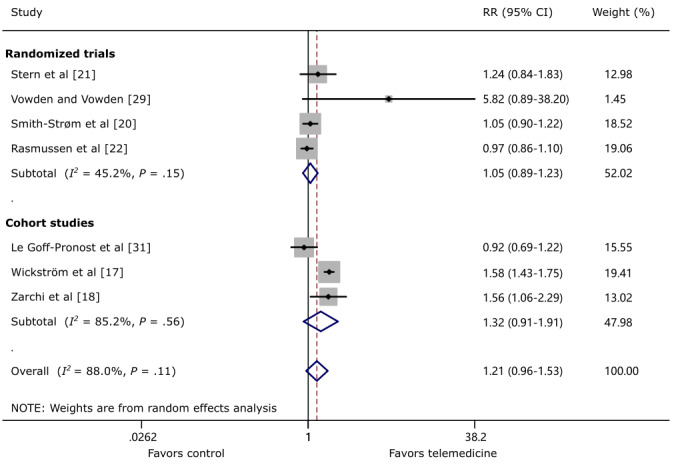
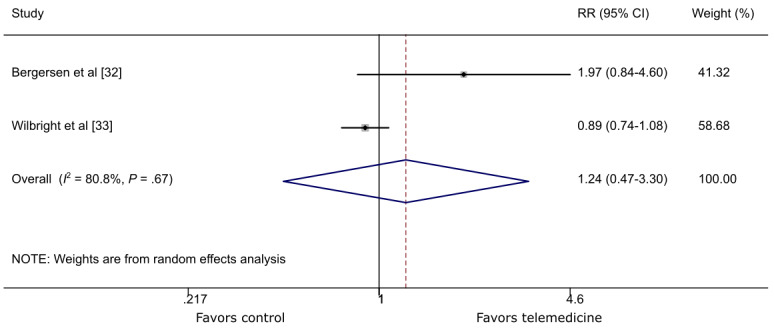
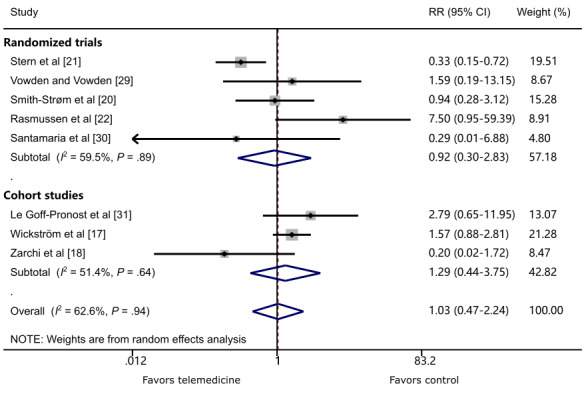
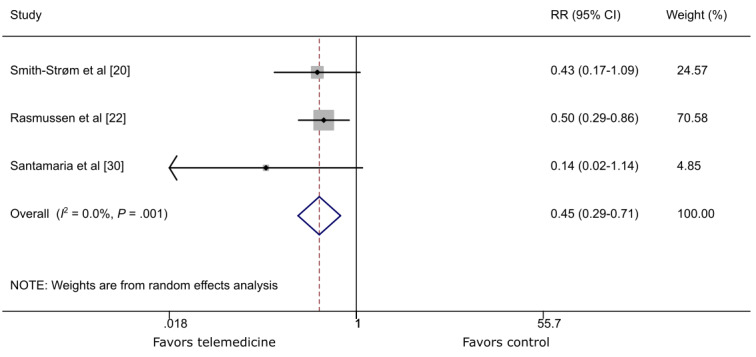
Results: A total of 6 RCTs and 6 cohort studies including 3913 patients were included. Of these, 4 studies used tablets or mobile phones programmed with apps, such as Skype and specialized interactive systems, whereas the remaining 8 studies used email, telephone, and videoconferencing to facilitate the implementation of TM using a specialized system. Efficacy outcomes in RCTs showed no significant differences in wound healing (hazard ratio [HR] 1.16, 95% CI 0.96-1.39; P=.13), and wound healing around 1 year (risk ratio [RR] 1.05, 95% CI 0.89-1.23; P=.15). Noninferiority criteria of TM were met. A decreased risk of amputation in patients receiving TM was revealed (RR 0.45, 95% CI 0.29-0.71; P=.001). The result of cohort studies showed that TM was more effective than standard care (HR 1.74, 95% CI 1.43-2.12; P<.001), whereas the outcome efficacy RR of wound healing around 1 year (RR 1.21, 95% CI 0.96-1.53; P=.56) and 3 months (RR 1.24, 95% CI 0.47-3.3; P=.67) was not significantly different between TM and standard care. Noninferiority criteria of TM were met for wound healing around 1 year in cohort studies.
Conclusions: Currently available evidence suggests that TM seems to have similar efficacy and safety, and met noninferiority criteria with conventional standard care of chronic wounds. Large-scale, well-designed RCTs are warranted.
Keywords: meta-analysis; telemedicine; wound healing; wounds and injuries.
©Lihong Chen, Lihui Cheng, Wei Gao, Dawei Chen, Chun Wang, Xingwu Ran. Originally published in JMIR mHealth and uHealth (http://mhealth.jmir.org), 25.06.2020.
Conflict of interest statement
Conflicts of Interest: None declared.
Figures
References
-
- Nelzén O, Bergqvist D, Lindhagen A, Hallböök T. Chronic leg ulcers: an underestimated problem in primary health care among elderly patients. J Epidemiol Community Health. 1991 Sep;45(3):184–7. doi: 10.1136/jech.45.3.184. http://jech.bmj.com/cgi/pmidlookup?view=long&pmid=1757758 - DOI - PMC - PubMed
-
- Sen CK, Gordillo GM, Roy S, Kirsner R, Lambert L, Hunt TK, Gottrup F, Gurtner GC, Longaker MT. Human skin wounds: a major and snowballing threat to public health and the economy. Wound Repair Regen. 2009;17(6):763–71. doi: 10.1111/j.1524-475X.2009.00543.x. http://europepmc.org/abstract/MED/19903300 - DOI - PMC - PubMed
-
- Purcell R, McInnes S, Halcomb EJ. Telemonitoring can assist in managing cardiovascular disease in primary care: a systematic review of systematic reviews. BMC Fam Pract. 2014 Mar 07;15:43. doi: 10.1186/1471-2296-15-43. https://bmcfampract.biomedcentral.com/articles/10.1186/1471-2296-15-43 - DOI - DOI - PMC - PubMed
Publication types
MeSH terms
LinkOut - more resources
Full Text Sources
Medical
Miscellaneous
