EUS-guided pancreatic drainage: A steep learning curve
- PMID: 32584312
- PMCID: PMC7430898
- DOI: 10.4103/eus.eus_3_20
EUS-guided pancreatic drainage: A steep learning curve
Abstract
Background and objective: EUS-guided pancreatic drainage (EUS-PD) is an efficacious, acceptable risk option for patients with pancreatic duct obstruction who fail conventional ERCP. The aim of this study was to define the learning curve (LC) for EUS-PD.
Methods: Consecutive patients undergoing EUS-PD by a single operator were included from a dedicated registry. Demographics, procedural info, adverse events, and follow-up data were collected. Nonlinear regression and cumulative sum (CUSUM) analyses were conducted for the LC.
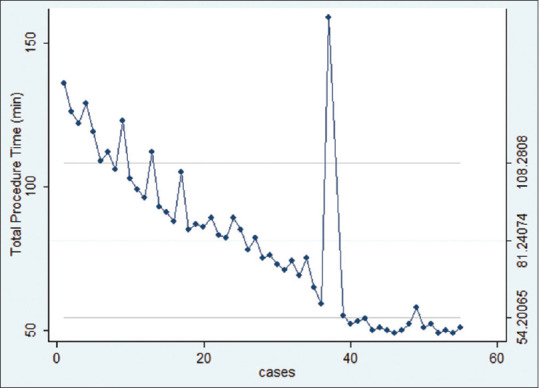
Results: Fifty-six patients were included (54% of male, with a mean age of 58 years). Technical success was achieved in 47 patients (84%). Stent placement was antegrade in 36 patients (77%) and retrograde in 11 (23%). Clinical success was achieved in 46/47 (98%) patients who achieved technical success. Adverse events were seen in 13 patients (6 of whom did not achieve technical success) and included bleeding requiring embolization (n = 5), bleeding treated with clips peri-procedurally (n = 1), pancreatitis (n = 5), and a pancreatic fluid collection drained via EUS-drainage (n = 2). The median procedural time was 80 min (range 49-159 min). The CUSUM chart showed that 80-min procedural time was achieved at the 27th procedure. Durations further reduced 40th procedure onward, reaching a plateau indicating proficiency (nonlinear regression P < 0.0001).
Conclusion: Endoscopists experienced in EUS-PD are expected to achieve a reduction in procedural time over successive cases, with efficiency reached at 80 min and a learning rate of 27 cases. Continued improvement is demonstrated with additional experience, with plateau indicating mastery suggested at the 40th case. EUS-PD is probably one of the hardest therapeutic endosonographic procedures to learn.
Keywords: EUS-guided pancreatic drainage; pancreatic stricture; pancreatico-jejunostomy; pancreaticogastrostomy; therapeutic EUS.
Conflict of interest statement
None
Figures
References
-
- Tessier G, Bories E, Arvanitakis M, et al. EUS-guided pancreatogastrostomy and pancreatobulbostomy for the treatment of pain in patients with pancreatic ductal dilatation inaccessible for transpapillary endoscopic therapy. Gastrointest Endosc. 2007;65:233–41. - PubMed
-
- François E, Kahaleh M, Giovannini M, et al. EUS-guided pancreaticogastrostomy. Gastrointest Endosc. 2002;56:128–33. - PubMed
-
- Brauer BC, Chen YK, Fukami N, et al. Single-operator EUS-guided cholangiopancreatography for difficult pancreaticobiliary access (with video) Gastrointest Endosc. 2009;70:471–9. - PubMed
-
- Vila JJ, Pérez-Miranda M, Vazquez-Sequeiros E, et al. Initial experience with EUS-guided cholangiopancreatography for biliary and pancreatic duct drainage: A Spanish national survey. Gastrointest Endosc. 2012;76:1133–41. - PubMed
-
- Mallery S, Matlock J, Freeman ML. EUS-guided rendezvous drainage of obstructed biliary and pancreatic ducts: Report of 6 cases. Gastrointest Endosc. 2004;59:100–7. - PubMed