Snakebite epidemiology and health-seeking behavior in Akonolinga health district, Cameroon: Cross-sectional study
- PMID: 32584806
- PMCID: PMC7343182
- DOI: 10.1371/journal.pntd.0008334
Snakebite epidemiology and health-seeking behavior in Akonolinga health district, Cameroon: Cross-sectional study
Abstract
Background: Snakebite envenoming causes 81,000-138,000 annual human deaths and pain, terror, or disability in 4.5-5.4 million victims. Accurate community-based epidemiological data is scarce. Our objective was to assess snakebite incidence, mortality, and health-seeking behavior, in an affected health district of Cameroon.
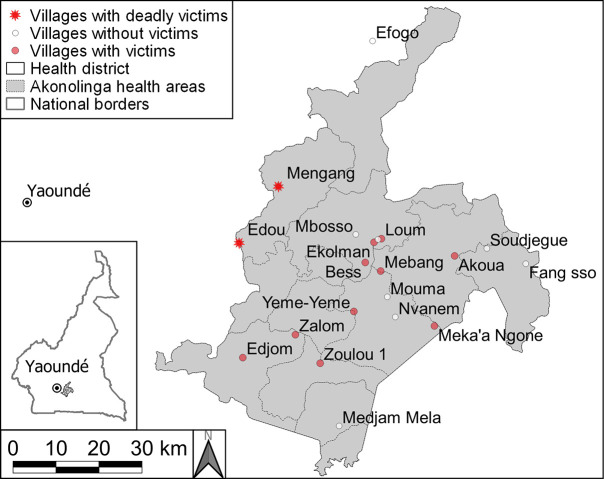
Methods: We conducted a cross-sectional multicluster household survey in Akonolinga health district, Centre Region, Cameroon, from October to December 2016. Using probability-proportional-to-size, 20 villages were randomly selected, then, all inhabited households were systematically selected. Annual incidence and adjusted odds-ratio for predictors were estimated.
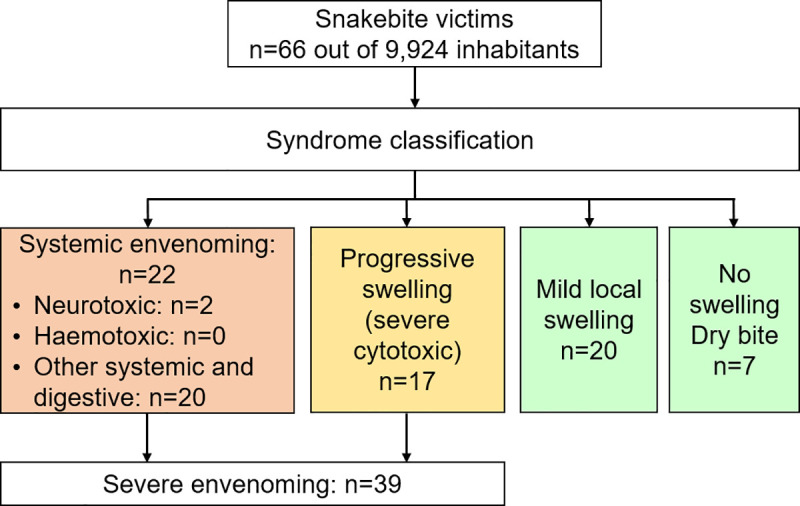
Findings: Among the 9,924 participants, 66 suffered a snakebite during the past year: the resulting incidence is 665 (95%CI: 519-841) per 100,000 inhabitants per year. Victims were aged 5-75y (median: 34y), 53% were male and 57% farmer-cultivators. Two children died (case-fatality rate: 3%); 39 (59%) presented severity signs, including 2 (3%) neurotoxic syndromes, 20 (30%) systemic digestive syndromes, and 17 (26%) severe cytotoxic syndromes. Non-severe cases included 20 (30%) mild cytotoxic syndromes and 7 (11%) dry bites. Only two victims (3%) received antivenom. 59 (89%) used family traditional practices, 25 (38%) traditional healers, and 31 (47%) consulted health facilities. Median delays to these three care-options were 5, 45, and 60 minutes, respectively. Traditional treatments included incisions (n = 57; 86%), tourniquets (n = 51; 77%) and black-stones (n = 44; 67%). The two last procedures were also used in health facilities (n = 18). Consulting traditional healers was associated with severity (adjusted-OR: 19.6 (2.5-156), p = 0.005) and complications (aOR: 17.3, 2.4-123, p = 0.004). Long-term disabilities were subjective psychological trauma (n = 47; 71%), finger amputation (n = 1; 2%), ankylosis (n = 1; 2%) and chronic pain (n = 1; 2%).
Conclusions: We observed alarming levels of snakebite incidence, mortality, antivenom scarcity, and use of traditional medicine. It could represent several thousands of victims at national level. We suggested conducting a country-wide study, and improving antivenom supply, first-aid training, for traditional healers and health professionals.
Conflict of interest statement
The authors have declared that no competing interests exist.
Figures
References
-
- WHO | Snakebite envenomation turns again into a neglected tropical disease! In: WHO [Internet]. [cited 28 Feb 2018]. Available: http://www.who.int/snakebites/resources/s40409-017-0127-6/en/
-
- WHO | Snakebite envenoming. In: WHO [Internet]. 28 Feb 2018 [cited 28 Feb 2018]. Available: http://www.who.int/mediacentre/factsheets/fs337/en/
-
- Gonwouo Nono Legrand, Lebreton Matthew, Chirio Laurent, Dzikouk G. Biogeographical distribution of snakes in Cameroon: The case of venomous snakes (PDF Download Available). ResearchGate. - PubMed
Publication types
MeSH terms
Substances
LinkOut - more resources
Full Text Sources
Miscellaneous