


Decreased Incidence of Hepatic Artery Thrombosis in Pediatric Liver Transplantation Using Technical Variant Grafts: Report of the Society of Pediatric Liver Transplantation Experience
- PMID: 32585237
- PMCID: PMC9380891
- DOI: 10.1016/j.jpeds.2020.06.053
Decreased Incidence of Hepatic Artery Thrombosis in Pediatric Liver Transplantation Using Technical Variant Grafts: Report of the Society of Pediatric Liver Transplantation Experience
Abstract
Objective: To evaluate risk factors for hepatic artery thrombosis (HAT) and examine the long-term outcomes of graft and patient survival after HAT in pediatric recipients of liver transplantation.
Study design: Using multicenter data from the Society of Pediatric Liver Transplantation, Kaplan-Meier and Cox regression analyses were performed on first-time pediatric (aged <18 years) liver transplant recipients (n = 3801) in the US and Canada between 1995 and 2016.
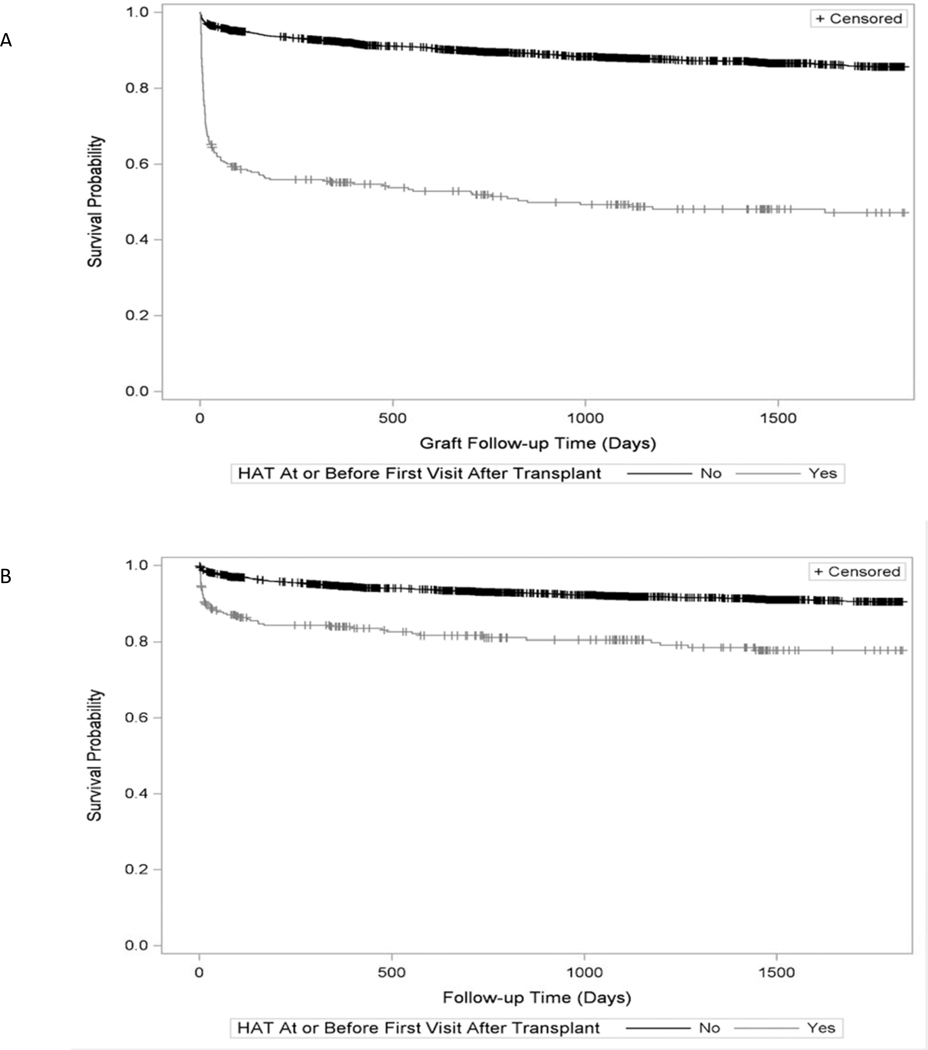
Results: Of children undergoing their first liver transplantation, 7.4% developed HAT within the first 90 days of transplantation and, of those who were retransplanted, 20.7% developed recurrent HAT. Prolonged warm ischemia times increased the odds of developing HAT (OR, 1.11; P = .02). Adolescents aged 11-17 years (OR, 0.53; P = .03) and recipients with split, reduced, or living donor grafts had decreased odds of HAT (OR, 0.59; P < .001 compared with whole grafts). Fifty percent of children who developed HAT developed graft failure within the first 90 days of transplantation (adjusted hazard ratio, 11.87; 95% CI, 9.02-15.62) and had a significantly higher post-transplant mortality within the first 90 days after transplantation (adjusted hazard ratio, 6.18; 95% CI, 4.01-9.53).
Conclusions: These data from an international registry demonstrate poorer long-term graft and patient survival in pediatric recipients whose post-transplant course is complicated by HAT. Notably, recipients of technical variant grafts had lower odds of HAT compared with whole liver grafts.
Keywords: anticoagulation; hepatology; liver transplant outcomes; living donor; recurrent hepatic artery thrombosis; reduced liver; split liver; transplant surgery; warm ischemia time; whole liver.
Copyright © 2020 Elsevier Inc. All rights reserved.
Conflict of interest statement
The authors declare no conflicts of interest.
Figures
References
-
- McDiarmid SV, Anand R, Martz K, Millis MJ, Mazariegos G and the SPLIT Research Group: A multivariate analysis of pre, peri, and post transplant factors effecting outcome after pediatric liver transplantation. Annals of Surgery 2011; 254:145–54. - PubMed
-
- Stringer MD, Marshall MM, Muiesan P, Karani JB, Kane PA, Mieli-Vergani G, et al. Survival and outcome after hepatic artery thrombosis complicating pediatric liver transplantation. J Pediatr Surg 2001;36:888–91. - PubMed
-
- Ackermann O, Branchereau S, Franchi-Abella S, Pariente D, Chevret L, Debray D, et al. The long-term outcome of hepatic artery thrombosis after liver transplantation in children: role of urgent revascularization. Am J Transplant 2012;12:1496–503. - PubMed
Publication types
MeSH terms
Grants and funding
LinkOut - more resources
Full Text Sources
Medical
