


Incidence, Risk Factors, and Outcomes of Pouchitis and Pouch-Related Complications in Patients With Ulcerative Colitis
- PMID: 32585362
- PMCID: PMC8552292
- DOI: 10.1016/j.cgh.2020.06.035
Incidence, Risk Factors, and Outcomes of Pouchitis and Pouch-Related Complications in Patients With Ulcerative Colitis
Abstract
Background & aims: Acute pouchitis is the most common non-surgical complication after restorative proctocolectomy with ileal pouch-anal anastomosis (IPAA) for ulcerative colitis (UC). We used validated case-finding definitions for pouchitis to search administrative claims data and determine the incidence of pouchitis in the first 2 years after IPAA.
Methods: We identified all patients who underwent proctocolectomy with IPAA for UC in the IQVIA Legacy PharMetrics Adjudicated Claims Database, from January 1, 2007 through June 1, 2016. The primary outcome was the development of pouchitis within 2 years after IPAA. Secondary outcomes included isolated acute vs recurrent pouchitis, immunosuppressive therapy, further surgery, and admission to the hospital.
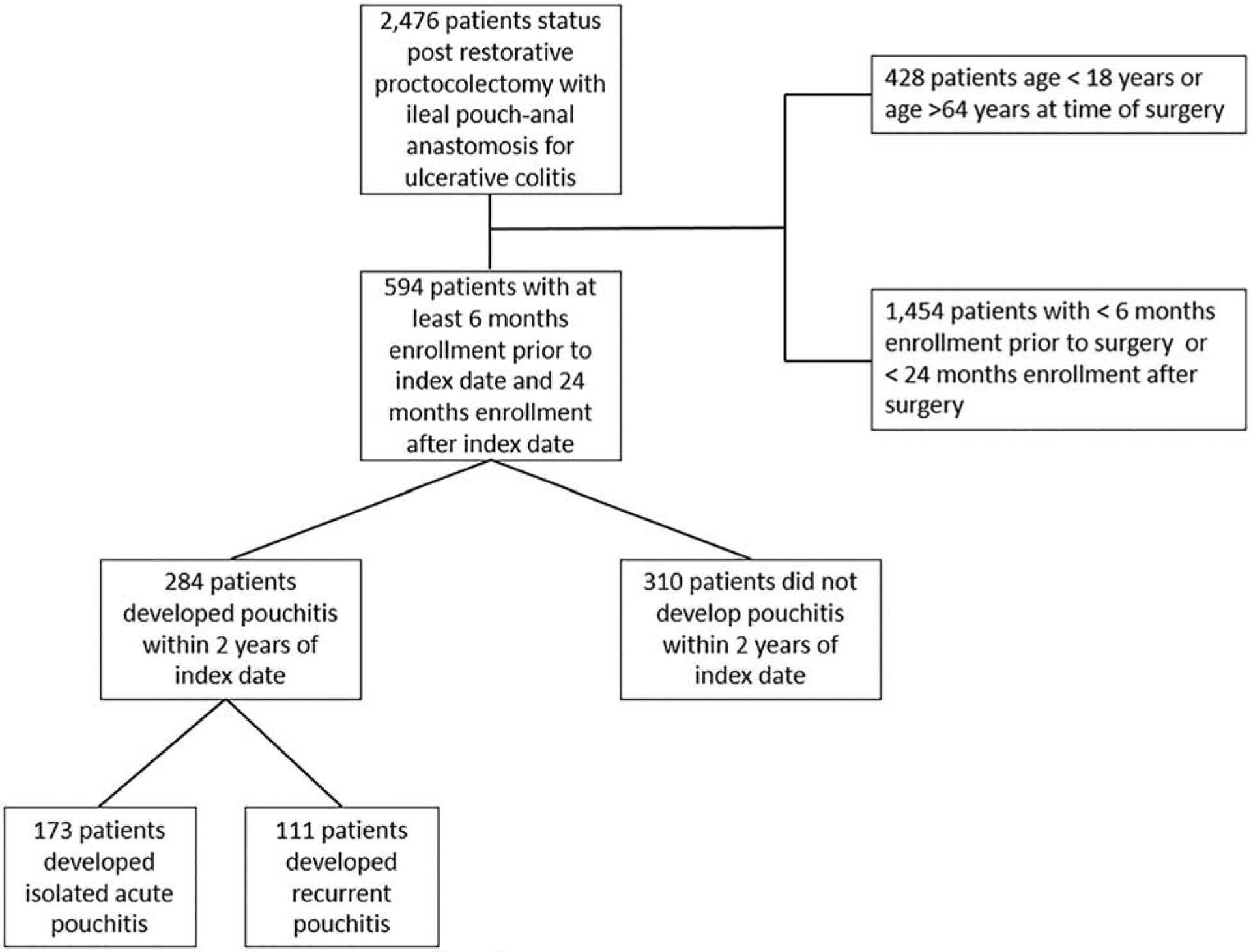
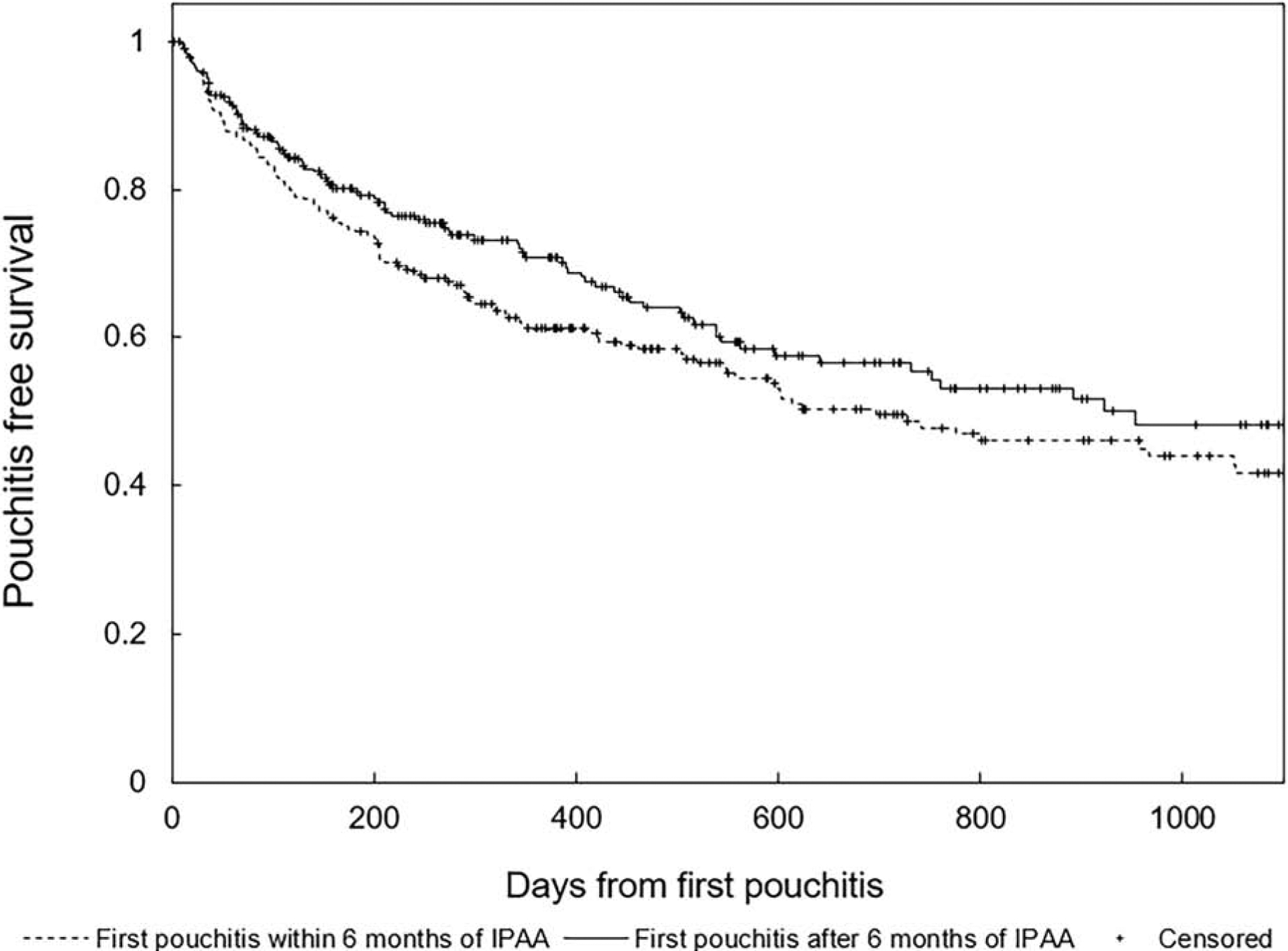
Results: Among 594 patients, the cumulative incidence of pouchitis within 2 years of IPAA was 48% (95% CI, 44%-52%). The cumulative incidence of isolated acute pouchitis was 29% (95% CI, 26%-33%). Compared to patients with isolated acute pouchitis, patients who received a diagnosis of recurrent pouchitis (cumulative incidence, 19%: 95% CI, 16%-22%) demonstrated increased outpatient visits, emergency department visits, and inpatient admissions (all P < .001). Patients who developed pouchitis were more likely to have a history of primary sclerosing cholangitis (adjusted odds ratio [aOR], 3.94; 95% CI, 1.05-14.8) and anti-tumor necrosis factor alpha therapy prior to colectomy (aOR 1.63; 95% CI, 1.09-2.45). Among patients with pouchitis, the cumulative frequency of new immunosuppressive therapy was 40% (95% CI, 35%-46%) and the cumulative incidence of pouch excision was 1.0% (95% CI, 0.4%-3.0%). The cumulative incidence of a new diagnosis of Crohn's disease after IPAA for UC was 9.0% (95% CI, 7.2%-11%).
Conclusions: In a geographically diverse population, 48% of patients with UC developed pouchitis within the first 2 years after IPAA. Patients with pouchitis had greater use of healthcare resources, indicating a significant burden of disease.
Keywords: Antibiotics; Hospitalization; Inflammation; Utilization.
Copyright © 2021 AGA Institute. Published by Elsevier Inc. All rights reserved.
Figures
Comment in
-
Stratifying Risks of Ileal Pouch Outcomes.Clin Gastroenterol Hepatol. 2022 Jul;20(7):1620-1621. doi: 10.1016/j.cgh.2021.08.051. Epub 2021 Sep 3. Clin Gastroenterol Hepatol. 2022. PMID: 34481959 No abstract available.
References
-
- Shen B Acute and chronic pouchitis--pathogenesis, diagnosis and treatment. Nat Rev Gastroenterol Hepatol 2012;9:323–33. - PubMed
-
- Lightner AL, Mathis KL, Dozois EJ, et al. Results at Up to 30 Years After Ileal Pouch-Anal Anastomosis for Chronic Ulcerative Colitis. Inflamm Bowel Dis 2017;23:781–790. - PubMed
-
- Gionchetti P, Rizzello F, Helwig U, et al. Prophylaxis of pouchitis onset with probiotic therapy: a double-blind, placebo-controlled trial. Gastroenterology 2003;124:1202–9. - PubMed
