. 2020 Jul 24;23(7):101262.
doi: 10.1016/j.isci.2020.101262. Epub 2020 Jun 12.

Titanium Tackles the Endoplasmic Reticulum: A First Genomic Study on a Titanium Anticancer Metallodrug

Affiliations

Titanium Tackles the Endoplasmic Reticulum: A First Genomic Study on a Titanium Anticancer Metallodrug

Maya Miller et al. iScience. .

Abstract

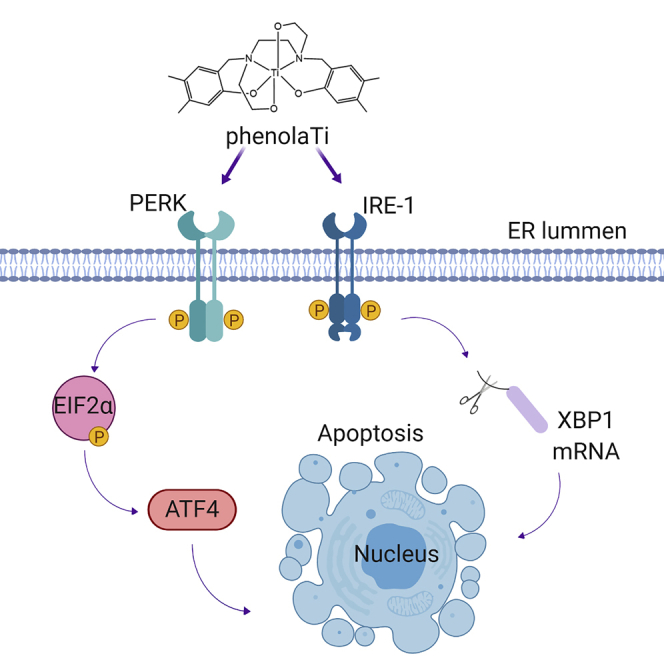
PhenolaTi is an advanced non-toxic anticancer chemotherapy; this inert bis(phenolato)bis(alkoxo) Ti(IV) complex demonstrates the intriguing combination of high and wide efficacy with no detected toxicity in animals. Here we unravel the cellular pathways involved in its mechanism of action by a first genome study on Ti(IV)-treated cells, using an attuned RNA sequencing-based available technology. First, phenolaTi induced apoptosis and cell-cycle arrest at the G2/M phase in MCF7 cells. Second, the transcriptome of the treated cells was analyzed, identifying alterations in pathways relating to protein translation, DNA damage, and mitochondrial eruption. Unlike for common metallodrugs, electrophoresis assay showed no inhibition of DNA polymerase activity. Reduced in vitro cytotoxicity with added endoplasmic reticulum (ER) stress inhibitor supported the ER as a putative cellular target. Altogether, this paper reveals a distinct ER-related mechanism by the Ti(IV) anticancer coordination complex, paving the way for wider applicability of related techniques in mechanistic analyses of metallodrugs.

Keywords: Biochemistry; Cancer; Genomics; Organometallic Chemistry.


Conflict of interest statement

Declaration of Interests The authors declare no competing interests. Relating patent: Tshuva EY and Hochman J; Cytotoxic titanium and vanadium complexes PCT/IL2013/05,069 filled 15/08/2013.

Figures
None
Graphical abstract
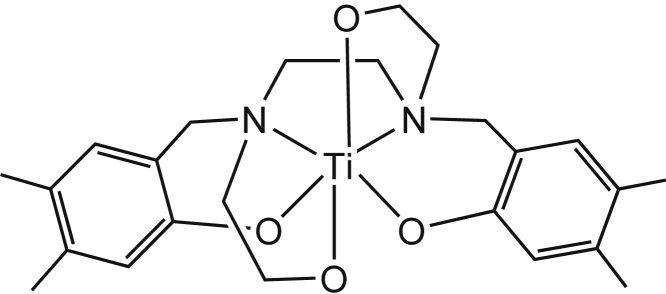
Scheme 1
Scheme 1
PhenolaTi
Figure 1
Figure 1
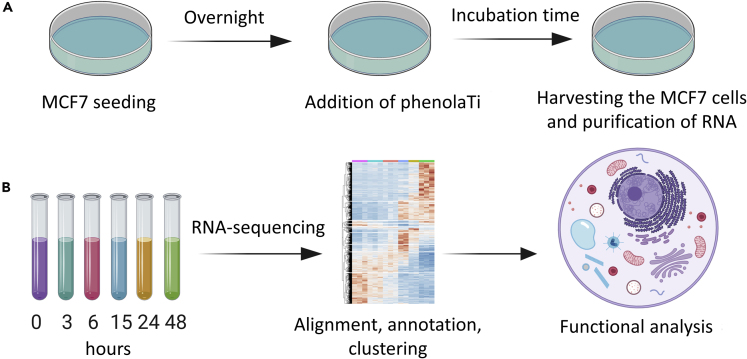
General Experimental Procedure (A) Experimental in vitro workflow; MCF7 cells were seeded overnight, phenolaTi was added at 54 μM at different time points, harvesting was generated at the same time point to obtain 3, 6, 15, 24, and 48 h of incubation (with untreated control samples, 0). (B) Generated samples were sequenced, aligned, annotated, clustered, and functionally analyzed. MCF7 cells undergo changes in response to phenolaTi treatment.
Figure 2
Figure 2
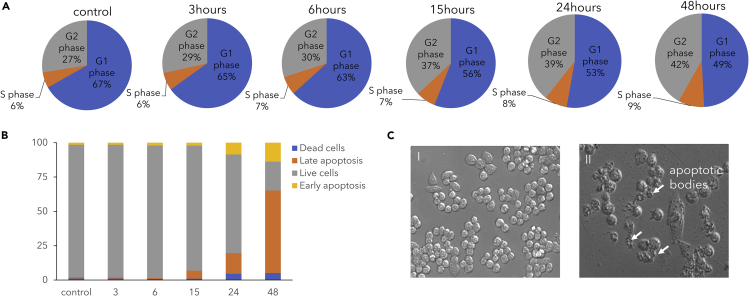
MCF7 Cells undergo Changes in Response to PhenolaTi Treatment (A) Cell-cycle distribution following incubation with phenolaTi at 54 μM at different time points. (B) Time-dependent effect of phenolaTi at 54 μM on apoptosis in MCF7 cancer cells, as recorded using flow cytometry. (C) Microscopic images of MCF7 cells (I) untreated cells, control (II) treated with phenolaTi at 54 μM for 36 h of incubation. Gene expression alteration in response to phenolaTi in MCF7 cells.
Figure 3
Figure 3
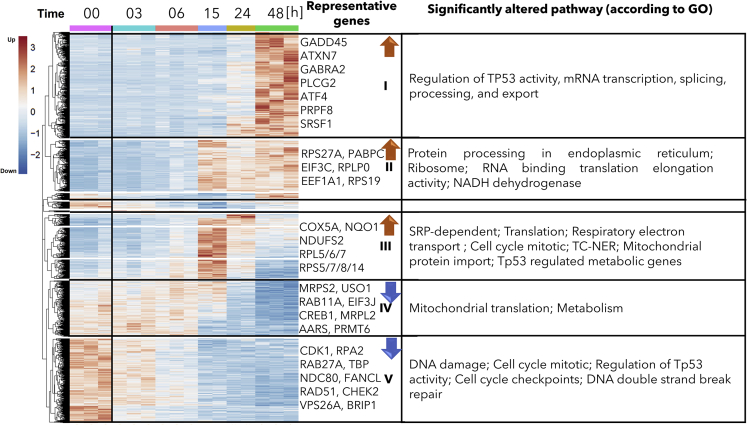
Gene Expression (RPM, Reads per Million) Alteration in Response to PhenolaTi in MCF7 Cells at 54 μM MCF7 were treated with 54 μM phenolaTi and sequenced in triplicates or duplicates after 0 (untreated), 3, 6, 15, 24, and 48 h. Expression analysis included CEL-seq2, Z-scoring, and hierarchical clustering. Roughly, the genes can be divided into five main clusters with distinct expression and significant biological functions. The biological functions of the genes were analyzed using GeneAnalytics, an integrative gene set analysis tool (Ben-Ari Fuchs et al., 2016). Blue, increased gene expression; red, decreased gene expression. Changes in expression of ER/hypoxia-related genes in response to phenolaTi in MCF7 cells.
Figure 4
Figure 4
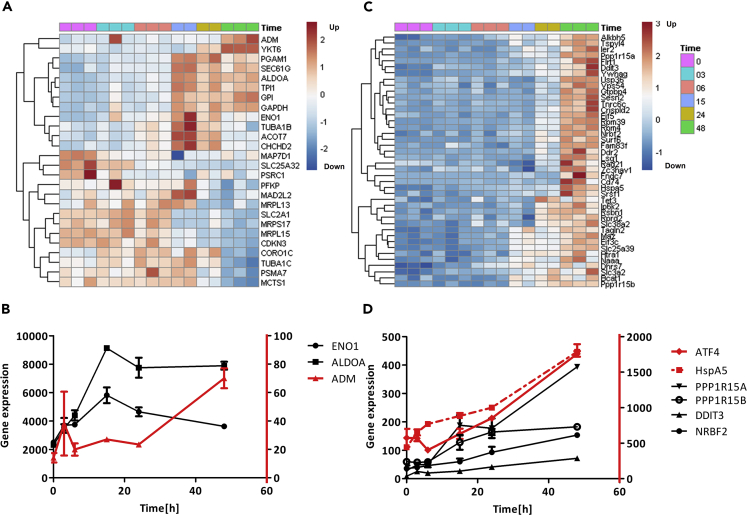
Changes in Expression of ER/Hypoxia-Related Genes in Response to PhenolaTi in MCF7 Cells at 54 μM (A) A 26-gene cluster of the total 51 genes previously reported to be overexpressed in hypoxia (Buffa et al., 2010); these were significantly altered over time in our experiment (p value < 0.05). (B) Expression of genes ENO1, ALDOA, and ADM, relating to hypoxic conditions. (C) A 52-gene cluster of the total 575 genes previously reported to be related to ER stress (Han et al., 2013); these were upregulated over time in our experiment (p value < 0.05). (D) Expression of genes ATF4, HspA5, PPP1R15A/B, DDIT3. and NRBF2, relating to ER stress. In vitro validation assays support ER-related mechanism of phenolaTi with no direct DNA binding.
Figure 5
Figure 5
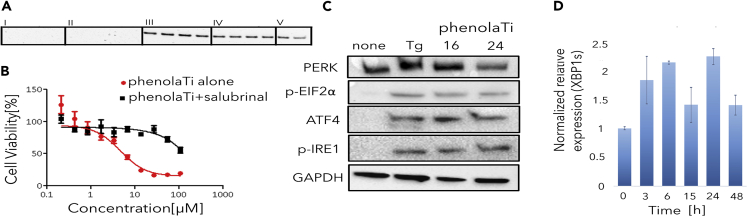
In Vitro Validation Assays Support ER-Related Mechanism of PhenolaTi with No Direct DNA Binding (A) Agarose gel electrophoresis of the PCR products for detection of actin after co-incubation with (I) cisplatin, (II) doxorubicin, (III) 5-fluorouracil, (IV) phenolaTi, (V) control, at 27 (left 2 bands) or 54 (right 2 bands) μM of each tested compound in duplicates (showing one of three repeats); phenolaTi, as 5-fluorouracil, does not interact directly with DNA. (B–D) (B) Cytotoxicity curves of phenolaTi toward human MCF7 cancer cells, with and without the addition of salubrinal, using the MTT assay following 72 h of incubation; activity of phenolaTi is abolished with the ER-stress inhibitor. (C) Expression of PERK, p-EIF2α, ATF4, and p-IRE1 levels (evaluated using immunoblotting) in MCF7 cells following incubation with phenolaTi; positive control Thapsigargin (Tg, a known ER Ca2+ ATPase inhibitor; 4 nM for 16 h); GAPDH as a loading control (inactivated PERK is observed at a lower molecular weight at time point 0, whereas activated PERK is observed upon treatment). (D) qPCR levels of XBP1s form over time in MCF7 cells exposed to phenolaTi at 54 μM concentration.

References

    1. Agúndez J.A.G. Cytochrome P450 gene polymorphism and cancer. Curr. Drug Metab. 2004;5:211–224. - PubMed
    1. Ardito F., Giuliani M., Perrone D., Troiano G., Lo Muzio L. The crucial role of protein phosphorylation in cell signaling and its use as targeted therapy. Int. J. Mol. Med. 2017;40:271–280. - PMC - PubMed
    1. Barresi V., Valenti G., Spampinato G., Musso N., Castorina S., Rizzarelli E., Condorelli D.F. Transcriptome analysis reveals an altered expression profile of zinc transporters in colorectal cancer. J. Cell Biochem. 2018;119:9707–9719. - PubMed
    1. Barroso S., Coelho A.M., Gomez-Ruiz S., Calhorda M.J., Zizak Z., Kaluderovic G.N., Martins A.M. Correction: synthesis, cytotoxic and hydrolytic studies of titanium complexes anchored by a tripodal diamine bis(phenolate) ligand. Dalt. Trans. 2015;44:2497. - PubMed
    1. Ben-Ari Fuchs S., Lieder I., Stelzer G., Mazor Y., Buzhor E., Kaplan S., Bogoch Y., Plaschkes I., Shitrit A., Rappaport N. GeneAnalytics: an integrative gene set analysis tool for next generation sequencing, RNA-seq and microarray data. Omi. A J. Integr. Biol. 2016;20:139–151. - PMC - PubMed