


Role of Minerals and Trace Elements in Diabetes and Insulin Resistance
- PMID: 32585827
- PMCID: PMC7353202
- DOI: 10.3390/nu12061864
Role of Minerals and Trace Elements in Diabetes and Insulin Resistance
Abstract
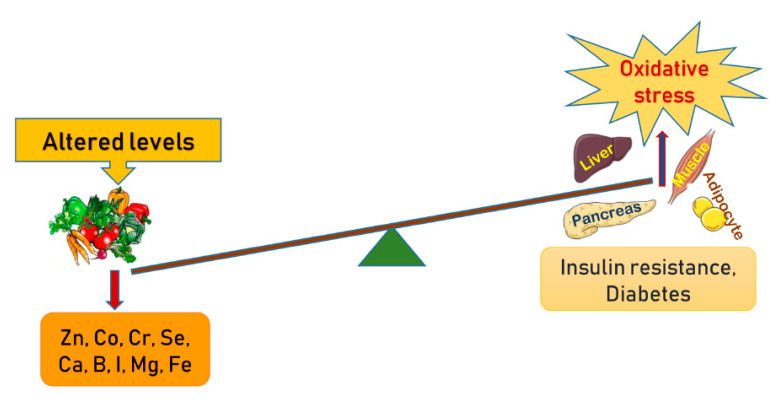
Minerals and trace elements are micronutrients that are essential to the human body but present only in traceable amounts. Nonetheless, they exhibit well-defined biochemical functions. Deficiencies in these micronutrients are related to widespread human health problems. This review article is focused on some of these minerals and trace element deficiencies and their consequences in diabetes and insulin resistance. The levels of trace elements vary considerably among different populations, contingent on the composition of the diet. In several Asian countries, large proportions of the population are affected by a number of micronutrient deficiencies. Local differences in selenium, zinc, copper, iron, chromium and iodine in the diet occur in both developed and developing countries, largely due to malnutrition and dependence on indigenous nutrition. These overall deficiencies and, in a few cases, excess of essential trace elements may lead to imbalances in glucose homeostasis and insulin resistance. The most extensive problems affecting one billion people or more worldwide are associated with inadequate supply of a number of minerals and trace elements including iodine, selenium, zinc, calcium, chromium, cobalt, iron, boron and magnesium. This review comprises various randomized controlled trials, cohort and case-controlled studies, and observational and laboratory-based studies with substantial outcomes of micronutrient deficiencies on diabetes and insulin resistance in diverse racial inhabitants from parts of Asia, Africa, and North America. Changes in these micronutrient levels in the serum and urine of subjects may indicate the trajectory toward metabolic changes, oxidative stress and provide disease-relevant information.
Keywords: diabetes; insulin; minerals; trace elements.
Conflict of interest statement
The authors have no conflict of interest. The funding sources were not involved in the data collection, analysis, interpretation of data, or writing the manuscript.
Figures
References
Publication types
MeSH terms
Substances
LinkOut - more resources
Full Text Sources
Medical
