


Enhancing Trigger Point Dry Needling Safety by Ultrasound Skin-to-Rib Measurement: An inter-Rater Reliability Study
- PMID: 32585845
- PMCID: PMC7356170
- DOI: 10.3390/jcm9061958
Enhancing Trigger Point Dry Needling Safety by Ultrasound Skin-to-Rib Measurement: An inter-Rater Reliability Study
Abstract
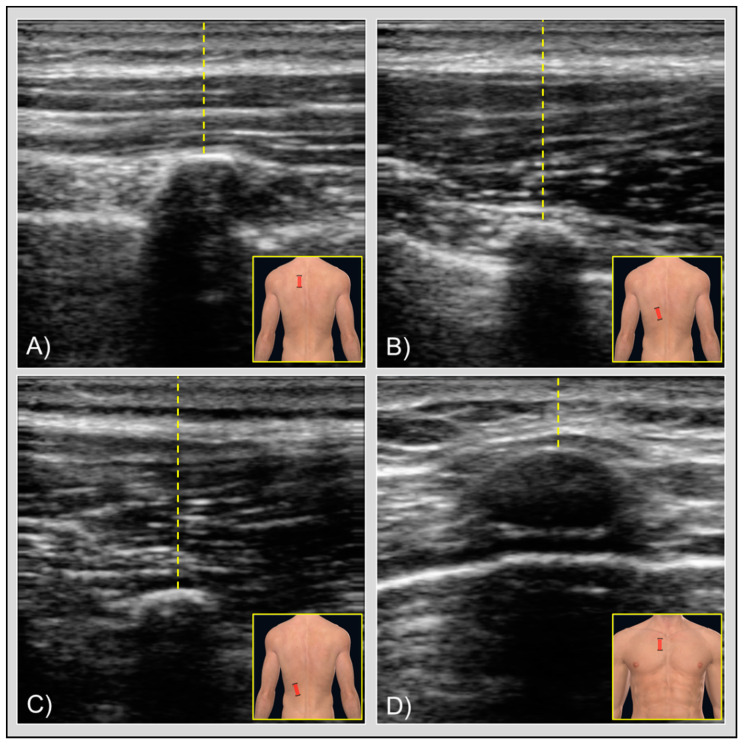
Dry needling (DN) is a minimally invasive treatment technique widely used by physical therapists to treat myofascial trigger points (MTrP). Even if its safety has been commonly declared and the majority of adverse events are considered mild, serious adverse events cannot be excluded and DN treatments of several trunk muscles can potentially result in pneumothorax. Ultrasound imaging (US) skin-to-rib measurement could ensure the safety of this treatment procedure. Therefore, the aim of this study was to determine the inter-rater reliability of depth measurement of different trunk muscles (i.e., rhomboid, lower trapezius, iliocostalis, and pectoralis major) between an expert and two novice physiotherapists. Skin-to-rib distance of 26 asymptomatic and normal weights subjects was consecutively, independently, and randomly measured for each muscle by the three examiners (1 expert and 2 novice physical therapists) with a handheld US wireless probe. Intraclass correlation coefficient (ICC3,k) and standard error of measurement (SEM) were used to assess inter-rater reliability. Inter-rater reliability of skin-to-rib measurements between the three examiners was good to excellent or excellent for every muscle, with an ICC3,k ranging from 0.92 and 0.98 (95% CI 0.86-0.99). The SEM never exceeded 10% of the skin-to-rib distance. In conclusion, skin-to-rib US measurements of the trunk muscles can be reliably performed by novice physical therapists using a handheld US device. These measures could be used as an innovative and reliable technique to improve the safety of some potential dangerous DN treatments.
Keywords: adverse events; dry needling; reliability; safety; skin-to-rib; trigger points; ultrasound.
Conflict of interest statement
The authors declare no conflict of interest.
Figures
References
-
- Hong C.Z. Considerations and recommendations regarding myofascial trigger point injection. J. Musculoskelet. Pain. 1994;2:29–59. doi: 10.1300/J094v02n01_03. - DOI
-
- Dommerholt J., Mayoral O., Gröbli C. Trigger point dry needling. J. Man. Manip. Ther. 2006;14:E70–E87. doi: 10.1179/jmt.2006.14.4.70E. - DOI
LinkOut - more resources
Full Text Sources
