


Internalized Stigmatization, Social Support, and Individual Mental Health Problems in the Public Health Crisis
- PMID: 32585910
- PMCID: PMC7345765
- DOI: 10.3390/ijerph17124507
Internalized Stigmatization, Social Support, and Individual Mental Health Problems in the Public Health Crisis
Abstract
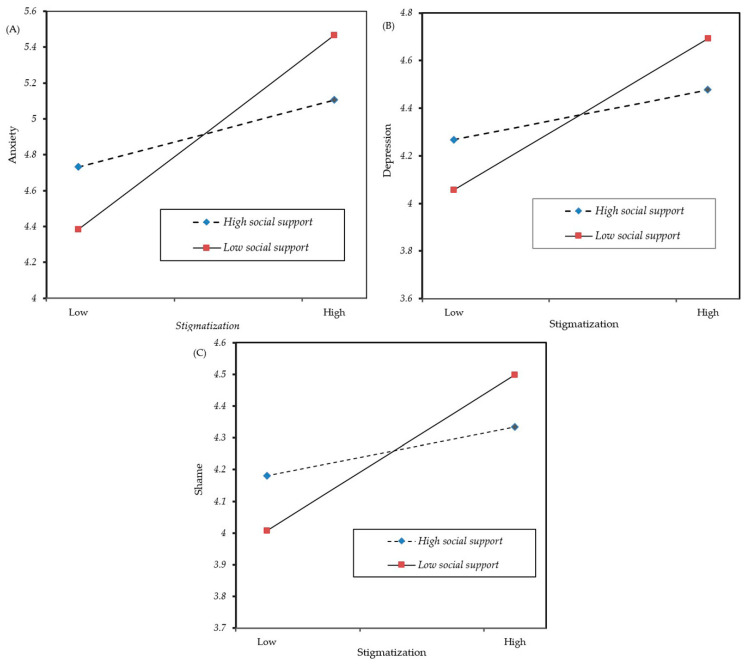
This study investigates the relationship between internalized stigmatization brought on by epicenter travel experiences and mental health problems (including anxiety, depression, and shame) during the period of the novel coronavirus disease emergency in China. The cross-sectional data were collected using the time-lag design to avoid the common method bias as much as possible. Regression results using structural equation modeling show that the internalized stigmatization of epicenter travel experiences may have positive relationships with mental health problems (i.e., anxiety, depression, and shame), and such relationships can be moderated by social support. Specifically, the positive relationships between internalized stigmatization and mental health problems are buffered/strengthened when social support is at a high/low level. The findings of this study suggest that, in this epidemic, people who have epicenter travel experience could be affected by internalized stigmatization, no matter whether they have ever got infected.
Keywords: internalized stigmatization; mental health problems; social support.
Conflict of interest statement
The authors declare no conflict of interest.
Figures
References
-
- Gohain Z., Halliday M.A.L. Internalized HIV-stigma, mental health, coping and perceived social support among people living with HIV/AIDS in Aizawl District A pilot study. Psychology. 2014;5:1794. doi: 10.4236/psych.2014.515186. - DOI
Publication types
MeSH terms
Grants and funding
LinkOut - more resources
Full Text Sources
Medical
