. 2020 Jun 23;9(6):1530.
doi: 10.3390/cells9061530.

The Barley S-Adenosylmethionine Synthetase 3 Gene HvSAMS3 Positively Regulates the Tolerance to Combined Drought and Salinity Stress in Tibetan Wild Barley

Affiliations

The Barley S-Adenosylmethionine Synthetase 3 Gene HvSAMS3 Positively Regulates the Tolerance to Combined Drought and Salinity Stress in Tibetan Wild Barley

Imrul Mosaddek Ahmed et al. Cells. .

Erratum in

Abstract

Drought and salinity are two of the most frequently co-occurring abiotic stresses. Despite recent advances in the elucidation of the effects of these stresses individually during the vegetative stage of plants, significant gaps exist in our understanding of the combined effects of these two frequently co-occurring stresses. Here, Tibetan wild barley XZ5 (drought tolerant), XZ16 (salt tolerant), and cultivated barley cv. CM72 (salt tolerant) were subjected to drought (D), salinity (S), or a combination of both treatments (D+S). Protein synthesis is one of the primary activities of the green part of the plant. Therefore, leaf tissue is an important parameter to evaluate drought and salinity stress conditions. Sixty differentially expressed proteins were identified by mass spectrometry (MALDI-TOF/TOF) and classified into 9 biological processes based on Gene Ontology annotation. Among them, 21 proteins were found to be expressed under drought or salinity alone; however, under D+S, 7 proteins, including S-adenosylmethionine synthetase 3 (SAMS3), were exclusively upregulated in drought-tolerant XZ5 but not in CM72. HvSAMS3 carries both N-terminal and central domains compared with Arabidopsis and activates the expression of several ethylene (ET)-responsive transcription factors. HvSAMS3 is mainly expressed in the roots and stems, and HvSAMS3 is a secretory protein located in the cell membrane and cytoplasm. Barley stripe mosaic virus-based virus-induced gene silencing (BSMV-VIGS) of HvSAMS3 in XZ5 severely compromised its tolerance to D+S and significantly reduced plant growth and K+ uptake. The reduced tolerance to the combined stress was associated with the inhibition of polyamines such as spermidine and spermine, polyamine oxidase, ethylene, biotin, and antioxidant enzyme activities. Furthermore, the exogenous application of ethylene and biotin improved the tolerance to D+S in BSMV-VIGS:HvSAMS3-inoculated plants. Our findings highlight the significance of HvSAMS3 in the tolerance to D+S in XZ5.

Keywords: Tibetan wild barley; barley stripe mosaic virus-based virus-induced gene silencing (BSMV-VIGS); combination of drought and salinity; polyamine; proteomics.


Conflict of interest statement

The authors declare no conflict of interest.

Figures
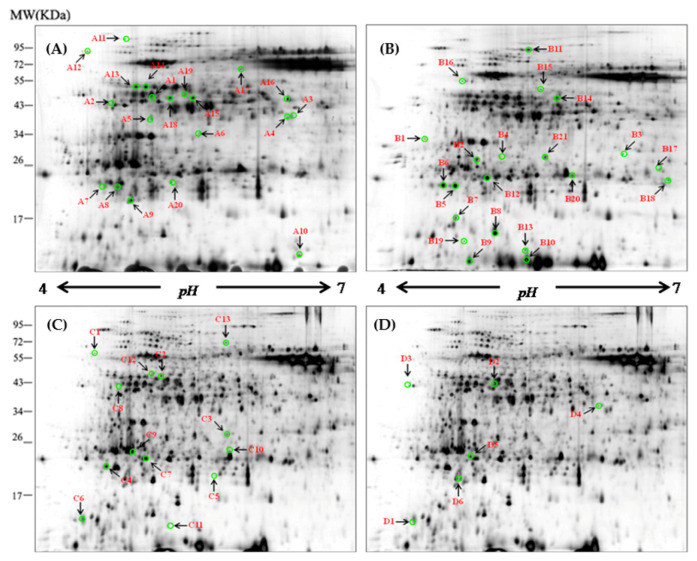
Figure 1
Figure 1
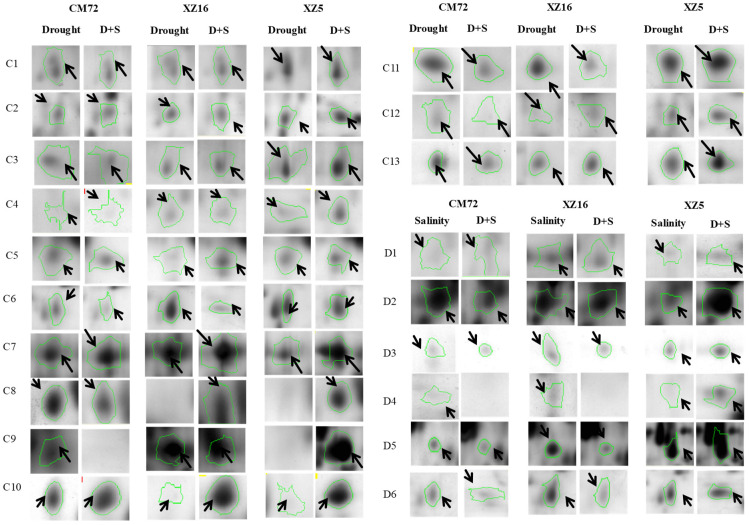
Representative two-dimensional gel electrophoresis (2-DE) maps of barley leaf proteins in XZ5. The proteins were isolated from the leaf of XZ5 exposed to drought (A), salinity alone (B), and combined stress D+S [(D+S vs. D (C), D+S vs. S (D)] during the vegetative stage at the 4% soil moisture level. Each 150-µg protein sample in 0.8% (v/v) Immobilized pH Gradient (IPG) buffer (Amersham Biosciences) was loaded onto analytical gels for 2-D gel image analysis using the silver-staining method. The spots were visualized by silver staining. Differentially accumulated protein spots are indicated by green sashes. Arrows indicate the differentially expressed protein spots whose expression levels were significantly induced (fold change ≥ 1.5) or downregulated (fold change < −1.50) in XZ5. The numbered leaf protein spots were labeled A1–A20, B1–B21, C1–C13, and D1–D6.
Figure 2
Figure 2
‘Spot view’ of the abundance of differentially expressed proteins (indicated with green circles) in the leaves of three barley genotypes XZ5, XZ16 and CM72 under drought stress, and salinity stress (200 mM NaCl) and D+S stress conditions. Protein spot IDs refer to numbers in Figure 1C,D and Table 1 and Table 2.
Figure 3
Figure 3
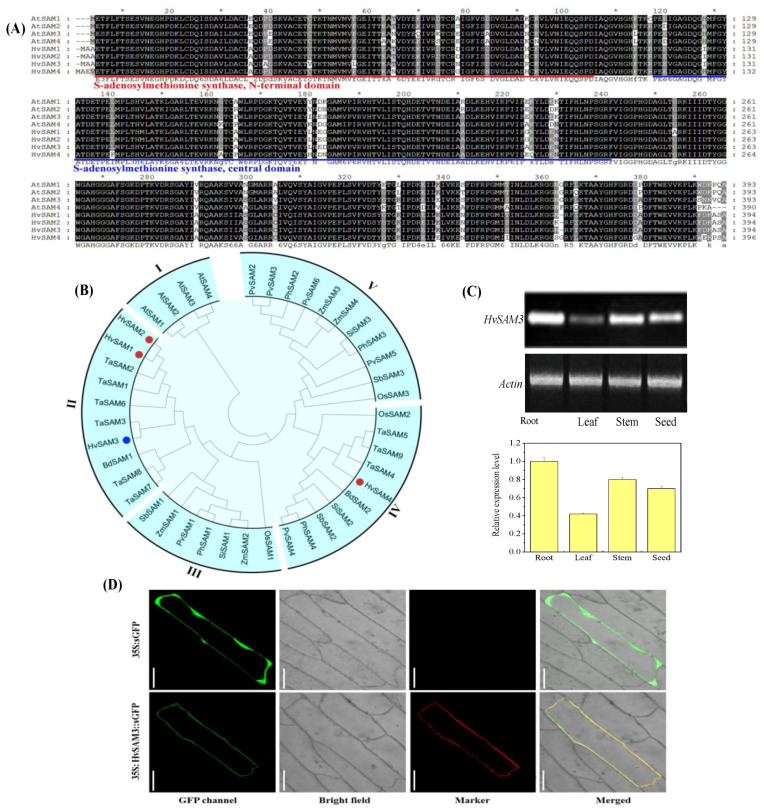
Identification of S-adenosylmethionine synthetase (SAM) proteins in monocots. (A) Multiple alignment of amino acid sequences of AtSAM1–AtSAM4 and identification of SAM in barley (HvSAMS1–HvSAMS4). The conserved S-adenosylmethionine synthetase N-terminal domain and S-adenosylmethionine synthetase central domain are shown. (B) Phylogenetic analysis of SAM proteins in monocots. The colored dots symbolize SAM members in barley. Tissue expression pattern and subcellular localization of S-adenosylmethionine Synthetase 3 (HvSAMS3). (C) RT-PCR analysis of the relative transcript levels of HvSAMS3 in different tissues of XZ5. (D) Transient expression of GFP (Green fluorescent protein) and the HvSAMS3-sGFP fusion protein in onion epidermis cells. Images are GFP fluorescence (GFP; green pseudocolor), red fluorescence [RFP PM marker (plasma membrane-localized marker); red pseudocolor], optical photomicrographs (bright field), and merged (optical photomicrographs, RFP PM marker, and GFP fluorescence). The data shown are representative of three independent experiments (n = 3). Scale bars, 100 μ.
Figure 4
Figure 4
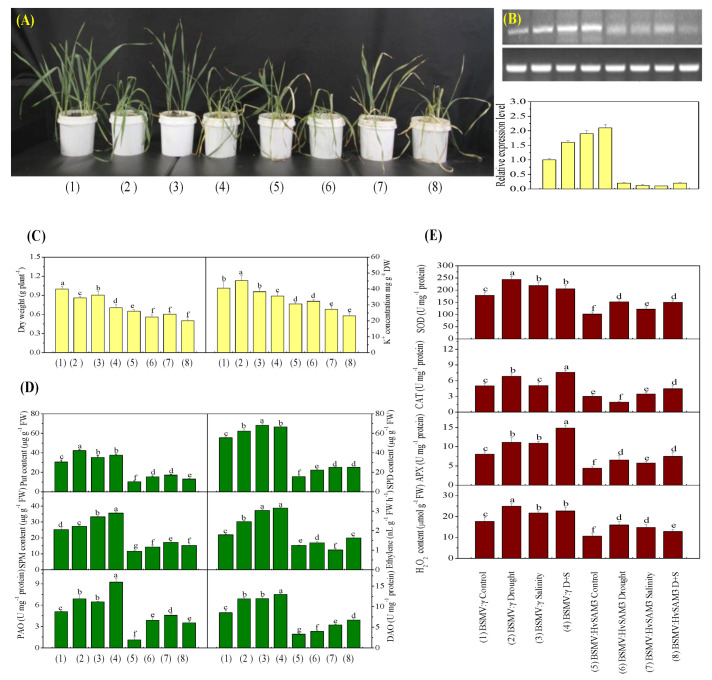
Functional assessment of HvSAMS3 in wild barley XZ5 via barley stripe mosaic virus-based virus-induced gene silencing (BSMV-VIGS). (A) Photography was performed 10 days after treatment. (B) RT-PCR analysis of the relative transcript levels of HvSAMS3 in XZ5 leaves. (C) Dry weight and K+ concentration in the roots of mock and BSMV:HvSAMS3-inoculated XZ5 seedlings. (D) Levels of putrescine (Put), spermidine (Spd) and spermine (Spm), ethylene production, and activities of polyamine oxidase (PAO) and diamine oxidase (DAO). (E) Superoxide dismutase (SOD), catalase (CAT), ascorbate-peroxidase (APX) activities and H2O2 content in response to drought or salinity alone and combined stresses of drought and salinity in BSMV:HvSAMS3-inoculated XZ5 seedlings compared with the BSMV:γ mock-inoculated seedlings. Error bars represent SD values (n = 4). Different letters indicate significant differences (p < 0.05) among the treatments. (1) BSMV:γ mock-inoculated seedlings grown in soil for 25 d (nonsalinized; 60–80% water-holding capacity); (2) BSMV:γ mock-inoculated seedlings grown in soil for 15 d and then exposed to drought for 10 d by withholding the water supply; (3) BSMV:γ mock-inoculated seedlings grown in soil for 15 d and then exposed to salinity for 10 d (200 mM NaCl; 60–80% water-holding capacity); (4) BSMV:γ mock-inoculated seedlings grown in soil for 15 d and then exposed to drought and salinity for 10 d (200 mM NaCl; withholding the water supply); (5) BSMV:HvSAMS3-inoculated seedlings grown in soil for 25 d (60–80% water-holding capacity); (6) BSMV:HvSAMS3-inoculated seedlings grown in soil for 15 d and then exposed to drought for 10 d by withholding the water supply; (7) BSMV:HvSAMS3-inoculated seedlings grown in soil for 15 d and then exposed to salinity for 10 d (200 mM NaCl, 60–80% water-holding capacity); (8) BSMV:HvSAMS3-inoculated seedlings grown in soil for 15 d and then exposed to drought and salinity for 10 d (200 mM NaCl and withholding the water supply).
Figure 5
Figure 5
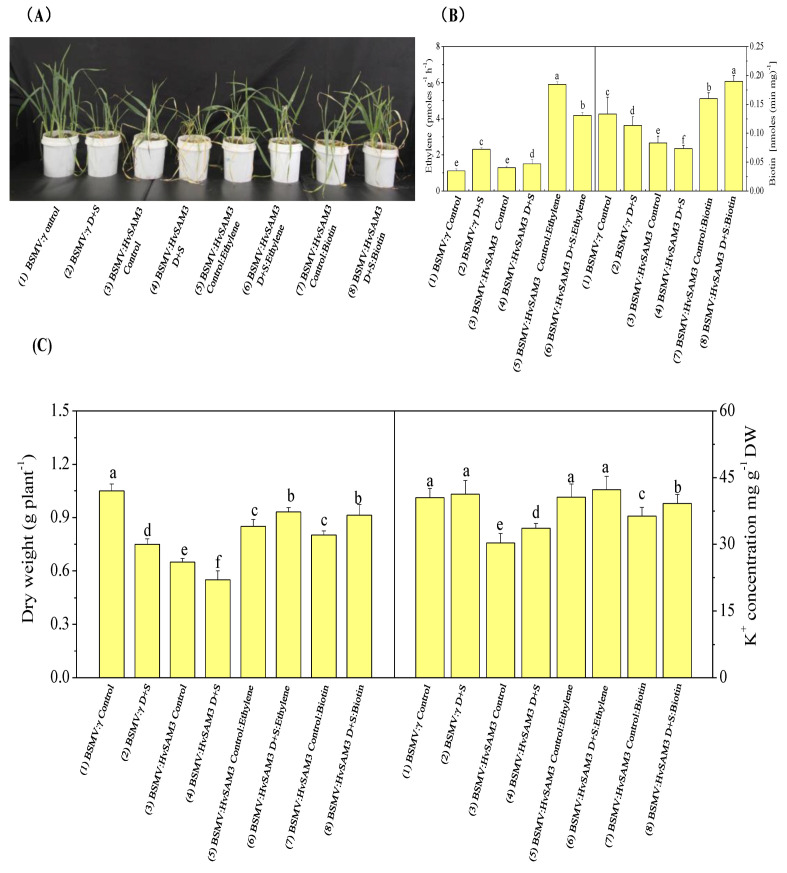
Functional assessment of HvSAMS3 in wild barley XZ5 via BSMV-VIGS. (A) Photography was performed at 10 days after treatment. (B) Ethylene production and biotin concentration of mock and BSMV:HvSAMS3-inoculated XZ5 seedlings. (C) Root dry weight and root K+ concentration of mock and BSMV:HvSAMS3-inoculated XZ5 seedlings. Error bars represent SD values (n = 4). Different letters indicate significant differences (p < 0.05) among the treatments. (1) BSMV:γ mock-inoculated seedlings grown in soil for 25 d (nonsalinized), in which the soils in the pots were kept humid (60–80% water-holding capacity); (2) BSMV:γ mock-inoculated seedlings grown in soil for 15 d and then exposed to drought and salinity for 10 d with 200 mM NaCl and withholding the water supply; (3) BSMV:HvSAMS3-inoculated seedlings grown in soil for 25 d, in which the soils in the pots were kept humid (60–80% water-holding capacity); (4) BSMV:HvSAMS3-inoculated seedlings grown in soil for 15 d and then exposed to drought and salinity for 10 d with 200 mM NaCl and withholding the water supply; (5) BSMV:HvSAMS3-inoculated seedlings grown in soil and sprayed with ethylene every alternate days from day 16 to day 25; (6) BSMV:HvSAMS3-inoculated seedlings grown in soil for 15 d and then exposed to D+S for 10 d by withholding the water supply coupled with ethylene spraying every alternate day from 16 d to 25 d; (7) BSMV:HvSAMS3-inoculated seedlings grown in soil and sprayed with biotin every alternate day from 16 d to 25 d; (8) BSMV:HvSAMS3-inoculated seedlings grown in soil for 15 d and then exposed to D+S for 10 d by withholding the water supply coupled with biotin spraying every alternate day from 16 d to 25 d.
Figure 6
Figure 6
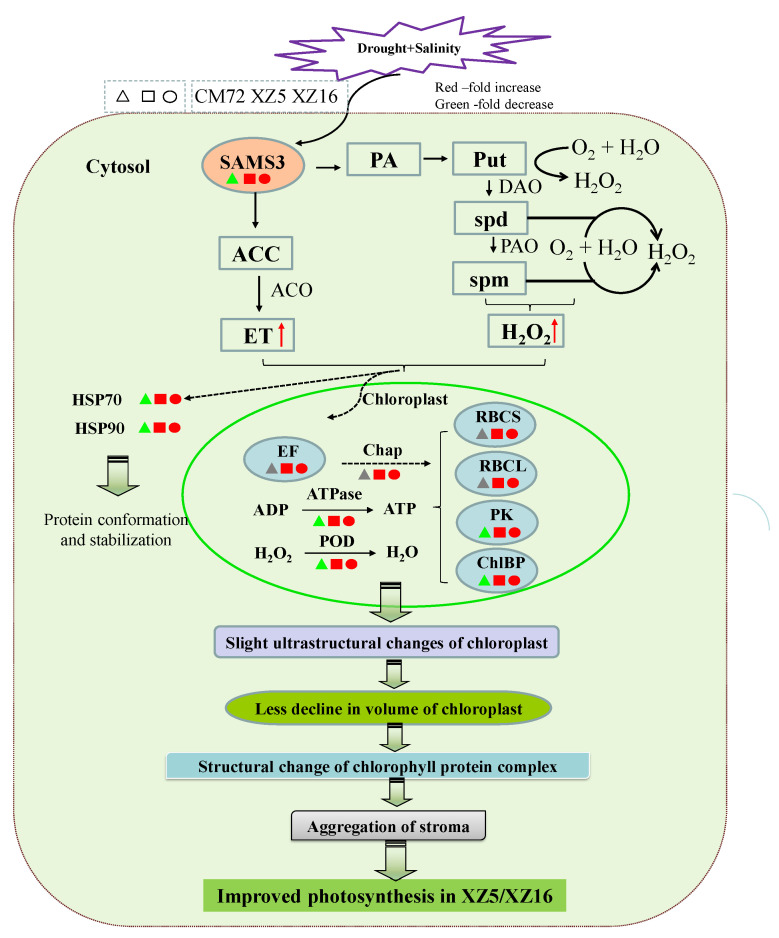
Integrated schematic of the mechanisms involved in the tolerance and adaptation of combined drought and salinity stress in Tibetan wild barley. The proteins in red, gray, and green are upregulated, nonchanged, and downregulated according to Table 1 and Table 2, respectively. The red arrows indicate upregulated changes. ACC, S-aminocyclopropane-1-carboxylate; ACO, S-aminocyclopropane-1-carboxylate oxidase; ATPase, ATP synthase subunit beta; Chap, 20 kDa chaperonin; ChlBP, chlorophyll a-b binding protein 1; DAO, diamine oxidase; ET, ethylene; EF, elongation factor Tu; HSP, heat shock protein; PA, polyamine; PAO, polyamine oxidase; PK, phosphoribulokinase; POD, peroxiredoxin-2E-2; Put, putrescine; RBCL, ribulose bisphosphate carboxylase large chain; RBCS, ribulose bisphosphate carboxylase small chain clone 512; SAM, S-adenosyl-L-methionine synthetase; spd, spermidine; spm, spermine. Moreover, slight ultrastructural changes in chloroplasts lead to a lower chloroplast volume, aggregation of stroma, structural changes in chlorophyll protein complex, and improved ATP synthesis.
Figure 7
Figure 7
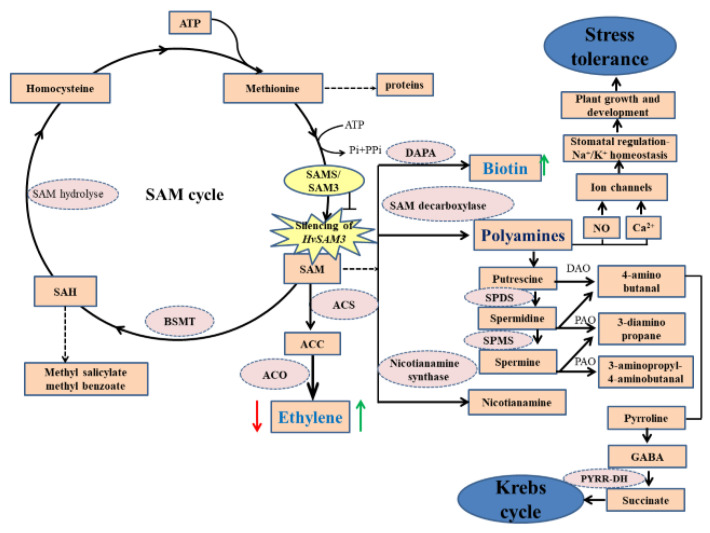
A proposed model for HvSAMS3 improvement of plant growth and development regulated by biotin and ethylene in wild barley XZ5. HvSAMS3 silencing of SAM cycle involving in ethylene, polyamines, and biotin biosynthesis process in Tibetan barley plants. Silencing of HvSAMS3 decreases ethylene, putrescine, spermidine and spermine, polyamine oxidase, and antioxidant enzyme activities, whereas these effects were alleviated by exogenous ethylene and biotin under combined stress. Thick arrows indicate up- and downregulated changes. Dashed arrows indicate multiple steps, the blunted arrow indicates the silence effect of HvSAMS3. Thick red arrows mark the effect of the BSMV:HvSAMS3, and thick green arrows mark relative changes by exogenous ethylene and biotin under combined drought and salinity stress. SAM: S-Adenosyl-L-methionine; SAMS: S-Adenosyl-L-methionine synthase; ACC: S-Aminocyclopropane-1-carboxylate; ACS: S-Aminocyclopropane-1-carboxylate synthase; ACO: S-Aminocyclopropane-1-carboxylate oxidase; BSMT: benzoic acid/salicylic acid; DAO: Diaminoxidase; DAPA: 8-diamino pelargonic acid aminotransferase; GABA: Aminobutyric acid; NO: Nitric oxide; PAO: polyamine oxidase; PYRR-DH, pyrroline dehydrogenase; SAH: S-Adenosyl-L-homocysteine; SAHH: S-Adenosyl-L-homocysteine hydrolase; SPDS: Spermidine synthase; SPMS: Spermine synthase.

References

    1. Altieri M.A., Nicholls C.I. The adaptation and mitigation potential of traditional agriculture in a changing climate. Clim. Chang. 2017;140:33–45. doi: 10.1007/s10584-013-0909-y. - DOI
    1. Fita A., Rodríguez-Burruezo A., Prohens J., Vicente O. Breeding and Domesticating Crops Adapted to Drought and Salinity: A New Paradigm for Increasing Food Production. Front. Plant Sci. 2015;6:978. doi: 10.3389/fpls.2015.00978. - DOI - PMC - PubMed
    1. Barkla B.J., Vera-Estrella R., Raymond C. Single-cell-type quantitative proteomic and ionomic analysis of epidermal bladder cells from the halophyte model plant Mesembryanthemum crystallinum to identify salt-responsive proteins. BMC Plant Biol. 2016;16:110. doi: 10.1186/s12870-016-0797-1. - DOI - PMC - PubMed
    1. Wu D., Shen Q., Qiu L., Han Y., Ye L., Jabeen Z., Shu Q., Zhang G.P. Identification of proteins associated with ion homeostasis and salt tolerance in barley. Proteomics. 2014;14:1381–1392. doi: 10.1002/pmic.201300221. - DOI - PubMed
    1. Ahmad J., Bashir H., Bagheri R., Baig A., Al-Huqail A., Ibrahim M.M. Drought and salinity induced changes in ecophysiology and proteomic profile of Parthenium hysterophorus. PLoS ONE. 2017;12:e0185118. doi: 10.1371/journal.pone.0185118. - DOI - PMC - PubMed

Publication types

Substances

LinkOut - more resources