


Collateral benefits on other respiratory infections during fighting COVID-19
- PMID: 32586667
- PMCID: PMC7274613
- DOI: 10.1016/j.medcli.2020.05.026
Collateral benefits on other respiratory infections during fighting COVID-19
Abstract
Purpose: Influenza virus infection is associated with a high disease burden. COVID-19 caused by SARS-CoV-2 has become a pandemic outbreak since January 2020. Taiwan has effectively contained COVID-19 community transmission. We aimed to validate whether fighting COVID-19 could help to control other respiratory infections in Taiwan.
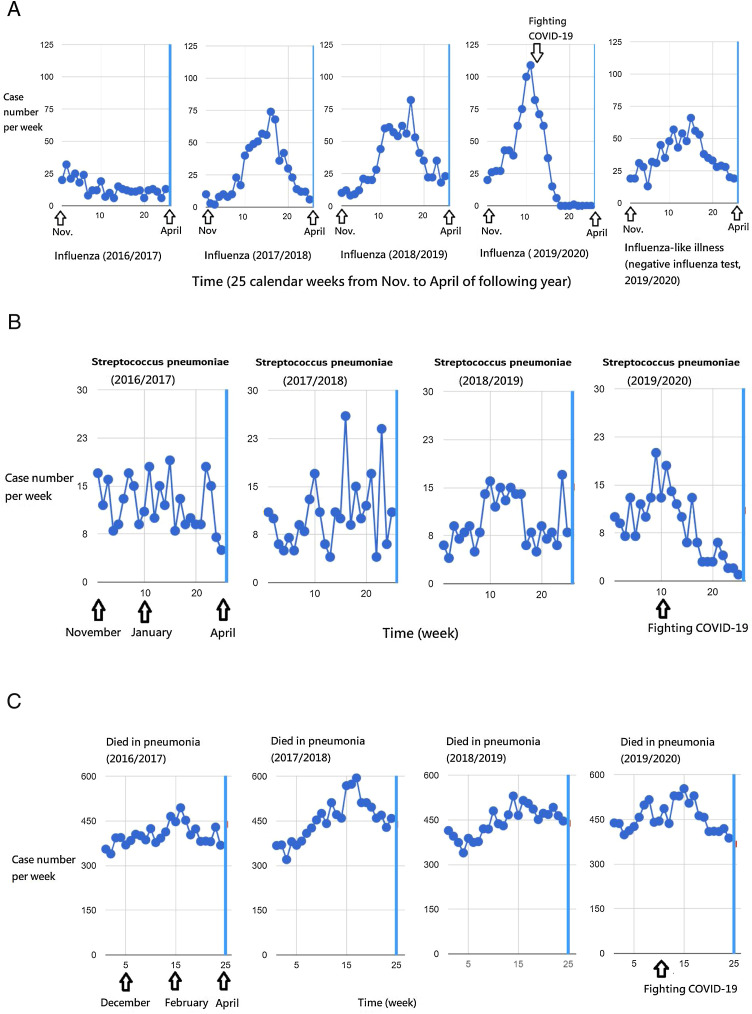
Method: We collected week-case data of severe influenza, invasive Streptococcus pneumoniae disease and death toll from pneumonia among 25 calendar weeks of the influenza season for four years (2016-2020), which were reported to Taiwan CDC. Trend and slope differences between years were compared.
Result: A downturn trend of severe influenza, invasive S. pneumoniae disease and the death toll from pneumonia per week in 2019/2020 season and significant trend difference in comparison to previous seasons were noted, especially after initiation of several disease prevention measures to fight potential COVID-19 outbreak in Taiwan.
Conclusions: Fighting COVID-19 achieved collateral benefits on significant reductions of severe influenza burden, invasive S. pneumoniae disease activity, and the death toll from pneumonia reported to CDC in Taiwan.
Propósitos: La COVID-19, causada por SARS-CoV-2, se ha convertido en un brote de pandemia desde enero de 2020. Taiwán ha contenido efectivamente la transmisión comunitaria de la COVID-19. Por otra parte, la influenza también es una enfermedad que se asocia con una alta carga de morbilidades. El objetivo del estudio es validar si combatir la COVID-19 podría ayudar a controlar otras infecciones respiratorias en Taiwán.
Métodos: Recopilamos datos semanales de casos de influenza grave, infecciones invasivas por Streptococcus pneumoniae y número de muertes por neumonía, que se informaron a los CDC de Taiwán en las 25 semanas de la temporada de influenza durante 4 años (2016-2020). Comparamos las diferencias de tendencia y de pendiente entre los años.
Resultados: Se observó una tendencia a la baja de la influenza grave, de las infecciones invasivas por Streptococcus pneumoniae y del número de muertes por neumonía por semana en la temporada de influenza de 2019-2020. Se observaron diferencias significativas en la tendencia en comparación con las temporadas anteriores, especialmente después del inicio de varias medidas de prevención de enfermedades para combatir el posible brote de COVID-19 en Taiwán.
Conclusiones: Por el número de casos reportados a los CDC de Taiwán, encontramos que la lucha contra la COVID-19 logró beneficios colaterales en cuanto a reducción significativa de la carga de la influenza grave, a las infecciones invasivas por Streptococcus pneumoniae y al número de muertes por neumonía.
Keywords: COVID-19; Influenza; Mascarilla; Mask; SARS-CoV-2; Streptococcus pneumoniae.
Copyright © 2020 Elsevier España, S.L.U. All rights reserved.
Figures
References
-
- Centers for Disease Control and Prevention. 2017–2018 Estimated influenza illnesses, medical visits, hospitalizations, and deaths and estimated influenza illnesses, medical visits, hospitalizations, and deaths averted by vaccination in the United States. https://www.cdc.gov/flu/about/burden-averted/2017-2018.htm
MeSH terms
LinkOut - more resources
Full Text Sources
Medical
Miscellaneous
