


Implementation of the Standards for adult immunization practice: A survey of U.S. Health care providers
- PMID: 32586760
- PMCID: PMC9638970
- DOI: 10.1016/j.vaccine.2020.05.073
Implementation of the Standards for adult immunization practice: A survey of U.S. Health care providers
Abstract
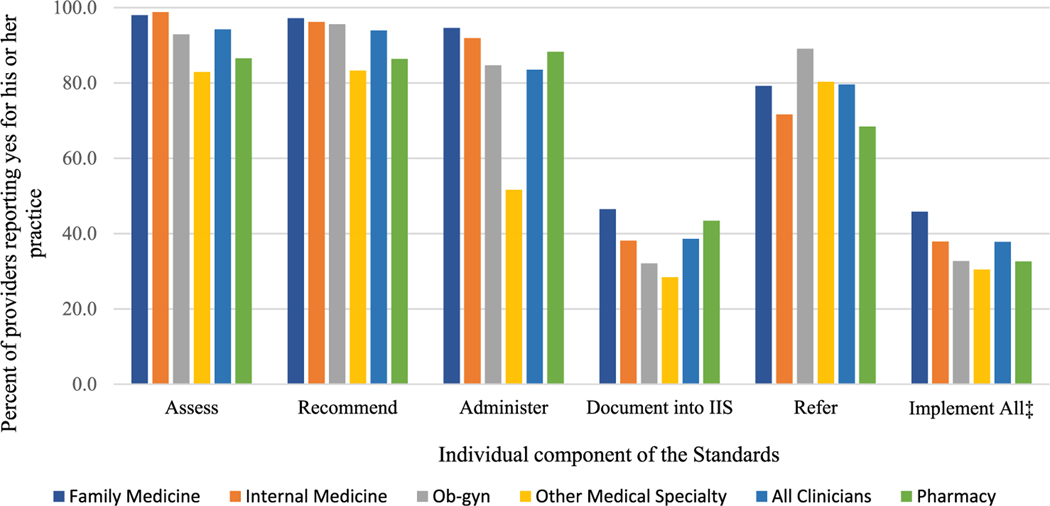
The revised Standards for Adult Immunization Practice ("Standards"), published in 2014, recommend routine vaccination assessment, strong provider recommendation, vaccine administration or referral, and documentation of vaccines administered into immunization information systems (IIS). We assessed clinician and pharmacist implementation of the Standards in the United States from 2016 to 2018. Participating clinicians (family and internal medicine physicians, obstetricians-gynecologists, specialty physicians, physician assistants, and nurse practitioners) and pharmacists responded using an internet panel survey. Weighted proportion of clinicians and pharmacists reporting full implementation of each component of the Standards were calculated. Adjusted prevalence ratio (APR) estimates of practice characteristics associated with self-reported implementation of the Standards are also presented. Across all medical specialties, the percentages of clinicians and pharmacists implementing the vaccine assessment and recommendation components of the Standards were >80.0%. However, due to low IIS documentation, full implementation of the Standards was low overall, ranging from 30.4% for specialty medicine to 45.8% in family medicine clinicians. The presence of an immunization champion (APR, 1.40 [95% confidence interval {CI}, 1.26 to 1.54]), use of standing orders (APR, 1.41 [95% CI, 1.27 to 1.57]), and use of a patient reminder-recall system (APR, 1.39 [95% CI, 1.26 to 1.54]) were positively associated with adherence to the Standards by clinicians. Similar results were observed for pharmacists. Nonetheless, vaccination improvement strategies, i.e., having standing orders in place, empowering an immunization champion, and using patient recall-reminder systems were underutilized in clinical settings; full implementation of the Standards was inconsistent across all health care provider practices.
Keywords: Adult; Immunization; Providers; Standards; Vaccination.
Copyright © 2020 Elsevier Ltd. All rights reserved.
Conflict of interest statement
Declaration of Competing Interest The authors declare the following financial interests/personal relationships which may be considered as potential competing interests: Regarding the present manuscript, the following co-authors do not report and conflicts of interest: Charleigh J. Granade, Amy Parker-Fiebelkorn, Carla L. Black, Anup Srivastav, Chelsea S. Lutz, Carolyn B. Bridges, and David K. Kim. Because the data presented in this manuscript was collected through a contractual agreement between CDC and Abt. Associates, the following co-authors report a conflict of interest: Sarah W. Ball, Rebecca G. Devlin, and Ann J. Cloud..
Figures
References
-
- U.S. Department of Health and Human Services. Healthy People 2020: immunization and infectious diseases objectives. Updated 2019 October 17. Accessed at https://www.healthypeople.gov/2020/topics-objectives/topic/immunization-... on 17 October 2019.
-
- Thompson M, Shay D, Zhou H, et al. Estimates of deaths associated with seasonal influenza-United States, 1976–2007. MMWR Morb Mortal Wkly Rep 2010;59:1057–62. - PubMed
-
- National Foundation for Infectious Diseases. Call to action: Adult vaccination saves lives. 2012. Accessed at https://www.nfid.org/wp-content/uploads/2019/08/cta-adult-1.pdf on 01 October 2019.
MeSH terms
Substances
Grants and funding
LinkOut - more resources
Full Text Sources
Medical
Miscellaneous
