How affinity of the ELT-2 GATA factor binding to cis- acting regulatory sites controls Caenorhabditis elegans intestinal gene transcription
- PMID: 32586978
- PMCID: PMC7390640
- DOI: 10.1242/dev.190330
How affinity of the ELT-2 GATA factor binding to cis- acting regulatory sites controls Caenorhabditis elegans intestinal gene transcription
Abstract
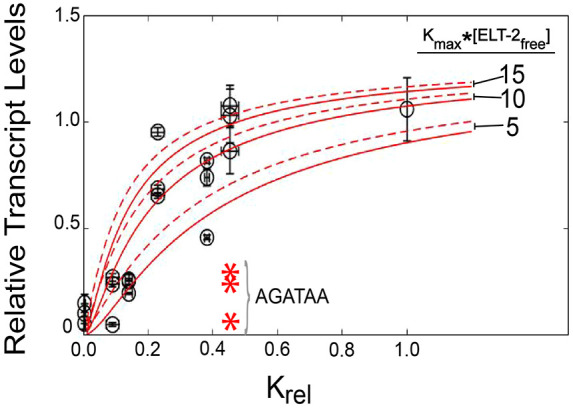
We define a quantitative relationship between the affinity with which the intestine-specific GATA factor ELT-2 binds to cis-acting regulatory motifs and the resulting transcription of asp-1, a target gene representative of genes involved in Caenorhabditis elegans intestine differentiation. By establishing an experimental system that allows unknown parameters (e.g. the influence of chromatin) to effectively cancel out, we show that levels of asp-1 transcripts increase monotonically with increasing binding affinity of ELT-2 to variant promoter TGATAA sites. The shape of the response curve reveals that the product of the unbound ELT-2 concentration in vivo [i.e. (ELT-2free) or ELT-2 'activity'] and the largest ELT-XXTGATAAXX association constant (Kmax) lies between five and ten. We suggest that this (unitless) product [Kmax×(ELT-2free) or the equivalent product for any other transcription factor] provides an important quantitative descriptor of transcription-factor/regulatory-motif interaction in development, evolution and genetic disease. A more complicated model than simple binding affinity is necessary to explain the fact that ELT-2 appears to discriminate in vivo against equal-affinity binding sites that contain AGATAA instead of TGATAA.
Keywords: Binding affinity; C. elegans; ELT-2; GATA Factor; Intestine; Protease; Transcription; asp-1; cis-acting regulatory motif.
© 2020. Published by The Company of Biologists Ltd.
Conflict of interest statement
Competing interestsThe authors declare no competing or financial interests.
Figures


References
-
- Bain D. L., Yang Q., Connaghan K. D., Robblee J. P., Miura M. T., Degala G. D., Lambert J. R. and Maluf N. K. (2012). Glucocorticoid receptor-DNA interactions: binding energetics are the primary determinant of sequence-specific transcriptional activity. J. Mol. Biol. 422, 18-32. 10.1016/j.jmb.2012.06.005 - DOI - PubMed
-
- Boulin T., Etchberger J. F. and Hobert O. (2006). Reporter gene fusions. WormBook. 1-23. (ed. The C. elegans Research Community): http://www.wormbook.org. 10.1895/wormbook.1.106.1 - DOI
-
- Carey M. F., Peterson C. L. and Smale S. T. (2009). Transcriptional Regulation in Eukaryotes: Concepts, Strategies, and Techniques, 2nd edn Cold Spring Harbor, New York: Cold Spring Harbor Laboratory Press.
Publication types
MeSH terms
Substances
LinkOut - more resources
Full Text Sources
Research Materials