


Arctic-adapted dogs emerged at the Pleistocene-Holocene transition
- PMID: 32587022
- PMCID: PMC7116267
- DOI: 10.1126/science.aaz8599
Arctic-adapted dogs emerged at the Pleistocene-Holocene transition
Abstract
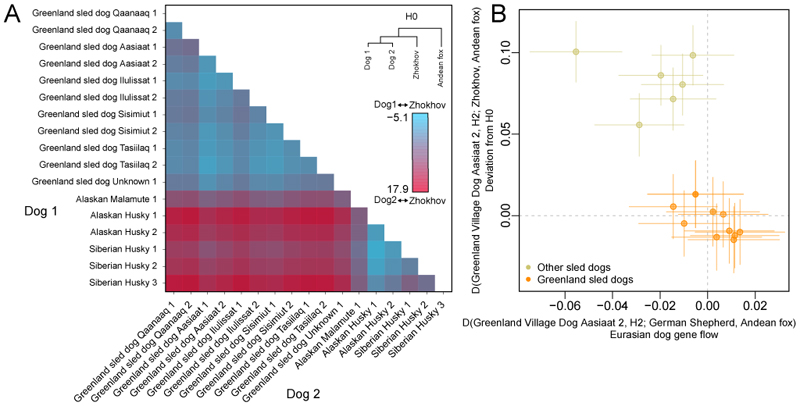
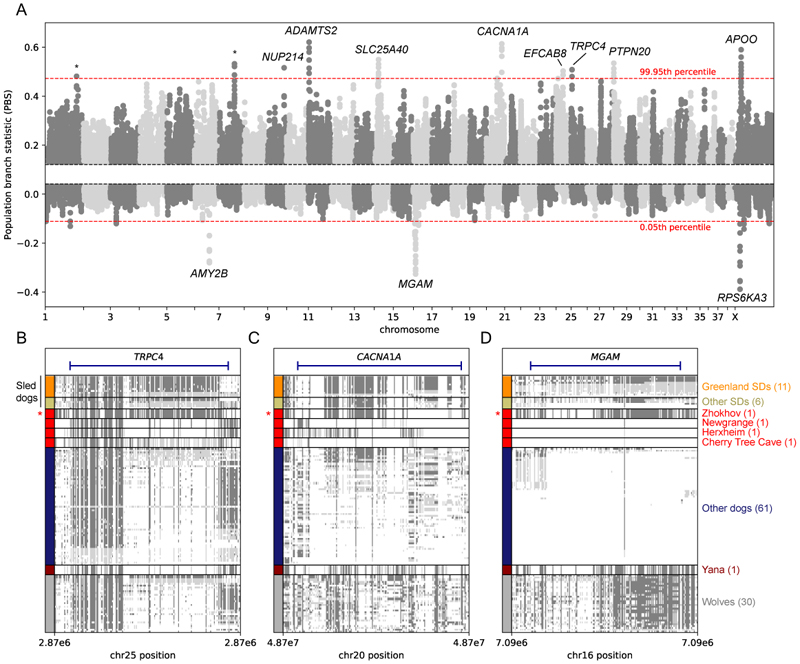
Although sled dogs are one of the most specialized groups of dogs, their origin and evolution has received much less attention than many other dog groups. We applied a genomic approach to investigate their spatiotemporal emergence by sequencing the genomes of 10 modern Greenland sled dogs, an ~9500-year-old Siberian dog associated with archaeological evidence for sled technology, and an ~33,000-year-old Siberian wolf. We found noteworthy genetic similarity between the ancient dog and modern sled dogs. We detected gene flow from Pleistocene Siberian wolves, but not modern American wolves, to present-day sled dogs. The results indicate that the major ancestry of modern sled dogs traces back to Siberia, where sled dog-specific haplotypes of genes that potentially relate to Arctic adaptation were established by 9500 years ago.
Copyright © 2020 The Authors, some rights reserved; exclusive licensee American Association for the Advancement of Science. No claim to original U.S. Government Works.
Conflict of interest statement
Authors declare no competing interests.
Figures

References
-
- Pitulko VV, Kasparov AK. Ancient Arctic hunters: material culture and survival strategy. Arctic Anthropol. 1996;33:1–36.
-
- Pitulko VV, Kasparov AK. Archaeological dogs from the Early Holocene Zhokhov site in the Eastern Siberian Arctic. Journal of Archaeological Science: Reports. 2017;13:491–515.
-
- See supplementary materials
-
- Skoglund P, Ersmark E, Palkopoulou E, Dalén L. Ancient wolf genome reveals an early divergence of domestic dog ancestors and admixture into high-latitude breeds. Curr Biol. 2015;25:1515–1519. - PubMed
Publication types
MeSH terms
Substances
Grants and funding
LinkOut - more resources
Full Text Sources
Other Literature Sources
