


Predicting the Potential for Cannabinoids to Precipitate Pharmacokinetic Drug Interactions via Reversible Inhibition or Inactivation of Major Cytochromes P450
- PMID: 32587099
- PMCID: PMC7543485
- DOI: 10.1124/dmd.120.000073
Predicting the Potential for Cannabinoids to Precipitate Pharmacokinetic Drug Interactions via Reversible Inhibition or Inactivation of Major Cytochromes P450
Abstract
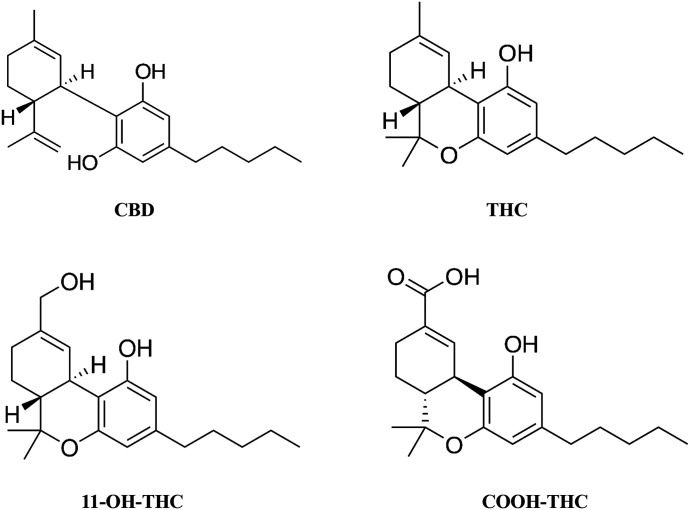
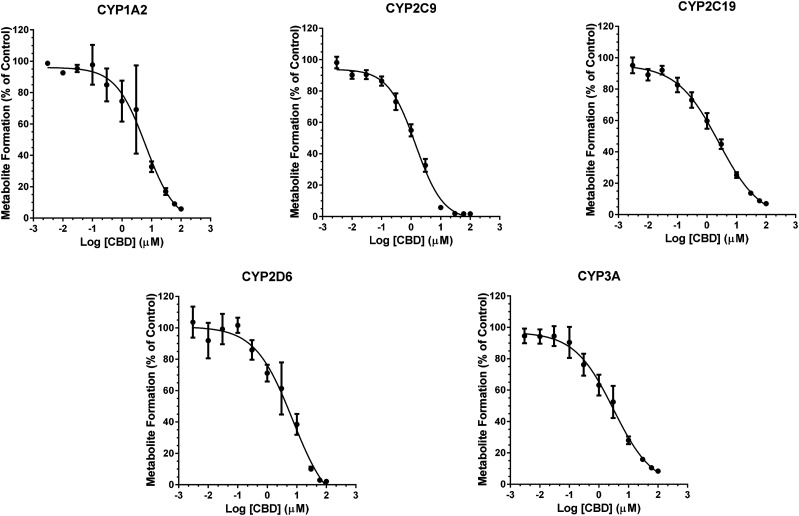
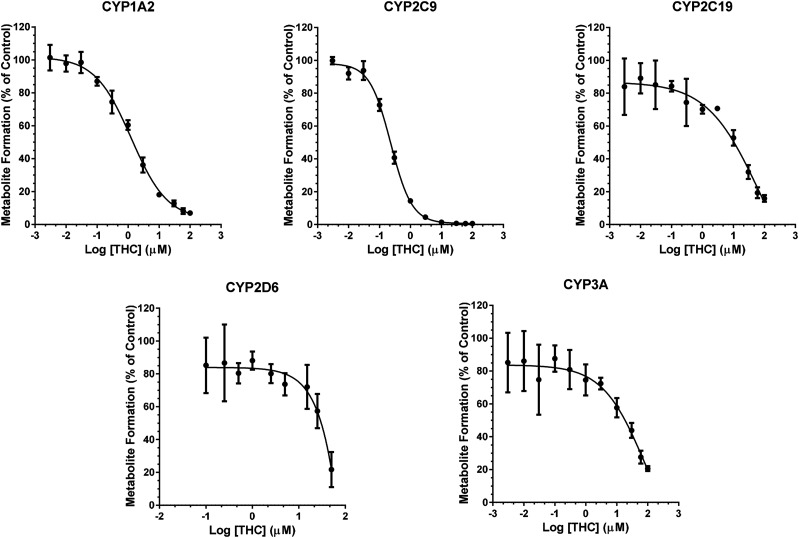
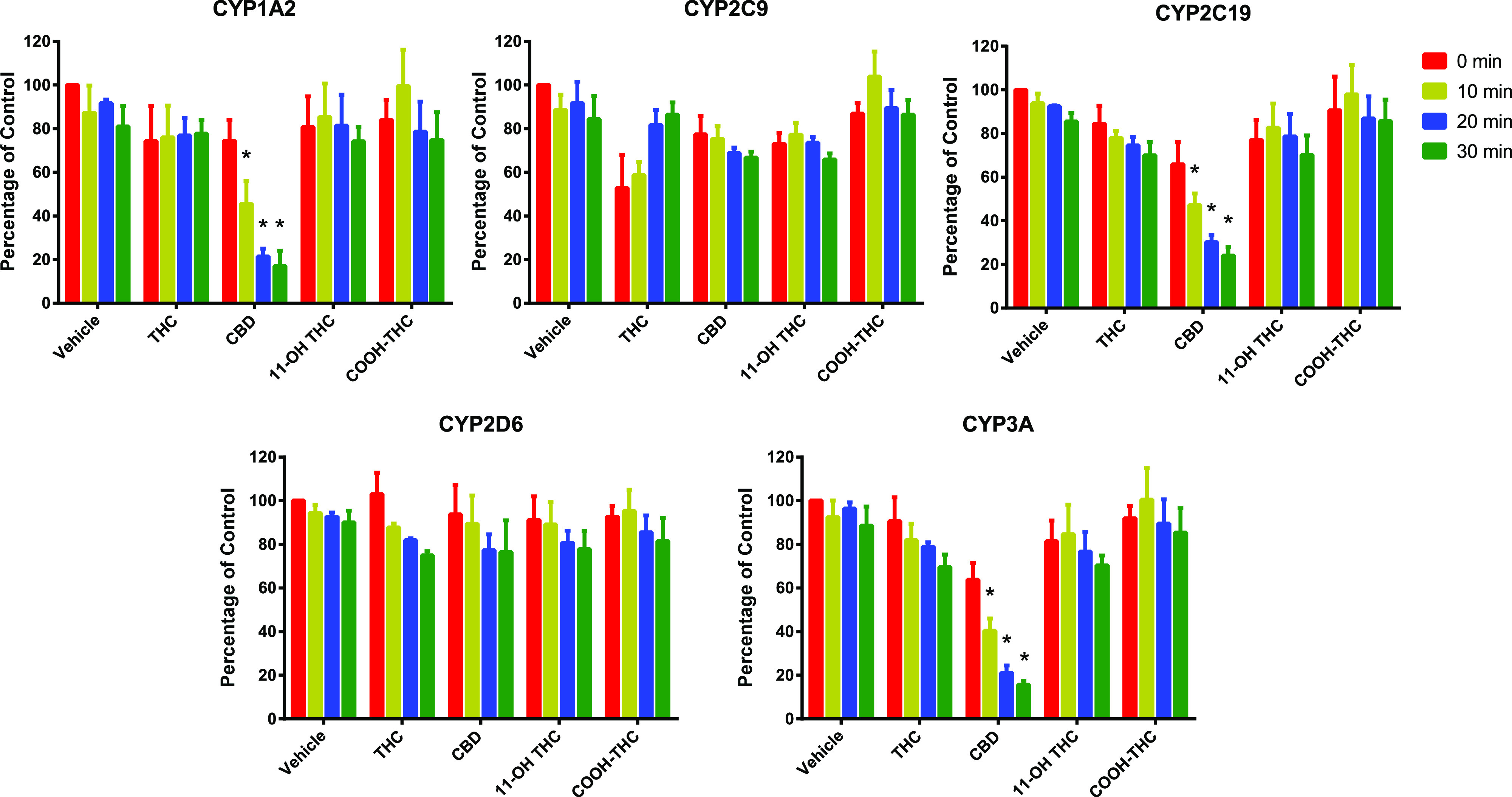
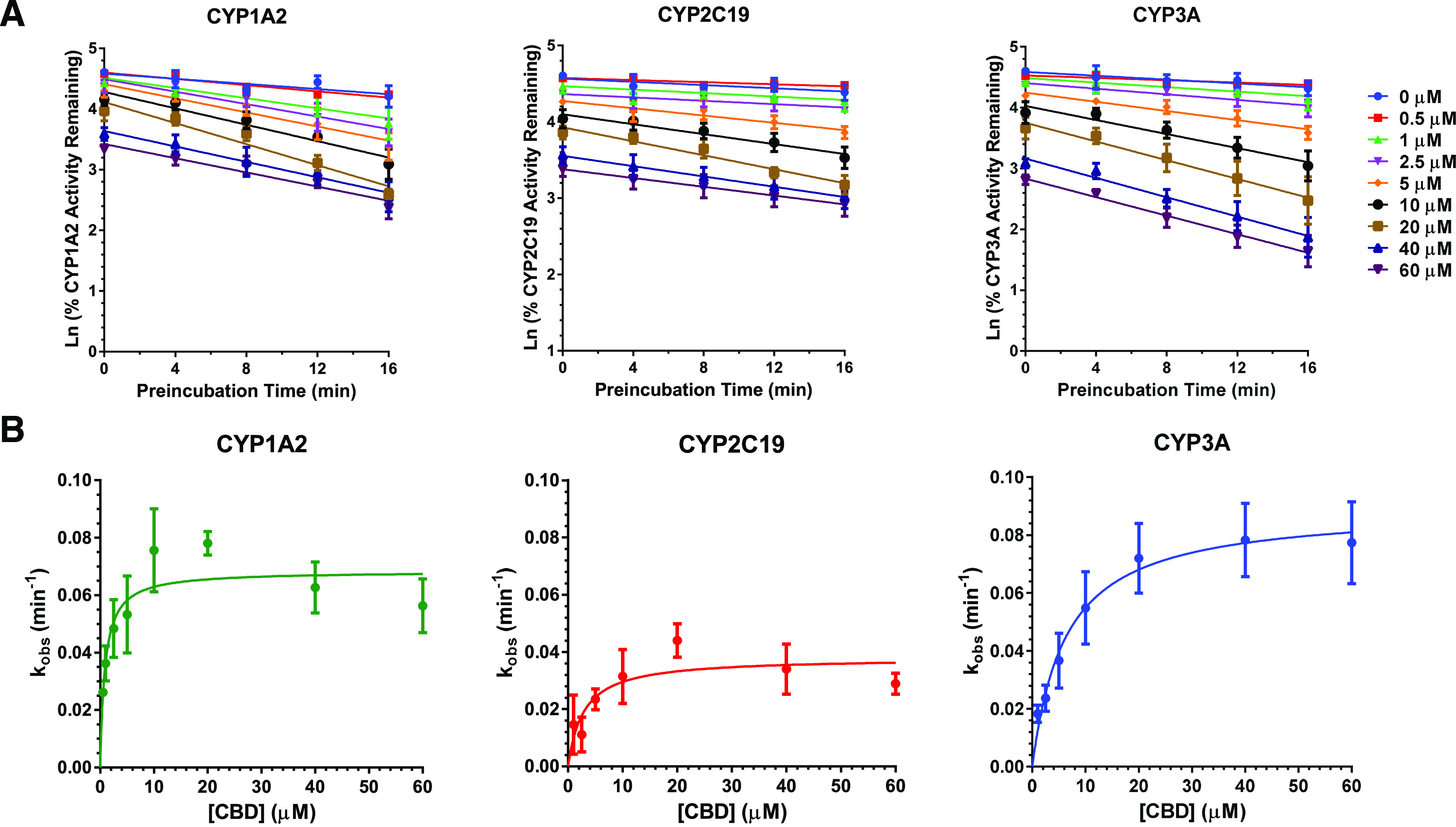
Cannabis is used for both recreational and medicinal purposes. The most abundant constituents are the cannabinoids - cannabidiol (CBD, nonpsychoactive) and (-)-trans-Δ9-tetrahydrocannabinol (THC, psychoactive). Both have been reported to reversibly inhibit or inactivate cytochrome P450 (CYPs) enzymes. However, the low aqueous solubility, microsomal protein binding, and nonspecific binding to labware were not considered, potentially leading to an underestimation of CYPs inhibition potency. Therefore, the binding-corrected reversible (IC50,u) and irreversible (K I,u ) inhibition potency of each cannabinoid toward major CYPs were determined. The fraction unbound of CBD and THC in the incubation mixture was 0.12 ± 0.04 and 0.05 ± 0.02, respectively. The IC50,u for CBD toward CYP1A2, 2C9, 2C19, 2D6, and 3A was 0.45 ± 0.17, 0.17 ± 0.03, 0.30 ± 0.06, 0.95 ± 0.50, and 0.38 ± 0.11 µM, respectively; the IC50,u for THC was 0.06 ± 0.02, 0.012 ± 0.001, 0.57 ± 0.22, 1.28 ± 0.25, and 1.30 ± 0.34 µM, respectively. Only CBD showed time-dependent inactivation (TDI) of CYP1A2, 2C19, and CYP3A, with inactivation efficiencies (k inact/K I,u) of 0.70 ± 0.34, 0.11 ± 0.06, and 0.14 ± 0.04 minutes-1 µM-1, respectively. A combined (reversible inhibition and TDI) mechanistic static model populated with these data predicted a moderate to strong pharmacokinetic interaction risk between orally administered CBD and drugs extensively metabolized by CYP1A2/2C9/2C19/2D6/3A and between orally administered THC and drugs extensively metabolized by CYP1A2/2C9/3A. These predictions will be extended to a dynamic model using physiologically based pharmacokinetic modeling and simulation and verified with a well-designed clinical cannabinoid-drug interaction study. SIGNIFICANCE STATEMENT: This study is the first to consider the impact of limited aqueous solubility, nonspecific binding to labware, or extensive binding to incubation protein shown by cannabidiol (CBD) and delta-9-tetrahydrocannabinol (THC) on their true cytochrome P450 inhibitory potency. A combined mechanistic static model predicted a moderate to strong pharmacokinetic interaction risk between orally administered CBD and drugs extensively metabolized by CYP1A2, 2C9, 2C19, 2D6, or 3A and between orally administered THC and drugs extensively metabolized by CYP1A2, 2C9, or 3A.
Copyright © 2020 by The American Society for Pharmacology and Experimental Therapeutics.
Figures
References
-
- Benowitz NL, Nguyen TL, Jones RT, Herning RI, Bachman J. (1980) Metabolic and psychophysiologic studies of cannabidiol-hexobarbital interaction. Clin Pharmacol Ther 28:115–120. - PubMed
-
- Bornheim LM, Grillo MP. (1998) Characterization of cytochrome P450 3A inactivation by cannabidiol: possible involvement of cannabidiol-hydroxyquinone as a P450 inactivator. Chem Res Toxicol 11:1209–1216. - PubMed
-
- Bose J, Hedden SL, Lipari RN, Park-LeeKey E. (2016) Substance Use and Mental Health Indicators in the United States: Results from the 2015 National Survey on Drug Use and Health. https://www.samhsa.gov/data/sites/default/files/NSDUH-FFR1-2015/NSDUH-FF...
Publication types
MeSH terms
Substances
Grants and funding
LinkOut - more resources
Full Text Sources
