


Liver-related effects of chronic hepatitis C antiviral treatment
- PMID: 32587440
- PMCID: PMC7304101
- DOI: 10.3748/wjg.v26.i22.2931
Liver-related effects of chronic hepatitis C antiviral treatment
Abstract
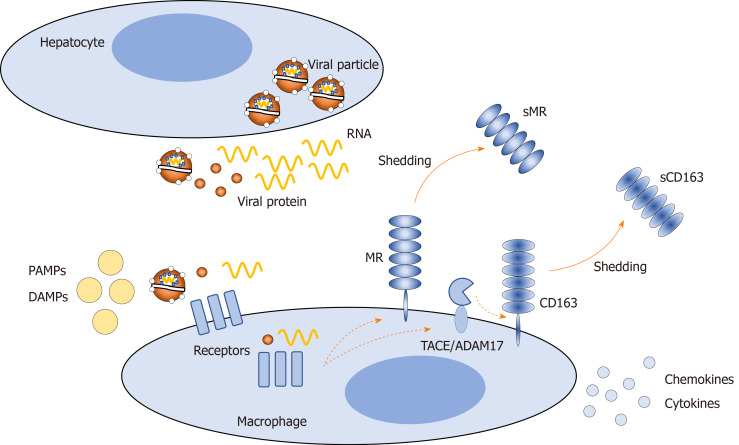
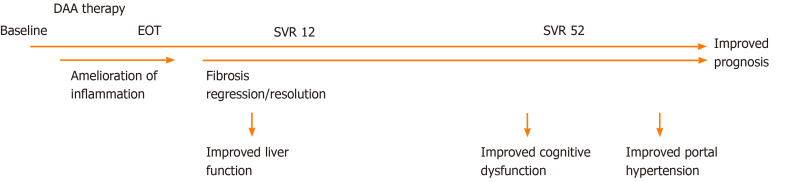
More than five years ago, the treatment of hepatitis C virus infection was revolutionized with the introduction of all-oral direct-acting antiviral (DAA) drugs. They proved highly efficient in curing patients with chronic hepatitis C (CHC), including patients with cirrhosis. The new DAA treatments were alleged to induce significant improvements in clinical outcome and prognosis, but the exact cause of the expected benefit was unclear. Further, little was known about how the underlying liver disease would be affected during and after viral clearance. In this review, we describe and discuss the liver-related effects of the new treatments in regards to both pathophysiological aspects, such as macrophage activation, and the time-dependent effects of therapy, with specific emphasis on inflammation, structural liver changes, and liver function, as these factors are all related to morbidity and mortality in CHC patients. It seems clear that antiviral therapy, especially the achievement of a sustained virologic response has several beneficial effects on liver-related parameters in CHC patients with advanced liver fibrosis or cirrhosis. There seems to be a time-dependent effect of DAA therapy with viral clearance and the resolution of liver inflammation followed by more discrete changes in structural liver lesions. These improvements lead to favorable effects on liver function, followed by an improvement in cognitive dysfunction and portal hypertension. Overall, the data provide knowledge on the several beneficial effects of DAA therapy on liver-related parameters in CHC patients suggesting short- and long-term improvements in the underlying disease with the promise of an improved long-term prognosis.
Keywords: Antiviral treatment; Chronic hepatitis C; Galactose elimination capacity; Hepatic encephalopathy; Inflammation; Liver cirrhosis; Liver fibrosis; Metabolic liver function; Portal hypertension; Urea synthesis capacity.
©The Author(s) 2020. Published by Baishideng Publishing Group Inc. All rights reserved.
Conflict of interest statement
Conflict-of-interest statement: George J is supported by the Robert W Storr Bequest to the Sydney Medical Foundation, University of Sydney; a National Health and Medical Research Council of Australia (NHMRC) Program Grant, No. APP1053206 and APP1149976) and Project grants, No. APP1107178 and APP1108422 and is on the advisory boards of Gilead, AbbVie, Novo Nordisk, MSD, Intercept, and Janssen; Grønbæk H received grants from the NOVO Nordisk Foundation, ‘‘Savværksejer Jeppe Juhl og hustru Ovita Juhls mindelegat”, AbbVie, and Intercept and is on the advisory board of Ipsen and Novartis; Laursen TL, Sandahl TD, and Kazankov K have no conflicts of interest to declare.
Figures
References
-
- Choo QL, Kuo G, Weiner AJ, Overby LR, Bradley DW, Houghton M. Isolation of a cDNA clone derived from a blood-borne non-A, non-B viral hepatitis genome. Science. 1989;244:359–362. - PubMed
-
- Polaris Observatory HCV Collaborators. Global prevalence and genotype distribution of hepatitis C virus infection in 2015: a modelling study. Lancet Gastroenterol Hepatol. 2017;2:161–176. - PubMed
-
- Gower E, Estes C, Blach S, Razavi-Shearer K, Razavi H. Global epidemiology and genotype distribution of the hepatitis C virus infection. J Hepatol. 2014;61:S45–S57. - PubMed
-
- Dalgard O, Egeland A, Ervik R, Vilimas K, Skaug K, Steen TW. [Risk factors for hepatitis C among injecting drug users in Oslo] Tidsskr Nor Laegeforen. 2009;129:101–104. - PubMed
-
- Duberg A, Janzon R, Bäck E, Ekdahl K, Blaxhult A. The epidemiology of hepatitis C virus infection in Sweden. Euro Surveill. 2008;13:18882. - PubMed
Publication types
MeSH terms
Substances
LinkOut - more resources
Full Text Sources
