


Single-nucleotide polymorphisms based genetic risk score in the prediction of pancreatic cancer risk
- PMID: 32587449
- PMCID: PMC7304113
- DOI: 10.3748/wjg.v26.i22.3076
Single-nucleotide polymorphisms based genetic risk score in the prediction of pancreatic cancer risk
Abstract
Background: Disease-related single nucleotide polymorphisms (SNPs) based genetic risk score (GRS) has been proven to provide independent inherited risk other than family history in multiple cancer types.
Aim: To evaluate the potential of GRS in the prediction of pancreatic cancer risk.
Methods: In this case-control study (254 cases and 1200 controls), we aimed to evaluate the association between GRS and pancreatic ductal adenocarcinoma (PDAC) risk in the Chinese population. The GRS was calculated based on the genotype information of 18 PDAC-related SNPs for each study subject (personal genotyping information of the SNPs) and was weighted by external odd ratios (ORs).
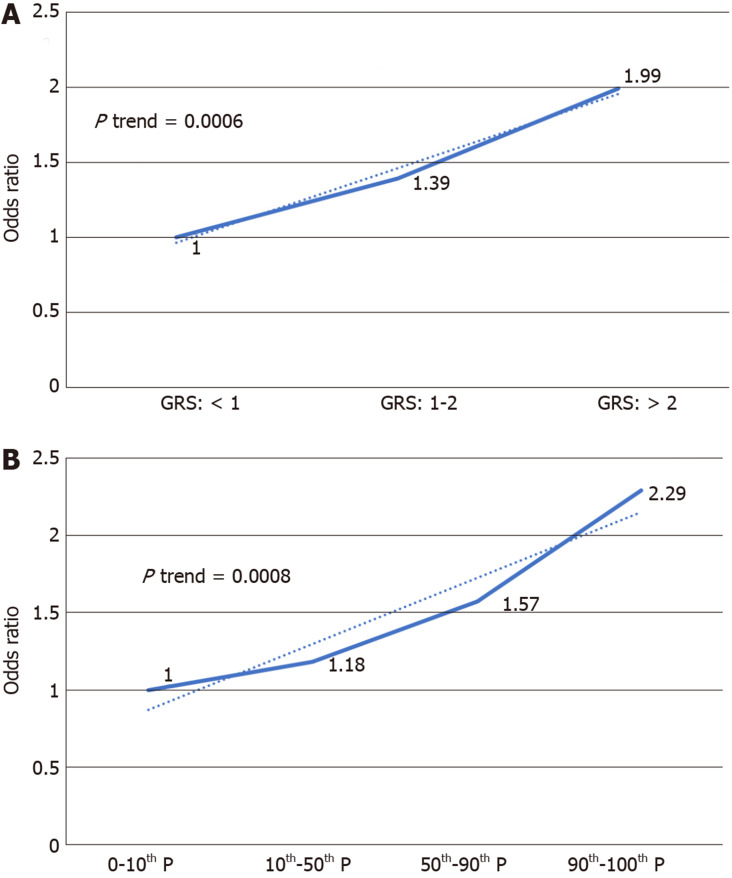
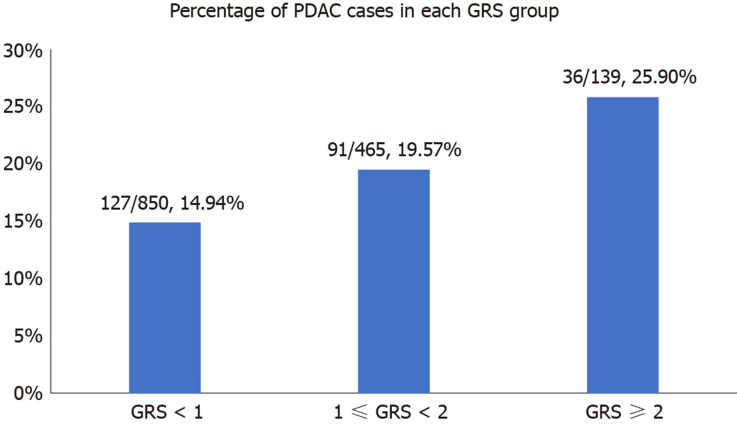
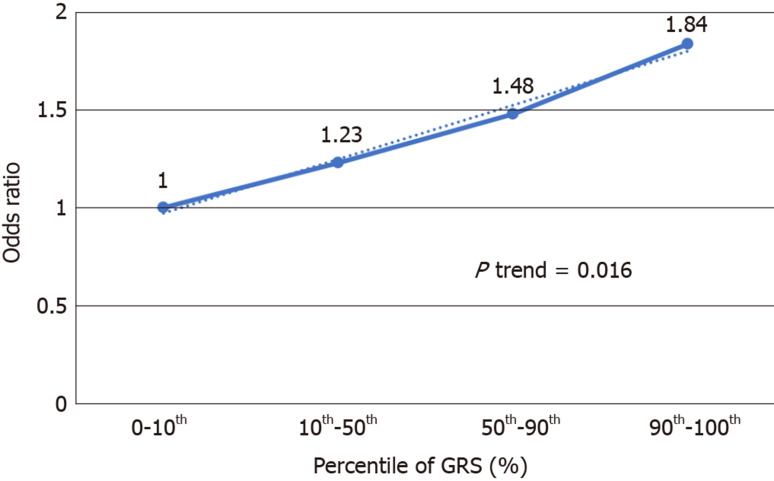
Results: GRS was significantly different in cases and controls (1.96 ± 3.84 in PDACs vs 1.09 ± 0.94 in controls, P < 0.0001). Logistic regression revealed GRS to be associated with PDAC risk [OR = 1.23, 95% confidence interval (CI): 1.13-1.34, P < 0.0001]. GRS remained significantly associated with PDAC (OR = 1.36, 95%CI: 1.06-1.74, P = 0.015) after adjusting for age and sex. Further analysis revealed an association of increased risk for PDAC with higher GRS. Compared with low GRS (< 1.0), subjects with high GRS (2.0) were 99% more likely to have PDAC (OR: 1.99, 95%CI: 1.30-3.04, P = 0.002). Participants with intermediate GRS (1.0-1.9) were 39% more likely to have PDAC (OR: 1.39, 95%CI: 1.03-1.84, P = 0.031). A positive trend was observed (P trend = 0.0006).
Conclusion: GRS based on PDAC-associated SNPs could provide independent information on PDAC risk and may be used to predict a high risk PDAC population.
Keywords: Chinese population; Genetic risk score; Genome-wide association study; Pancreatic cancer; Single nucleotide polymorphisms.
©The Author(s) 2020. Published by Baishideng Publishing Group Inc. All rights reserved.
Conflict of interest statement
Conflict-of-interest statement: No benefits in any form have been received or will be received from a commercial party related directly or indirectly to the subject of this article.
Figures
References
-
- Torre LA, Bray F, Siegel RL, Ferlay J, Lortet-Tieulent J, Jemal A. Global cancer statistics, 2012. CA Cancer J Clin. 2015;65:87–108. - PubMed
-
- Chen W, Zheng R, Baade PD, Zhang S, Zeng H, Bray F, Jemal A, Yu XQ, He J. Cancer statistics in China, 2015. CA Cancer J Clin. 2016;66:115–132. - PubMed
-
- Zheng R, Zeng H, Zhang S, Chen T, Chen W. National estimates of cancer prevalence in China, 2011. Cancer Lett. 2016;370:33–38. - PubMed
-
- Zhou M, Wang H, Zhu J, Chen W, Wang L, Liu S, Li Y, Wang L, Liu Y, Yin P, Liu J, Yu S, Tan F, Barber RM, Coates MM, Dicker D, Fraser M, González-Medina D, Hamavid H, Hao Y, Hu G, Jiang G, Kan H, Lopez AD, Phillips MR, She J, Vos T, Wan X, Xu G, Yan LL, Yu C, Zhao Y, Zheng Y, Zou X, Naghavi M, Wang Y, Murray CJ, Yang G, Liang X. Cause-specific mortality for 240 causes in China during 1990-2013: a systematic subnational analysis for the Global Burden of Disease Study 2013. Lancet. 2016;387:251–272. - PubMed
-
- Society AC. Cancer Facts and Figures 2016. 2016. Available from: https://www.cancer.org/content/dam/cancer-org/research/cancer-facts-and-....
MeSH terms
LinkOut - more resources
Full Text Sources
Medical
