


Socioeconomic Status and Psychological Well-Being: Revisiting the Role of Subjective Socioeconomic Status
- PMID: 32587560
- PMCID: PMC7298147
- DOI: 10.3389/fpsyg.2020.01303
Socioeconomic Status and Psychological Well-Being: Revisiting the Role of Subjective Socioeconomic Status
Abstract
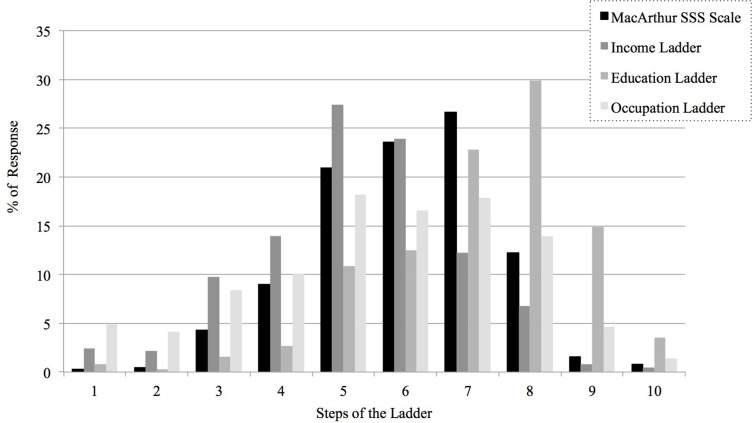
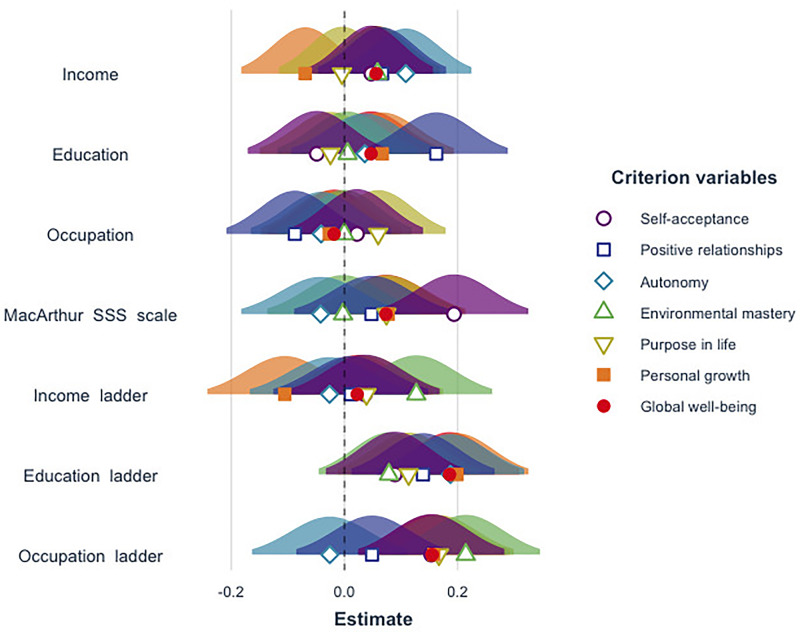
Socioeconomic status (SES) is a complex and multidimensional construct, encompassing both independent objective characteristics (e.g., income or education) and subjective people's ratings of their placement in the socioeconomic spectrum. Within the growing literature on subjective SES belongingness and psychological well-being, subjective indices of SES have tended to center on the use of pictorial rank-related social ladders where individuals place themselves relative to others by simultaneously considering their income, educational level, and occupation. This approach, albeit consistent with the idea of these social ladders as summative or cognitive SES markers, might potentially constrain individuals' conceptions of their SES. This research (N = 368; M age = 39.67, SD = 13.40) is intended to expand prior investigations on SES and psychological well-being by revisiting the role of subjective SES. In particular, it (a) proposes an innovative adaptation of the traditional MacArthur Scale of subjective SES to income, education, and occupation, thus resulting in three separate social ladders; and (b) tests the empirical contribution of such three social ladders to psychological well-being. Overall, our findings showed that the novel education and occupation ladders (excluding the income ladder) are predictive of a significant part of the variance levels of psychological well-being that is not due to canonical objective metrics of SES (i.e., income, education, and occupation), or to the conventional MacArthur Scale of subjective SES. Although preliminary, these results underscore the need to further reconsider (subjective) SES-related conceptualization and measurement strategies to gather a more comprehensive understanding of the SES-psychological well-being link.
Keywords: objective socioeconomic status; psychological well-being; social class; socioeconomic status; subjective socioeconomic status.
Copyright © 2020 Navarro-Carrillo, Alonso-Ferres, Moya and Valor-Segura.
Figures
References
-
- Akinwande M. O., Dikko H. G., Samson A. (2015). Variance inflation factor: as a condition for the inclusion of suppressor variable(s) in regression analysis. Open J. Stat. 5 754–767. 10.4236/ojs.2015.57075 - DOI
-
- American Psychological Association (2007). Report of the APA Task Force On Socioeconomic Status. Washington, DC: American Psychological Association.
-
- Baker E. H. (2014). “Socioeconomic status, definition,” in The Wiley Blackwell Encyclopedia of Health, Illness, Behavior, And Society, eds Cockerham W. C., Dingwall R., Quah S. R. (Hoboken, NJ: Wiley-Blackwell; ), 2210–2214. 10.1002/9781118410868.wbehibs395 - DOI
-
- Baumann S., Szabo M., Johnston J. (2019). Understanding the food preferences of people of low socioeconomic status. J. Consum. Cult. 19 316–339. 10.1177/1469540517717780 - DOI
LinkOut - more resources
Full Text Sources
