


Triglyceride Glucose Index and Prognosis of Patients With Ischemic Stroke
- PMID: 32587566
- PMCID: PMC7297915
- DOI: 10.3389/fneur.2020.00456
Triglyceride Glucose Index and Prognosis of Patients With Ischemic Stroke
Abstract
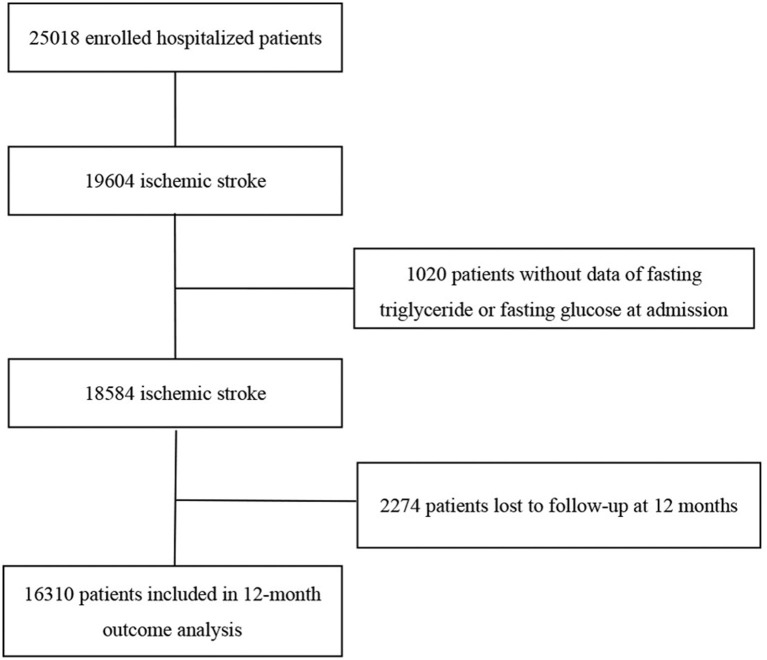
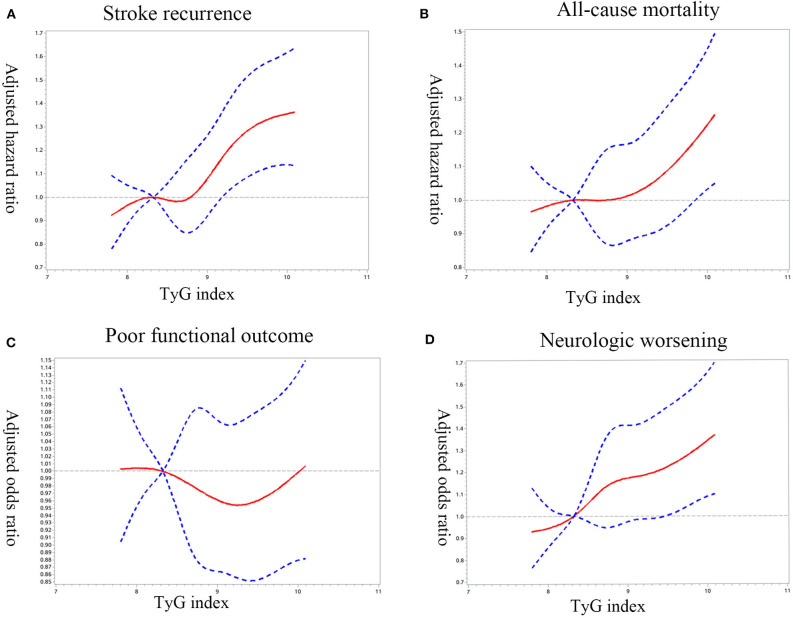
Background: The triglyceride glucose index (TyG index) has been proposed as a simple and credible surrogate marker of insulin resistance. However, it is unclear whether TyG index correlates with adverse clinical outcomes in patients with ischemic stroke. Accordingly, this study aimed to explore the relationship between baseline TyG index and clinical outcomes of ischemic stroke individuals. Methods: We included eligible subjects with ischemic stroke from the China National Stroke Registry II for the current analysis. TyG index was calculated and divided into quartiles to explore the relationship with the outcomes of ischemic stroke. Outcomes included stroke recurrence, all-cause mortality, poor functional outcome at 12 months, and neurologic worsening at discharge. Multivariable Cox regression and logistic regression models were performed to explore the correlation of baseline TyG index with the outcomes. Results: Among the 16,310 patients enrolled in the study, the average age was 64.83 ± 11.9 years, and 63.48% were men. The median TyG index was 8.73 (interquartile range, 8.33-9.21). After adjustment for multiple potential covariates, the fourth quartile of TyG index was associated with an increased risk of stroke recurrence (adjusted HR, 1.32; 95% CI, 1.11-1.57; P = 0.002), all-cause mortality (adjusted HR, 1.25; 95%CI, 1.06-1.47; P = 0.01) at 12-month follow-up, and neurological worsening (adjusted OR, 1.26; 95% CI, 1.02-1.55; P = 0.03) at discharge, but not poor functional outcome compared with the first quartile. Conclusion: TyG index representing insulin resistance was associated with an increased risk of stroke recurrence, all-cause mortality, and neurologic worsening in patients with ischemic stroke.
Keywords: insulin resistance; ischemic stroke; prognosis; stroke recurrence; triglyceride glucose index.
Copyright © 2020 Zhou, Pan, Yan, Wang, Li, Zhao, Li, Meng, Wang, Liu and Wang.
Figures
References
-
- Gast KB, Smit JWA, Heijer M den, Middeldorp S, Rippe RCA, le Cessie S, et al. . Abdominal adiposity largely explains associations between insulin resistance, hyperglycemia and subclinical atherosclerosis: The NEO study. Atherosclerosis. (2013) 229:423–9. 10.1016/j.atherosclerosis.2013.05.021 - DOI - PubMed
LinkOut - more resources
Full Text Sources
