Quality of life after hip fracture: a 12-month prospective study
- PMID: 32587793
- PMCID: PMC7304420
- DOI: 10.7717/peerj.9215
Quality of life after hip fracture: a 12-month prospective study
Abstract
Background: Hip fracture is an important and frequent health problem worldwide. To date, there are still limited studies focused on the analysis of health-related quality of life (HRQOL) after a hip fracture in the Spanish population, especially with long-term follow-up.
Objective: To determine the HRQOL at 12 months after hip fracture and to identify potential factors associated with HRQOL.
Design: Prospective observational study.
Setting: Traumatology units of two university hospitals in province Cáceres (Spain).
Participants: A total of 224 patients were admitted to the unit and required immediate surgery due to a hip fracture.
Methods: HRQOL was measured with the EuroQol-5D questionnaire (EQ-5D) and the SF-12 Health Survey.
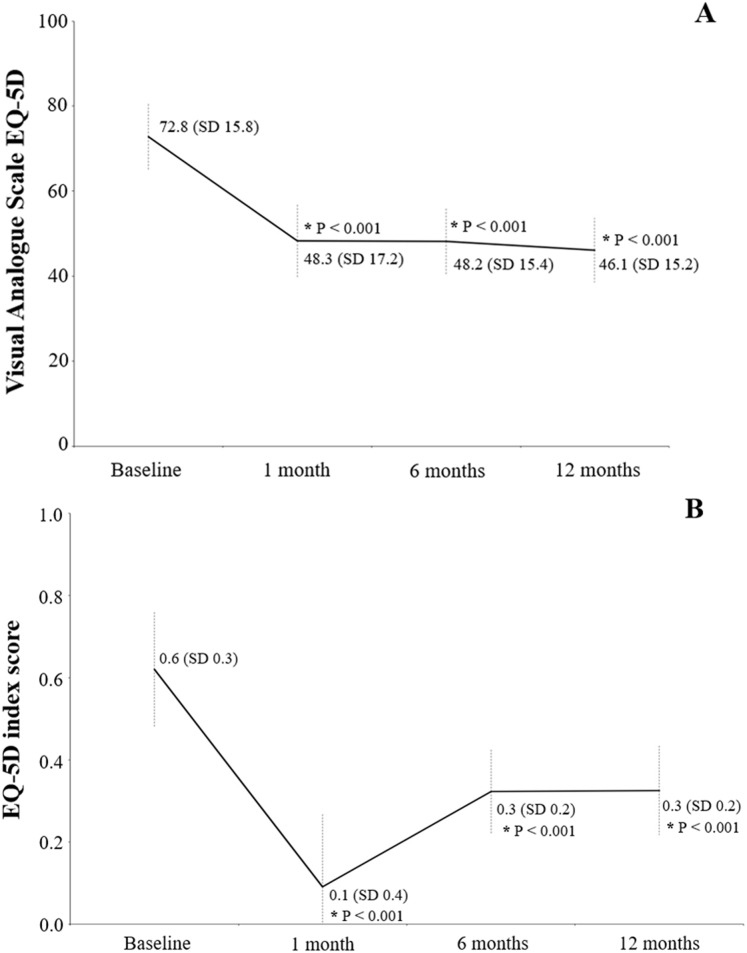
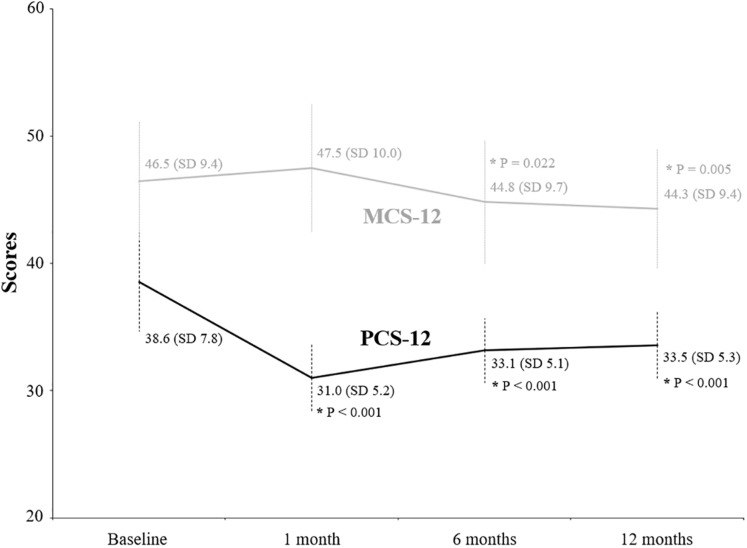
Results: Scores from the visual analog scale EQ-5D decreased significantly (p < 0.001) from 72.8 at baseline to 48.3 after 1 month, to 48.2 after 6 months and to 46.1 after 12 months. The EQ-5D index score showed a similar significant reduction (p < 0.001) from 0.6 to 0.1, 0.3 and 0.3, respectively. Values of the physical component summary (PCS-12) significantly decreased (p < 0.001) from 38.6 at baseline to 31.0, 33.1 and 33.5. The mental component summary (MCS-12) decreased from 46.5 to 44.8 after 6 months (p = 0.022) and 44.3 after 12 months (p = 0.005). Factors potentially associated with HRQOL at 12 months after hip fracture were depression status after 12 months (B = 0-1.876; 95% CI [-2.409 to -1.343]; p < 0.001), functional ambulation classification after 12 months (B = -12.133; 95% CI [-17.970 to -6.297]; p < 0.001), EQ-5D VAS at baseline (B = 0.223; 95% CI [0.115-0.330]; p < 0.001), and age (B = -0.323; 95% CI [-0.594 to -0.053; p = 0.015).
Conclusions: Patients experience a significant impairment in HRQOL H after a hip fracture, especially in self-care, pain/discomfort, usual activities, mobility and anxiety/depression. The decline in the HRQOL is effective the first month and lasts at least 12 months after the surgical intervention.
Keywords: Geriatric care; Health-related quality of life; Hip fracture.
© 2020 Amarilla-Donoso et al.
Conflict of interest statement
José María Morán-García is an Academic Editor for PeerJ.
Figures
References
-
- Abimanyi-Ochom J, Watts JJ, Borgström F, Nicholson GC, Shore-Lorenti C, Stuart AL, Zhang Y, Luliano S, Seeman E, Prince R, March L, Cross M, Winzenberg T, Laslett LL, Duque G, Ebeling PR, Sanders KM. Changes in quality of life associated with fragility fractures: Australian arm of the international cost and utility related to osteoporotic fractures study (AusICUROS) Osteoporosis International. 2015;26(6):1781–1790. - PMC - PubMed
-
- Badia X, Roset M, Montserrat S, Herdman M, Segura A. La versión española del EuroQol: descripción y aplicaciones. Medicina Clinica. 1999;112(Suppl. 1):79–86. - PubMed
LinkOut - more resources
Full Text Sources