


Inhalational volatile-based sedation for COVID-19 pneumonia and ARDS
- PMID: 32588067
- PMCID: PMC7315695
- DOI: 10.1007/s00134-020-06154-8
Inhalational volatile-based sedation for COVID-19 pneumonia and ARDS
Abstract
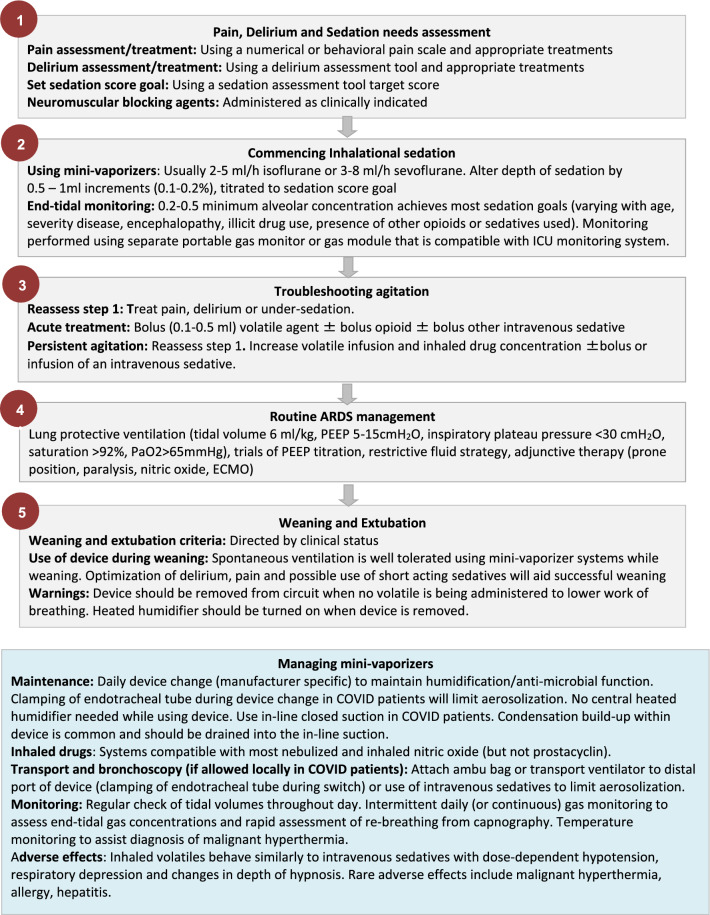
Hospitals worldwide are experiencing a shortage in essential intravenous sedative medications. This is attributable to high number and high sedative needs of COVID-19 critical care patients with disruption of drug supply chains. Inhaled volatile anesthetic agents are an abundant resource and readily implementable solution for providing ICU sedation. Inhaled volatile agents may also provide important pulmonary benefits for COVID-19 patients with ARDS that could improve gas exchange and reduce time spent on a ventilator. We review the use of volatile agents, and provide a technical overview and algorithm for administering inhaled volatile-based sedation in ICUs.
Keywords: ARDS; COVID-19; Sedation; Ventilation; Volatile anesthetics.
Conflict of interest statement
AJ and NDF have consulted for Sedana Medical, Sweden. NDF has received fees from Getinge and Xenios. AJ and BC have received funds from the Innovation Fund of the Alternative Funding Plan for the Academic Health Sciences Centres of Ontario.
Figures
References
-
- FDA Drug shortages (2020) Book FDA Drug shortages. https://www.accessdata.fda.gov/scripts/drugshortages/default.cfm. Accessed 14 Apr 2020.
-
- Government of Canada (2020) Exceptional importation and sale of drugs in relation to COVID-19: tier 3 drug shortages. https://www.canada.ca/en/health-canada/services/drugs-health-products/co.... Accessed 13 Apr 2020.
-
- Jabaudon M, Boucher P, Imhoff E, Chabanne R, Faure JS, Roszyk L, Thibault S, Blondonnet R, Clairefond G, Guerin R, Perbet S, Cayot S, Godet T, Pereira B, Sapin V, Bazin JE, Futier E, Constantin JM. Sevoflurane for sedation in acute respiratory distress syndrome. A randomized controlled pilot study. Am J Respir Crit Care Med. 2017;195:792–800. doi: 10.1164/rccm.201604-0686OC. - DOI - PubMed
-
- De Conno E, Steurer MP, Wittlinger M, Zalunardo MP, Weder W, Schneiter D, Schimmer RC, Klaghofer R, Neff TA, Schmid ER, Spahn DR, Z'Graggen BR, Urner M, Beck-Schimmer B. Anesthetic-induced improvement of the inflammatory response to one-lung ventilation. Anesthesiology. 2009;110:1316–1326. doi: 10.1097/ALN.0b013e3181a10731. - DOI - PubMed
-
- Ferrando C, Aguilar G, Piqueras L, Soro M, Moreno J, Belda FJ. Sevoflurane, but not propofol, reduces the lung inflammatory response and improves oxygenation in an acute respiratory distress syndrome model: a randomised laboratory study. Eur J Anaesthesiol. 2013;30:455–463. doi: 10.1097/EJA.0b013e32835f0aa5. - DOI - PubMed
Publication types
MeSH terms
Substances
LinkOut - more resources
Full Text Sources
Medical
