. 2020 Sep:286:198074.
doi: 10.1016/j.virusres.2020.198074. Epub 2020 Jun 23.

The ORF6, ORF8 and nucleocapsid proteins of SARS-CoV-2 inhibit type I interferon signaling pathway

Affiliations

The ORF6, ORF8 and nucleocapsid proteins of SARS-CoV-2 inhibit type I interferon signaling pathway

Jin-Yan Li et al. Virus Res. 2020 Sep.

Abstract

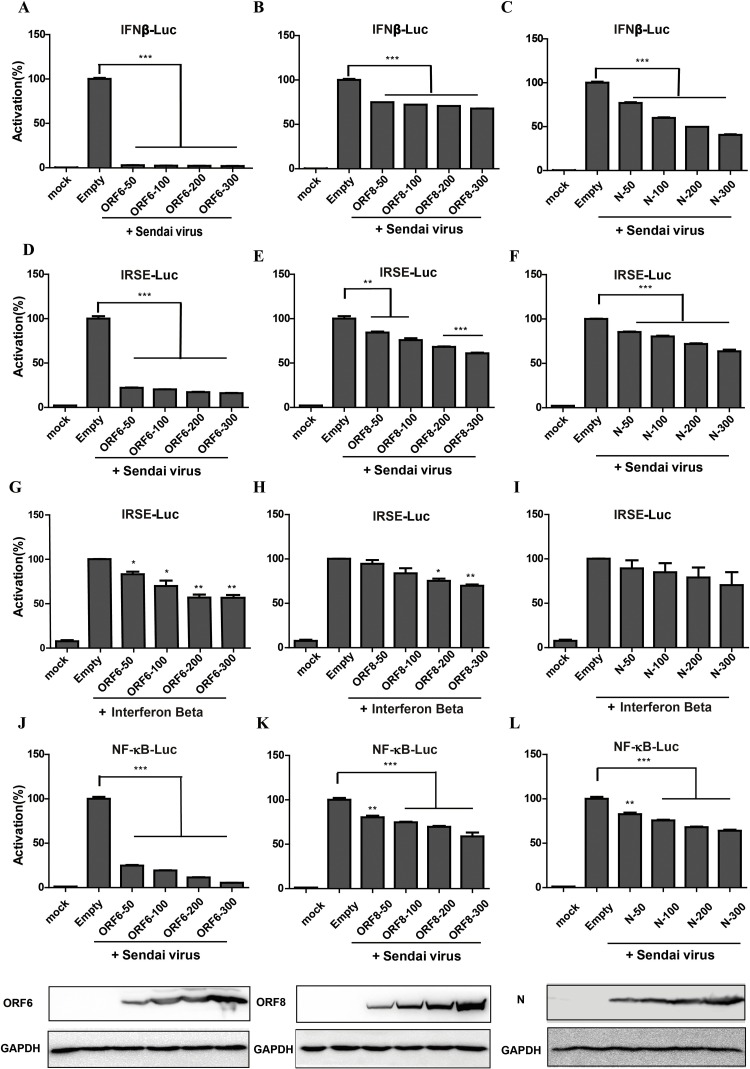
The severe acute respiratory syndrome coronavirus 2 (SARS-CoV-2) is a novel human coronavirus causing the pandemic of severe pneumonia (Coronavirus Disease 2019, COVID-19). SARS-CoV-2 is highly pathogenic in human, having posed immeasurable public health challenges to the world. Innate immune response is critical for the host defense against viral infection and the dysregulation of the host innate immune responses probably aggravates SARS-CoV-2 infection, contributing to the high morbidity and lethality of COVID-19. It has been reported that some coronavirus proteins play an important role in modulating innate immunity of the host, but few studies have been conducted on SARS-CoV-2. In this study, we screened the viral proteins of SARS-CoV-2 and found that the viral ORF6, ORF8 and nucleocapsid proteins were potential inhibitors of type I interferon signaling pathway, a key component for antiviral response of host innate immune. All the three proteins showed strong inhibition on type I interferon (IFN-β) and NF-κB-responsive promoter, further examination revealed that these proteins were able to inhibit the interferon-stimulated response element (ISRE) after infection with Sendai virus, while only ORF6 and ORF8 proteins were able to inhibit the ISRE after treatment with interferon beta. These findings would be helpful for the further study of the detailed signaling pathway and unveil the key molecular player that may be targeted.

Keywords: Accessory proteins; COVID-19; Interferon; SARS-CoV-2; Structural proteins.


Conflict of interest statement

The authors declare that they have no conflict of interest.

Figures
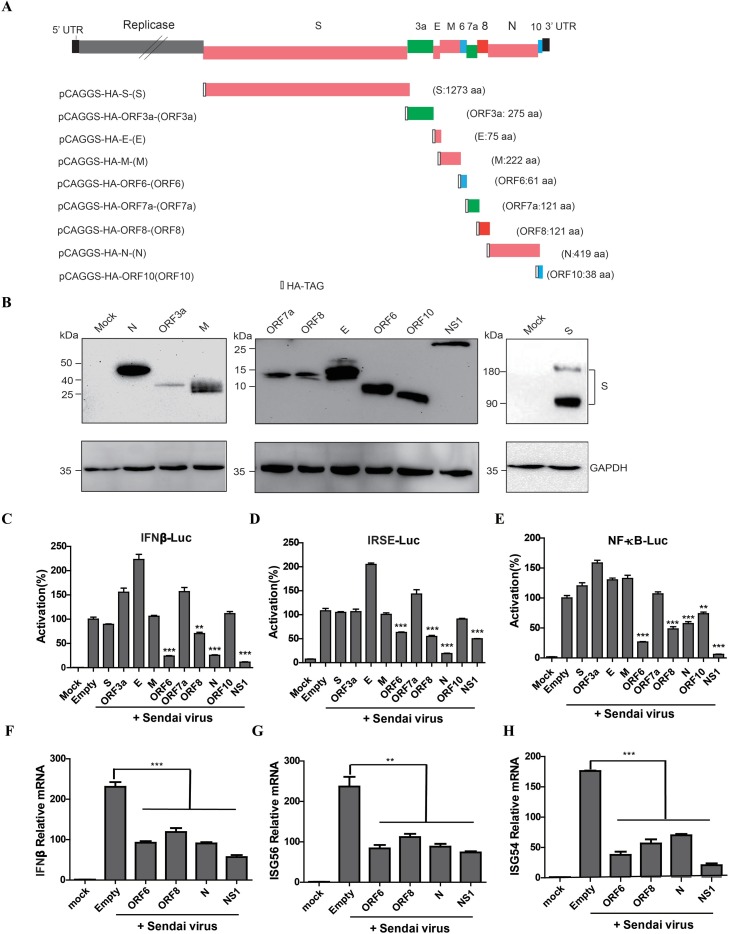
Fig. 1
Fig. 1
SARS-CoV-2 ORF6, ORF8, and N proteins inhibit the expression of IFN-β and the activation of ISGs. (A) Schematic diagram of the genome organization of SARS-CoV-2 and expression constructs used in this study. The synthesized coding genes of individual structural and accessory proteins were inserted into the expression vector pCAGGS with an HA-tag at the N-terminus of each protein. (B) Expression verification of the individual structural and accessory proteins of SARS-CoV-2 in HEK-293 T cells. Samples were collected from cells transiently transfected with individual ORF expression plasmids or pCAGGS (indicated as Mock) at 48 h post transfection. Proteins were separated by SDS-PAGE and the SARS-CoV-2 proteins were detected by Western blotting using mouse anti-HA and anti-GAPDH monoclonal antibodies. (C, D, E) HEK-293 T cells were co-transfected with IFN-β-Luc (C), ISRE-Luc (D) or NF-κB-Luc (E) together with the pRL-TK plasmid, and then transfected with the plasmid expressing the indicated SARS-CoV-2 protein. 24 h after the initial transfection, the cells were infected with Sendai virus. Luciferase assays were performed 18 h after infection. The results were presented as the means and standard deviations of data from three independent experiments. The relative firefly luciferase activity was normalized to the Renilla reniformis luciferase activity, and the treated empty vector control value was set to 100. (F, G, H) HEK-293 T cells were transfected with empty vector- or expressing plasmids for 24 h and then mock infected or infected with SeV for 18 h. mRNA expression levels of IFN-β (F), ISG56 (G), and ISG54 (H) in the collected cells were detected by qPCR. *, P < 0.05; **, P < 0.01; *** P < 0.001 versus empty (Student’s t-test).
Fig. 2
Fig. 2
Dose-dependent inhibition the activation of IFN-β promoter, ISRE and NF-κB promoter by SARS-CoV-2 ORF6, ORF8, and N proteins. HEK-293 T cells were co-transfected with IFN-β-Luc, ISRE-Luc or NF-κB together with the pRL-TK plasmid (a plasmid constitutively expressing Renilla luciferase), and then were transfected with the plasmid pCAGGS-HA-ORF6 (A, D, G, J) or pCAGGS-HA-ORF8 (B, E, H, K) or pCAGGS-HA-N (C, F, I, L) of 0, 0.05, 0.1, 0.2 and 0.3 μg. The IFN-β promoter activity was measured upon SeV infection (A-C). The ISRE promoter activity was measured upon SeV infection (D-F) or the recombinant IFN-β protein treatment (G-I). The NF-κB promoter activity was measured upon SeV infection and equal amounts of lysates were also used for Western blotting analysis to ensure equal expression for each transfection (J-L).

References

    1. Catanzaro M., Fagiani F., Racchi M., Corsini E., Govoni S., Lanni C. Immune response in COVID-19: addressing a pharmacological challenge by targeting pathways triggered by SARS-CoV-2. Signal Transduct. Target. Ther. 2020;5(1):84. - PMC - PubMed
    1. Deng X., van Geelen A., Buckley A.C., O’Brien A., Pillatzki A., Lager K.M., Faaberg K.S., Baker S.C. Coronavirus endoribonuclease activity in porcine epidemic diarrhea virus suppresses type I and type III interferon responses. J. Virol. 2019;93(8) - PMC - PubMed
    1. Du Y., Xin L., Shi Y., Zhang T.H., Wu N.C., Dai L., Gong D., Brar G., Shu S., Luo J., Reiley W., Tseng Y.W., Bai H., Wu T.T., Wang J., Shu Y., Sun R. Genome-wide identification of interferon-sensitive mutations enables influenza vaccine design. Science. 2018;359(6373):290–296. - PubMed
    1. García-Sastre A., Biron C.A. Type 1 interferons and the virus-host relationship: a lesson in détente. Science. 2006;312(5775):879–882. - PubMed
    1. Gong Y.N., Tsao K.C., Hsiao M.J., Huang C.G., Huang P.N., Huang P.W., Lee K.M., Liu Y.C., Yang S.L., Kuo R.L., Chen K.F., Liu Y.C., Huang S.Y., Huang H.I., Liu M.T., Yang J.R., Chiu C.H., Yang C.T., Chen G.W., Shih S.R. SARS-CoV-2 genomic surveillance in Taiwan revealed novel ORF8-deletion mutant and clade possibly associated with infections in Middle East. Emerg. Microbes & Infec. 2020:1–37. - PMC - PubMed

Publication types

MeSH terms

LinkOut - more resources