


Intersectional social control: The roles of incarceration and police discrimination in psychological and HIV-related outcomes for Black sexual minority men
- PMID: 32590189
- PMCID: PMC7506501
- DOI: 10.1016/j.socscimed.2020.113121
Intersectional social control: The roles of incarceration and police discrimination in psychological and HIV-related outcomes for Black sexual minority men
Abstract
Rationale: Although Black gay, bisexual, and other sexual minority men face disproportionately high levels of incarceration and police discrimination, little research examines how these stressors may drive HIV and psychological health inequities among these men.
Objective: In this study we examined associations between incarceration history, police and law enforcement discrimination, and recent arrest with sexual HIV risk, Pre-Exposure Prophylaxis (PrEP) willingness, and psychological distress among Black sexual minority men.
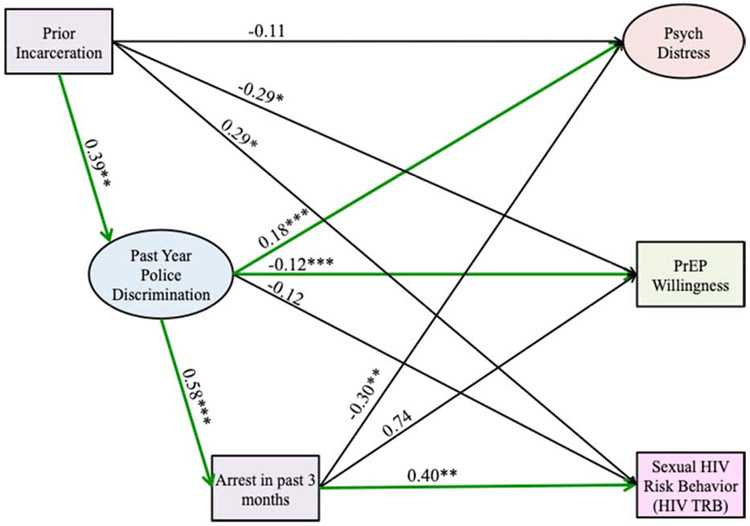
Method: Participants were a U.S. national sample of 1172 Black sexual minority men who responded in 2017-2018 to self-report measures of incarceration history, past year police and law enforcement discrimination, recent arrests, sexual HIV risk, PrEP willingness, and psychological distress. We used structural equation modeling to examine direct and indirect pathways from incarceration, police and law enforcement discrimination, and arrests to sexual HIV risk, PrEP willingness, and psychological distress.
Results: Past-year police and law enforcement discrimination prevalence was 43%. Incarceration history was positively associated with later police and law enforcement discrimination, which, in turn, was positively associated with recent arrest. Incarceration and recent arrest and were associated with greater sexual HIV risk; incarceration and police and law enforcement discrimination were associated with lower PrEP willingness; and police and law enforcement discrimination was associated with higher psychological distress. Mediation analyses showed that the effects of incarceration were partially mediated by police and law enforcement discrimination.
Conclusion: Findings suggest police discrimination may be a mechanism of mass incarceration and fundamental driver of health inequities among Black sexual minority men.
Keywords: Black sexual minority men; HIV risk; Incarceration; MSM; Minority stress; Police discrimination; PrEP willingness; Psychological distress.
Copyright © 2020 Elsevier Ltd. All rights reserved.
Figures
References
-
- Adler N, & Stewart J (2007). The MacArthur scale of subjective social status.
-
- American Psychological Association Working Group on Health Disparities in Boys and Men. (2018). Health disparities in racial/ethnic and sexual minority boys and men. Retrieved from https://www.apa.org/pi/health-disparities/resources/race-sexuality-men-r..., on September 28, 2019.
-
- American Public Health Association (Policy number: 201811), 2018. Addressing law enforcement violence as a public health issue.
Publication types
MeSH terms
Grants and funding
LinkOut - more resources
Full Text Sources
Medical
Miscellaneous
