. 2020 Sep;184(1):130-147.
doi: 10.1104/pp.20.00593. Epub 2020 Jun 26.

Terpene Synthases and Terpene Variation in Cannabis sativa

Affiliations

Terpene Synthases and Terpene Variation in Cannabis sativa

Judith K Booth et al. Plant Physiol. 2020 Sep.

Abstract

Cannabis (Cannabis sativa) resin is the foundation of a multibillion dollar medicinal and recreational plant bioproducts industry. Major components of the cannabis resin are the cannabinoids and terpenes. Variations of cannabis terpene profiles contribute much to the different flavor and fragrance phenotypes that affect consumer preferences. A major problem in the cannabis industry is the lack of proper metabolic characterization of many of the existing cultivars, combined with sometimes incorrect cultivar labeling. We characterized foliar terpene profiles of plants grown from 32 seed sources and found large variation both within and between sets of plants labeled as the same cultivar. We selected five plants representing different cultivars with contrasting terpene profiles for clonal propagation, floral metabolite profiling, and trichome-specific transcriptome sequencing. Sequence analysis of these five cultivars and the reference genome of cv Purple Kush revealed a total of 33 different cannabis terpene synthase (CsTPS) genes, as well as variations of the CsTPS gene family and differential expression of terpenoid and cannabinoid pathway genes between cultivars. Our annotation of the cv Purple Kush reference genome identified 19 complete CsTPS gene models, and tandem arrays of isoprenoid and cannabinoid biosynthetic genes. An updated phylogeny of the CsTPS gene family showed three cannabis-specific clades, including a clade of sesquiterpene synthases within the TPS-b subfamily that typically contains mostly monoterpene synthases. The CsTPSs described and functionally characterized here include 13 that had not been previously characterized and that collectively explain a diverse range of cannabis terpenes.


Figures

Figure 1.
Figure 1.
Terpene and cannabinoid biosynthetic pathways. Precursors and intermediates are shown in black, final product classes in green, and enzyme names in purple. Cannabinoid pathway: FAD, Fatty acid desaturase; LOX, lipoxygenase; HPL, hydroperoxide lyase; AAE, acyl activating enzyme. MEP pathway: CMK, 4-Diphosphocytidyl-2-C-methyl-d-erythritol kinase; MDS, 2-C-methyl-d-erythritol 2,4-cyclodiphosphate synthase; MEV pathway: HMGS, 3-HMG-CoA synthase; HMGR, HMG-CoA reductase; MK, MEV kinase; PMK, MEV-3-phosphate kinase; MPDC, MEV-5-pyrophosphate decarboxylase; IDI, isopentenyl diphosphate isomerase; FPPS, farnesyl diphosphate synthase.
Figure 2.
Figure 2.
Stages of floral maturation. Drawing showing four stages of floral maturation within the inflorescence. Representative photographs are of a cv PK inflorescence at four different stages, from youngest (1) to oldest (4). Different stages are characterized as follows: (1) very pale pistils and few to no stalked trichomes; (2) no browned pistils and ∼50% stalked trichomes; (3) pistils beginning to brown, with entirely stalked trichomes; (4) entirely browned pistils, with brown or amber trichome heads. For this study, metabolite analyses were performed at stages 1 and 3.
Figure 3.
Figure 3.
Genome locations of genes related to terpenoid and cannabinoid biosynthesis. Scaffolds are from Laverty et al. (2019). TPSs are shown in pink, UbiA family prenyltransferases in blue, MEP pathway genes in green, and cannabinoid biosynthetic genes in black. Loci with identical labels represent duplicated genes.
Figure 4.
Figure 4.
Foliar terpene profiles differentiate cannabis plants grown from seeds. A, First two dimensions (Dim) of a PCA of foliar terpene profiles from 32 cannabis plants. Dim1 accounts for 26.35% of the variance between individuals and Dim2 accounts for 19.73%. Colors indicate the names under which seeds were obtained. Boxed points are individuals that were chosen for clonal propagation and further characterization. B, Unsupervised hierarchical cluster analysis of 46 terpenoid peaks (x axis) in 32 cannabis seedlings. Ward’s minimum variance was used as the clustering method. Seven clusters, indicated by the colored boxes, were determined by inertia gain.
Figure 5.
Figure 5.
Terpene content in leaves and flowers of five different cannabis cultivars. Fan leaves were taken from flowering plants at ∼14 DPI. Juvenile flowers of stage 1 (Fig. 2) were sampled in triplicate, at the same time as the leaves, from three clones of each cultivar. Mature flowers of stage 3 (Fig. 2) were sampled in triplicate from three clones of each cultivar between 51 and 60 DPI. Error bars represent the mean ± se across nine samples.
Figure 6.
Figure 6.
Gene expression in floral trichomes of five cannabis cultivars. A, Whole-transcriptome PCA of the first two dimensions (Dim). B, Heatmap and expression of contigs representing genes annotated as terpene or cannabinoid biosynthesis. Colors indicate row-wise Z-score, or standard deviations from the mean. Gray bars at right show the average log2 CPM across 24 samples for eight individuals with three technical replicates. For the bar diagram, cv Choc 3 was treated as an outlier and not included in the log-mean expression results. C, Volcano plots showing differentially expressed contigs for four cultivars compared to cv BC. The P-values were determined using a modified Student’s t test with the R package “limma” (Ritchie et al., 2015). Significance categories were not significant (NS; gray), significant at a log2 fold change of 2 (Log2 FC; green); significant at an adjusted P-value of 0.05 (P; blue); and significant by both fold change and adjusted P-value (P & Log2 FC; red). Contigs labeled with names are those shown with yellow diamonds, representing transcripts that may be associated with resin biosynthesis. Green numbers indicate the number of transcript contigs in each cultivar with abundance significantly higher compared to cv BC, and red numbers the number of transcript contigs significantly lower compared to cv BC. AAE1, Acyl activating enzyme; PKS, polyketide synthase; OAC, olivetolic acid cyclase; 1-deoxy-d-xylulose-5-phosphate reductase: MCT, 2-C-methyl-d-erythritol 4-phosphate cytidylyltransferase; HDS, HMB-PP synthase; HDR, HMB-PP reductase; GPPS lsu, GPPS large subunit; GPPS ssu: GPPS small subunit; HMGS, 3-HMG-CoA synthase; HMGR, HMG-CoA reductase; MK, MEV kinase; PMK, MEV-3-phosphate kinase; FPPS, farnesyl diphosphate synthase.
Figure 7.
Figure 7.
Maximum-likelihood phylogeny of CsTPS relative to other plant TPSs. CsTPSs are in bold. The size of purple dots represents the size of bootstrap values from 100 bootstrap replicates. TPS subfamilies are color coded as follows: TPS-a (purple), TPS-b (orange), TPS-d (brown), TPS-c (black), TPS-e/f (red), and TPS-g (green). Colored lines outside the tree show the location of CsTPSs within the corresponding subfamilies. The tree scale, 0.5, represents 50% sequence difference.
Figure 8.
Figure 8.
Transcript abundance of CsTPS genes in floral trichomes of five different Cannabis cultivars. Values are log2 fold change compared to average CPM for each cultivar. Colored “X” symbols indicate individual data points and black box plots show quartiles and outliers.
Figure 9.
Figure 9.
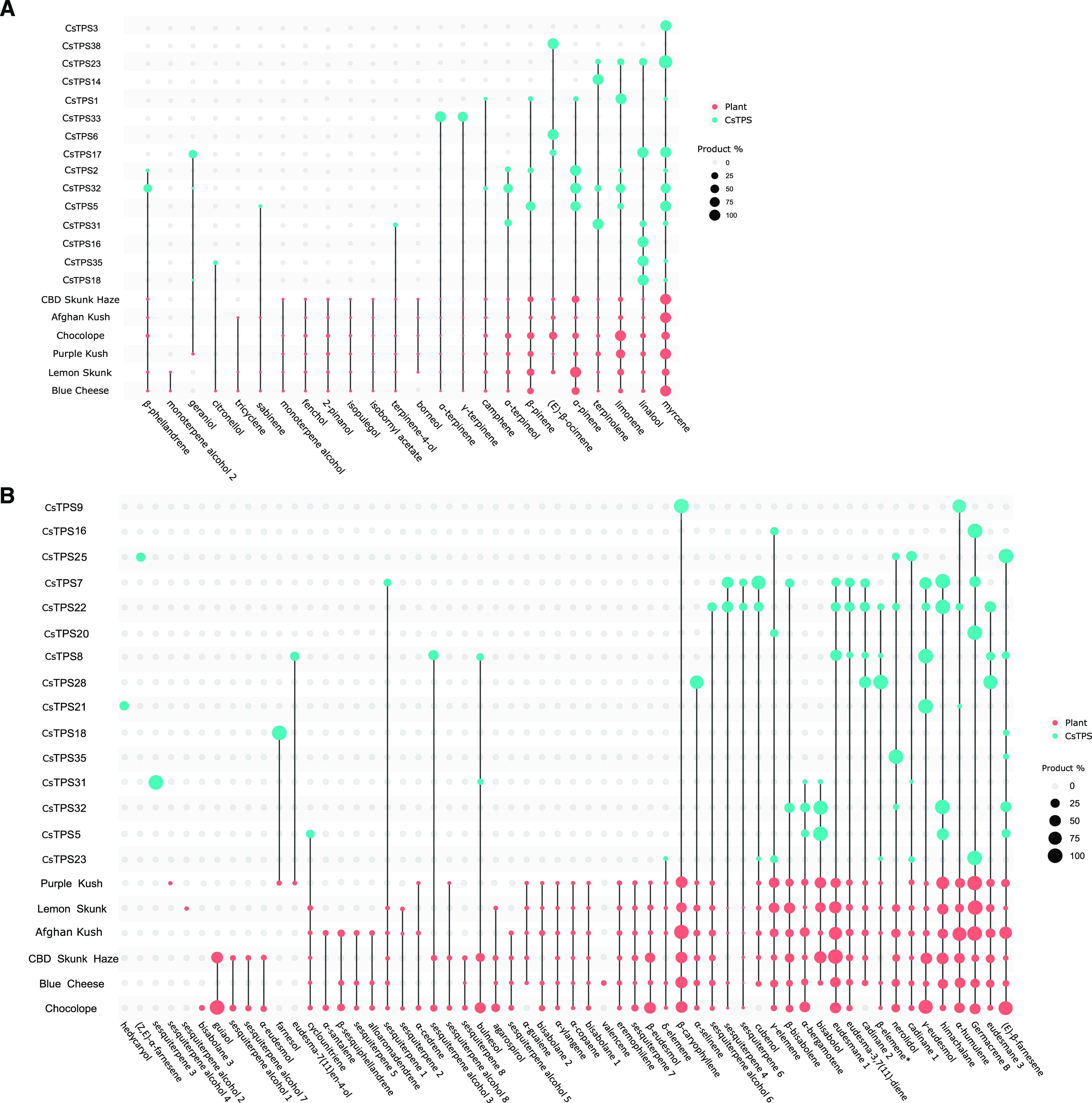
Products of functionally characterized CsTPSs and their representation in cannabis floral trichome terpene profiles of different cultivars. A, Monoterpenes. B, Sesquiterpenes. CsTPS gene identification and cultivar names are shown on the y axis and compounds on the x axis. Dot size corresponds to the percentage of each compound compared to the most abundant product of a given CsTPS (blue dots) or floral metabolite (pink dots). β-elemene is marked with an asterisk because it may be a degradation product of germacrene A.
Figure 10.
Figure 10.
Proposed routes of sesquiterpene formation by CsTPS and correlation with CsTPS sequence relatedness. A, Schematic of carbocation intermediates and sesquiterpene classes (according to Degenhardt et al. [2009]) for sesquiterpenes identified in Cannabis floral trichomes. B, Intermediates and major and minor products of CsTPSs described in this article. Intermediates include all major proposed cationic intermediates, and “major product” is the class of the most abundant sesquiterpene product of each enzyme. 1, (E,E)-farnesyl diphosphate; 2, (E,E)-farnesyl cation; 3, farnesane skeleton; 4, nerolidyl cation; 5, bisabolyl cation; 6, (E,E)-germacranedienyl cation; 7, (E,E)-humulyl cation; 8, (Z,E)-germacranedienyl cation; 9, (Z,E)-humulyl cation; 10, bisabolane skeleton; 11, elemane skeleton; 12: eudesmane skeleton; 13, humulane skeleton; 14, cadinane skeleton; 15, germacrane skeleton; 16, guaiane skeleton; 17, aromadendrane skeleton; 18, himachalane skeleton.

Comment in

References

    1. Allen KD, McKernan K, Pauli C, Roe J, Torres A, Gaudino R(2019) Genomic characterization of the complete terpene synthase gene family from Cannabis sativa. PLoS One 14: e0222363. - PMC - PubMed
    1. van Bakel H, Stout JM, Cote AG, Tallon CM, Sharpe AG, Hughes TR, Page JE(2011) The draft genome and transcriptome of Cannabis sativa. Genome Biol 12: R102. - PMC - PubMed
    1. Booth JK, Bohlmann J(2019) Terpenes in Cannabis sativa—From plant genome to humans. Plant Sci 284: 67–72 - PubMed
    1. Booth JK, Page JE, Bohlmann J(2017) Terpene synthases from Cannabis sativa. PLoS One 12: e0173911. - PMC - PubMed
    1. Braich S, Baillie RC, Jewell LS, Spangenberg GC, Cogan NOI(2019) Generation of a comprehensive transcriptome atlas and transcriptome dynamics in medicinal cannabis. Sci Rep 9: 16583. - PMC - PubMed

Publication types

MeSH terms

LinkOut - more resources