. 2021 Jan;56(1):110-120.
doi: 10.1038/s41409-020-0986-2. Epub 2020 Jun 26.

Comparison of reduced-toxicity conditioning protocols using fludarabine, melphalan combined with thiotepa or carmustine in allogeneic hematopoietic cell transplantation

Affiliations

Comparison of reduced-toxicity conditioning protocols using fludarabine, melphalan combined with thiotepa or carmustine in allogeneic hematopoietic cell transplantation

Jesús Duque-Afonso et al. Bone Marrow Transplant. 2021 Jan.

Abstract

The age of patients undergoing allogeneic hematopoietic cell transplantation (allo-HCT) has increased during the last decades, mainly due to improved reduced-intensity/toxicity conditioning protocols. A reduced-intensity conditioning based on fludarabin, carmustin/BCNU and melphalan (FBM) has been previously developed at our institution. Since we observed detrimental effects in individual patients with compromised lung function, efforts have been made in order to replace BCNU by thiotepa (FTM) to reduce toxicity. In this study, we retrospectively analyzed the outcome, GvHD incidence, lung function and organ toxicity of patients with a median age of 62 years (range 21-79) transplanted for malignant disease (96.7%, 62.3% in intermediate/advanced disease stage) at our institution after conditioning with FBM (n = 136) or FTM (n = 105) between 2013 and 2017. Median follow-up was 868 days (range 0-2615). In multivariate analysis for overall survival, no difference was detected between both conditioning protocols in the presence of impaired lung function, age, lower performance, and liver disease previous allo-HCT. In the subgroup analysis, FTM was not inferior to FBM in patients with pulmonary disease prior allo-HCT, lymphoid malignancies, and higher comorbidity index. In conclusion, the reduced-intensity FBM and FTM conditioning protocols show adequate antineoplastic efficacy and are suitable for patients with impaired lung function.


Conflict of interest statement

The authors declare no conflicting financial interest with the submission of this article. JF received research support and speakers honoraria from Medac, Neovii and Riemser. JD-A received speakers honoraria from Roche and travel support from Gilead and Sobi. RZ received speakers honoraria from Incyte, Novartis, Roche, and Mallinckroth.

Figures

Fig. 1
Fig. 1. Impact of reduced-intensity/toxicity conditioning on outcome.
Kaplan–Meier curves represent overall survival for (a) unadjusted and (b) adjusted for parameters influencing mortality in multivariate analysis (FEV1 < 70% of predicted, DLCOcSB < 60% of predicted, Karnofsky index < 80%, HCT-CI liver, age < 55 years) by conditioning in all patients included in this study. Statistical analysis was performed for overall survival by log-rank test. Allo-HCT allogeneic hematopoietic cell transplantation, FBM fludarabine, BCNU, melphalan; FTM: fludarabine, thiotepa, melphalan; Pts., patients.
Fig. 2
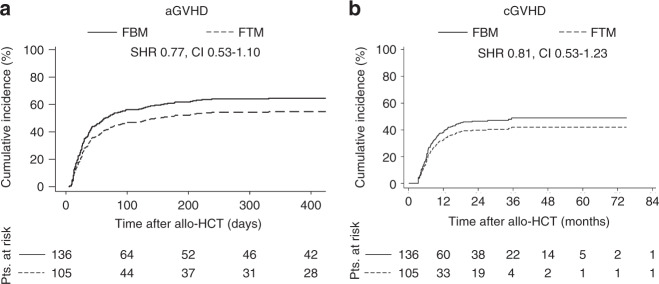
Fig. 2. Incidence of acute and chronic GvHD is not affected by conditioning FTM protocol.
Cumulative incidences of (a) acute GvHD (aGvHD) and (b) chronic GvHD (cGvHD) were calculated for FBM and FTM conditioning protocols. Clinical evidence of aGvHD or cGvHD was computed as event, death was considered as competing risk and time to last contact as censored event. Statistical differences were calculated by Fine and Gray regression model in the presence of competing-risks. SHRs represent the risk of FTM as compared to FBM. Pts. patients. FBM: fludarabine, BCNU/carmustine, melphalan; FTM fludarabine, thiotepa, melphalan.
Fig. 3
Fig. 3. Impact of conditioning protocol on lung function after allo-HCT.
Dot plots represent pulmonary function tests (PFT) values from patients before allo-HCT and at 1 year after allo-HCT. Only patients with lung function available at both time points were included in the analysis. PFT parameters were compared by conditioning protocol from patients with available PFT at both time points (FBM, n = 80/99 alive at d+365, 80.8%; FTM, n = 47/61 alive at d+365, 77.0%). Each dot represent the indicated PFT value from a patient, horizontal bar represents the median. Statistical analysis were performed by Student’s T-test assuming a normal distribution. Allo-HCT allogeneic hematopoietic cell transplantation, FEV1 forced expiratory volume in 1 s, FEV1/maximal vital capacity (), FEV1/forced vital capacity (FVC); MEF50, mid-expiratory flow 50%; RV/TLC, residual volume (RV)/total lung capacity (TLC); TLC, total lung capacity; DLCOcSB, diffusion capacity of carbon monoxide adjusted for hemoglobin level. FBM: fludarabine, BCNU/carmustine, melphalan; FTM: fludarabine, thiotepa, melphalan.

References

    1. Storb R, Sandmaier BM. Nonmyeloablative allogeneic hematopoietic cell transplantation. Haematologica. 2016;101:521–30. doi: 10.3324/haematol.2015.132860. - DOI - PMC - PubMed
    1. Gyurkocza B, Sandmaier BM. Conditioning regimens for hematopoietic cell transplantation: one size does not fit all. Blood. 2014;124:344–53. doi: 10.1182/blood-2014-02-514778. - DOI - PMC - PubMed
    1. Jagannath S, Dicke KA, Armitage JO, Cabanillas FF, Horwitz LJ, Vellekoop L, et al. High-dose cyclophosphamide, carmustine, and etoposide and autologous bone marrow transplantation for relapsed Hodgkin’s disease. Ann Intern Med. 1986;104:163–8. doi: 10.7326/0003-4819-104-2-163. - DOI - PubMed
    1. Armitage JO, Jagannath S, Spitzer G, Bierman P, Kessinger A, Kumar P, et al. High dose therapy and autologous marrow transplantation as salvage treatment for patients with diffuse large cell lymphoma. Eur J Cancer Clin Oncol. 1986;22:871–7. doi: 10.1016/0277-5379(86)90376-7. - DOI - PubMed
    1. Sivaraj D, Bacon W, Long GD, Rizzieri DA, Horwitz ME, Sullivan KM, et al. High-dose BCNU/Melphalan conditioning regimen before autologous stem cell transplantation in newly diagnosed multiple myeloma. Bone Marrow Transpl. 2018;53:34–8. doi: 10.1038/bmt.2017.208. - DOI - PubMed

Publication types