Observational Study
. 2020 Dec;30(12):6770-6778.
doi: 10.1007/s00330-020-07013-2. Epub 2020 Jun 26.

Quantitative chest CT analysis in COVID-19 to predict the need for oxygenation support and intubation

Affiliations
Observational Study

Quantitative chest CT analysis in COVID-19 to predict the need for oxygenation support and intubation

Ezio Lanza et al. Eur Radiol. 2020 Dec.

Abstract

Objective: Lombardy (Italy) was the epicentre of the COVID-19 pandemic in March 2020. The healthcare system suffered from a shortage of ICU beds and oxygenation support devices. In our Institution, most patients received chest CT at admission, only interpreted visually. Given the proven value of quantitative CT analysis (QCT) in the setting of ARDS, we tested QCT as an outcome predictor for COVID-19.

Methods: We performed a single-centre retrospective study on COVID-19 patients hospitalised from January 25, 2020, to April 28, 2020, who received CT at admission prompted by respiratory symptoms such as dyspnea or desaturation. QCT was performed using a semi-automated method (3D Slicer). Lungs were divided by Hounsfield unit intervals. Compromised lung (%CL) volume was the sum of poorly and non-aerated volumes (- 500, 100 HU). We collected patient's clinical data including oxygenation support throughout hospitalisation.

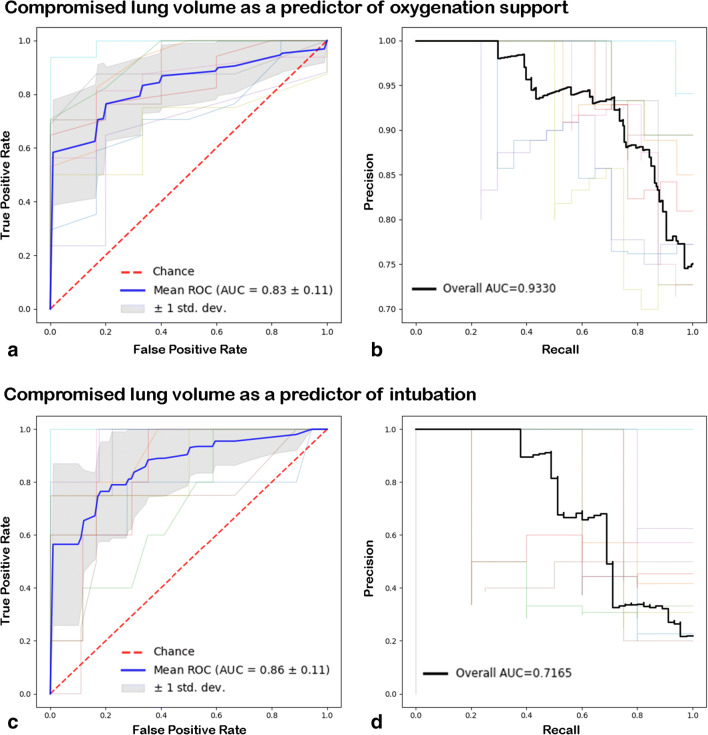
Results: Two hundred twenty-two patients (163 males, median age 66, IQR 54-6) were included; 75% received oxygenation support (20% intubation rate). Compromised lung volume was the most accurate outcome predictor (logistic regression, p < 0.001). %CL values in the 6-23% range increased risk of oxygenation support; values above 23% were at risk for intubation. %CL showed a negative correlation with PaO2/FiO2 ratio (p < 0.001) and was a risk factor for in-hospital mortality (p < 0.001).

Conclusions: QCT provides new metrics of COVID-19. The compromised lung volume is accurate in predicting the need for oxygenation support and intubation and is a significant risk factor for in-hospital death. QCT may serve as a tool for the triaging process of COVID-19.

Key points: • Quantitative computer-aided analysis of chest CT (QCT) provides new metrics of COVID-19. • The compromised lung volume measured in the - 500, 100 HU interval predicts oxygenation support and intubation and is a risk factor for in-hospital death. • Compromised lung values in the 6-23% range prompt oxygenation therapy; values above 23% increase the need for intubation.

Keywords: COVID-19; Intubation; Pulmonary ventilation; Tomography, spiral computed.


Conflict of interest statement

The authors of this manuscript declare no relationships with any companies whose products or services may be related to the subject matter of the article.

Figures

Fig. 1
Fig. 1
Quantitative lung CT analysis of an 81-year-old male patient affected by COVID-19. a Non-contrast chest CT at admission showing bilateral ground-glass opacities, common findings of the novel coronavirus pneumonia. b Semi-automated segmentation using 3D Slicer. Blue areas are normal lung parenchyma; yellow areas represent poorly aerated lung in the − 500, − 100 HU interval. c 3D volumetric representation of both lungs. d Comparison between normal and compromised lung volumes. This patient had 6% of compromised lung volume, required no oxygenation support and was discharged after 15 days of observation and supportive therapy
Fig. 2
Fig. 2
Ten-fold cross-validation for receiver operating characteristic (a) and precision-recall curves (b) showing performance of compromised lung volume as a predictor of oxygenation therapy and of intubation (c and d), based on quantitative analysis of chest CT at hospital admittance
Fig. 3
Fig. 3
Quantitative lung CT analysis of a 35-year-old male patient affected by COVID-19. a Non-contrast chest CT at admission showing bilateral ground-glass opacities, interstitial thickening and consolidation in the posterior lung zones. b Semi-automated segmentation using 3D Slicer. Blue areas are normal lung parenchyma; yellow areas represent poorly aerated lung in the − 500, − 100 HU interval; red areas represent non-aerated lung and interstitium, in the − 100, 100 HU interval. c 3D volumetric representation of both lungs showing multiple red areas in keeping with moderate lung impairment. d Comparison between normal and compromised lung volumes. This patient had 18% of compromised lung volume, required high-flow oxygenation support through a Venturi Mask. He was discharged after 17 days of sub-intensive care
Fig. 4
Fig. 4
Quantitative Lung CT analysis of a 43 years old male patient affected by COVID-19. a) Non-contrast chest CT showing extensive areas of bilateral lung consolidation, multiple ground-glass opacities and interstitial thickening and consolidation b) Semi-automated segmentation using 3D Slicer. Blue areas are normal lung parenchyma; yellow areas represent poorly aerated lung in the − 500, − 100 HU interval; red areas represent non-aerated lung and interstitium, in the − 100, 100 HU interval. c 3D volumetric representation of both lungs showing extensive red areas of consolidation in keeping with severe pneumonia. d Comparison between normal and compromised lung volumes. This patient had 50% of compromised lung volume and required immediate intubation and mechanical ventilation. He died after 13 days of intensive care, due to multi-organ failure

References

    1. Guan W-J, Ni Z-Y, Hu Y et al (2020) Clinical characteristics of coronavirus disease 2019 in China. N Engl J Med. 10.1056/NEJMoa2002032 - PMC - PubMed
    1. Situation update for the EU/EEA and the UK, as of 27 March 2020. https://www.ecdc.europa.eu/en/cases-2019-ncov-eueea. Accessed 28 Mar 2020
    1. McMichael TM, Currie DW, Clark S et al (2020) Epidemiology of Covid-19 in a long-term care facility in King County, Washington. N Engl J Med. 10.1056/NEJMoa2005412 - PMC - PubMed
    1. Zhou F, Yu T, Du R, et al. Clinical course and risk factors for mortality of adult inpatients with COVID-19 in Wuhan, China: a retrospective cohort study. Lancet. 2020;395:1054–1062. doi: 10.1016/S0140-6736(20)30566-3. - DOI - PMC - PubMed
    1. Poston JT, Patel BK, Davis AM (2020) Management of critically ill adults with COVID-19. JAMA. 10.1001/jama.2020.4914 - PubMed

Publication types

MeSH terms