


How to consider target heart rate in patients with systolic heart failure
- PMID: 32592292
- PMCID: PMC7524252
- DOI: 10.1002/ehf2.12814
How to consider target heart rate in patients with systolic heart failure
Erratum in
-
Corrigendum.ESC Heart Fail. 2021 Aug;8(4):3448. doi: 10.1002/ehf2.13456. Epub 2021 Jun 4. ESC Heart Fail. 2021. PMID: 34085416 Free PMC article. No abstract available.
Abstract
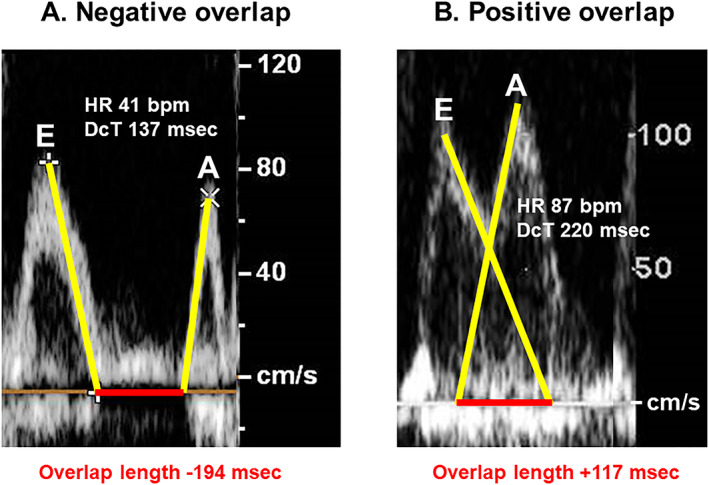
Aims: Heart rate reduction therapy using ivabradine, a selective inhibitor of the funny current of the sinoatrial node, is widely used in the systolic heart failure cohort. However, the optimal target of heart rate remains controversial. The association between heart rate and 'overlap' between E-wave and A-wave in the pulse wave transmitral flow Doppler echocardiography might be a key to find the ideal heart rate in each individual.
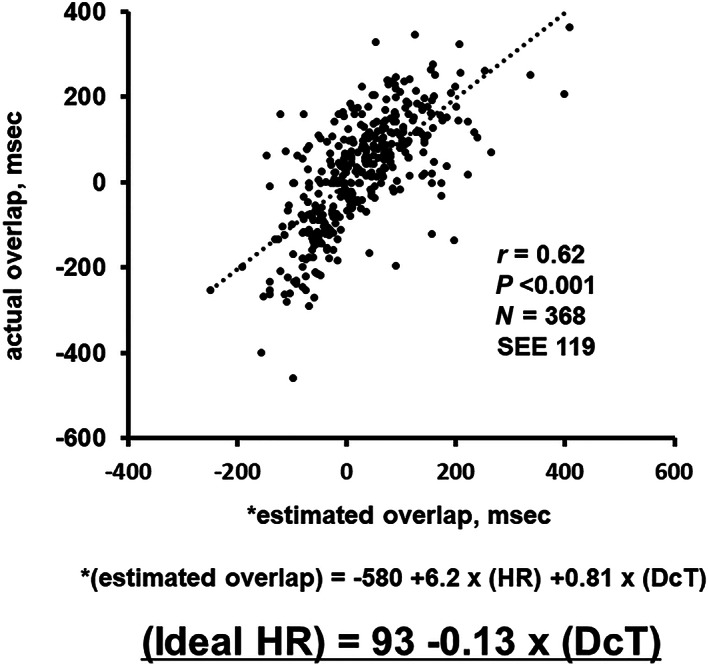
Methods and results: We performed transthoracic echocardiography in patients with systolic heart failure, and the association between heart rate, deceleration time, and overlap length between E-wave and A-wave was assessed. In total, 368 patients with systolic heart failure (median 76 years old, 190 men, median ejection fraction 40%) were included. The measured overlap length was 35 (-72, 115) ms. Given the results of multiple linear regression analyses, we constructed a formula: estimated overlap length (ms) = -589 + 6.2 × heart rate (bpm) + 0.81 × deceleration time (ms), which had a good agreement with actually measured one (r = 0.62). The ideal heart rate, at which the overlap length is 'zero' and probably cardiac output is maximized, is calculated as follows: ideal heart rate (bpm) = 93 - 0.13 × deceleration time (ms).
Conclusions: We proposed a novel formula using deceleration time to estimate ideal heart rate that achieves a zero overlap between E-wave and A-wave in patients with systolic heart failure. Prognostic impact of the formula-guided heart rate optimization should be studied.
Keywords: Deceleration time; Echocardiography; Ivabradine.
© 2020 The Authors. ESC Heart Failure published by John Wiley & Sons Ltd on behalf of the European Society of Cardiology.
Conflict of interest statement
None.
Figures
References
-
- Hori M, Sasayama S, Kitabatake A, Toyo‐oka T, Handa S, Yokoyama M, Matsuzaki M, Takeshita A, Origasa H, Matsui K, Hosoda S, Investigators M. Low‐dose carvedilol improves left ventricular function and reduces cardiovascular hospitalization in Japanese patients with chronic heart failure: the Multicenter Carvedilol Heart Failure Dose Assessment (MUCHA) trial. Am Heart J 2004; 147: 324–330. - PubMed
-
- Kato N, Kinugawa K, Imamura T, Muraoka H, Minatsuki S, Inaba T, Maki H, Shiga T, Hatano M, Yao A, Komuro I, Nagai R. Trend of clinical outcome and surrogate markers during titration of beta‐blocker in heart failure patients with reduced ejection fraction: relevance of achieved heart rate and beta‐blocker dose. Circ J 2013; 77: 1001–1008. - PubMed
-
- Swedberg K, Komajda M, Bohm M, Borer JS, Ford I, Dubost‐Brama A, Lerebours G, Tavazzi L, Investigators S. Ivabradine and outcomes in chronic heart failure (SHIFT): a randomised placebo‐controlled study. Lancet 2010; 376: 875–885. - PubMed
-
- Tsutsui H, Momomura SI, Yamashina A, Shimokawa H, Kihara Y, Saito Y, Hagiwara N, Ito H, Yano M, Yamamoto K, Ako J, Inomata T, Sakata Y, Tanaka T, Kawasaki Y, Investigators JSS. Efficacy and safety of ivabradine in Japanese patients with chronic heart failure—J‐SHIFT study. Circ J 2019; 83: 2049–2060. - PubMed
-
- Bohm M, Swedberg K, Komajda M, Borer JS, Ford I, Dubost‐Brama A, Lerebours G, Tavazzi L, Investigators S. Heart rate as a risk factor in chronic heart failure (SHIFT): the association between heart rate and outcomes in a randomised placebo‐controlled trial. Lancet 2010; 376: 886–894. - PubMed
MeSH terms
LinkOut - more resources
Full Text Sources
