


Characteristics and Impact of HPV-Associated p16 Expression on Head and Neck Squamous Cell Carcinoma in Thai Patients
- PMID: 32592364
- PMCID: PMC7568885
- DOI: 10.31557/APJCP.2020.21.6.1679
Characteristics and Impact of HPV-Associated p16 Expression on Head and Neck Squamous Cell Carcinoma in Thai Patients
Abstract
Background: Head and neck squamous cell carcinoma (HNSCC) is a common malignancy in Asia. Infection by human papilloma virus (HPV) has been recognized as an etiological risk for HNSCC, especially oropharyngeal region. While the association between HPV and HNSCC has been well evaluated in Western countries, only a few investigated the HPV-associated HNSCC in Southeast Asia. This study evaluated the prevalence, the characteristics, and the impact of HPV on the treatment outcomes in Thai HNSCC patients.
Methods: Non-nasopharyngeal HNSCC patients treated at Ramathibodi Hospital during 2007-2013 were identified through the cancer registry database. Baseline patient, treatment data and survivals were retrospectively reviewed. The formalin-fixed paraffin-embedded (FFPE) tissue sections were retrieved for p16 analysis. The HPV status was determined by p16 immunohistochemistry. The survival outcomes were analyzed in cases which p16 status was confirmed.
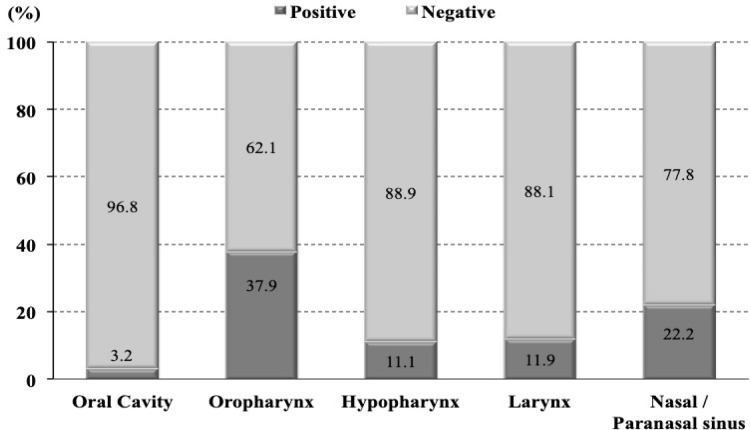
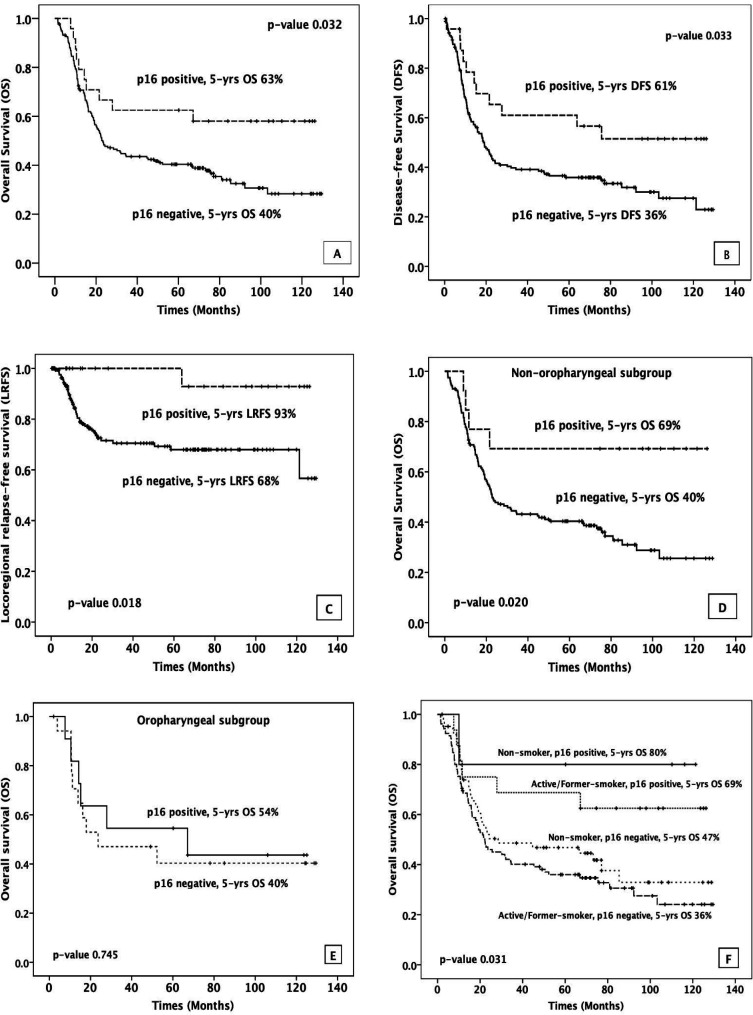
Results: Total of 200 FFPE tissues of HNSCC patients was evaluated for p16 expression. Positive p16 status was observed in 24 cases (12%); majority of p16-positive were men (20:4 cases). The oropharynx (37.9%) was the most common site found in p16-positive while oral cavity (3.2%) was the least common site. Interestingly, 66.7% of p16-positive were former/current smokers, and 70.8% of this subgroup was categorized as clinical AJCC stage III-IV. The p16-positive HNSCC was significantly superior in 5-year overall survival [5-yrs OS 63% vs. 40%, p=0.03], 5-year disease-free survival [5-yrs DFS 61% vs. 36%, p=0.03] and in 5-year locoregional relapse-free survival [5-yrs LRFS 93% vs. 68%, p=0.018] when compared with p16-negative.
Conclusions: In comparison to the results from the Western countries, the prevalence of HPV-related HNSCC in Thai patients was less, and differences in some characteristics were observed. Nevertheless, improvement in OS, DFS and LRFS were observed in p16-positive patients. Our analyses suggested that p16 status is also a strong prognostic marker for HNSCC patients in Thailand.
Keywords: HPV; Head and neck squamous cell carcinoma; P16; Thailand; head and neck cancer.
Figures

References
-
- Bray F, Ferlay J, Soerjomataram I, et al. Global cancer statistics 2018: GLOBOCAN estimates of incidence and mortality worldwide for 36 cancers in 185 countries. CA Cancer J Clin. 2018;68:394–424. - PubMed
MeSH terms
Substances
LinkOut - more resources
Full Text Sources
Medical
