


Etiology of Diarrhea Requiring Hospitalization in Bangladesh by Quantitative Polymerase Chain Reaction, 2014-2018
- PMID: 32592580
- PMCID: PMC8563176
- DOI: 10.1093/cid/ciaa840
Etiology of Diarrhea Requiring Hospitalization in Bangladesh by Quantitative Polymerase Chain Reaction, 2014-2018
Abstract
Background: Diarrhea remains a major public health problem and characterization of its etiology is needed to prioritize interventions. However, most data are from single-site studies of children. We tested samples from participants of any age from 11 geographically diverse hospitals in Bangladesh to describe pathogen-specific burdens of diarrhea.
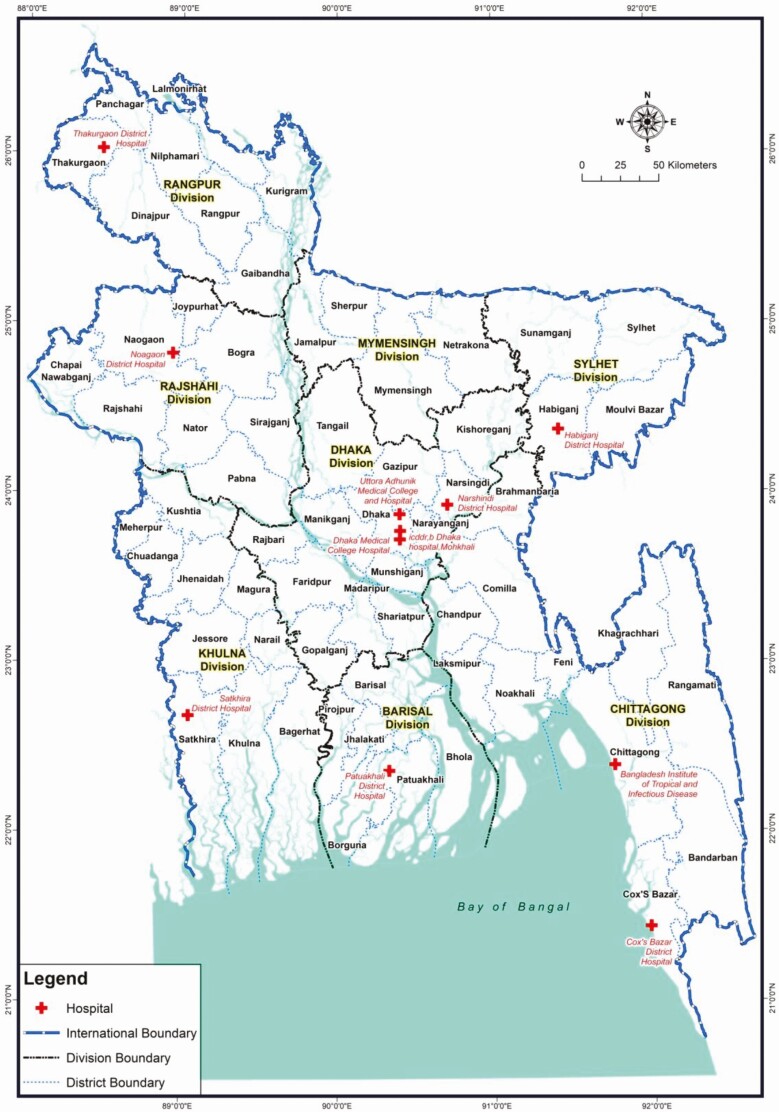
Methods: We utilized 2 existing diarrhea surveillance systems: a Nationwide network at 10 sentinel hospitals and at the icddr,b hospital. We tested stools from enrolled participants and nondiarrheal controls for enteropathogens using quantitative polymerase chain reaction and calculated pathogen-specific attributable fractions (AFs) of diarrhea.
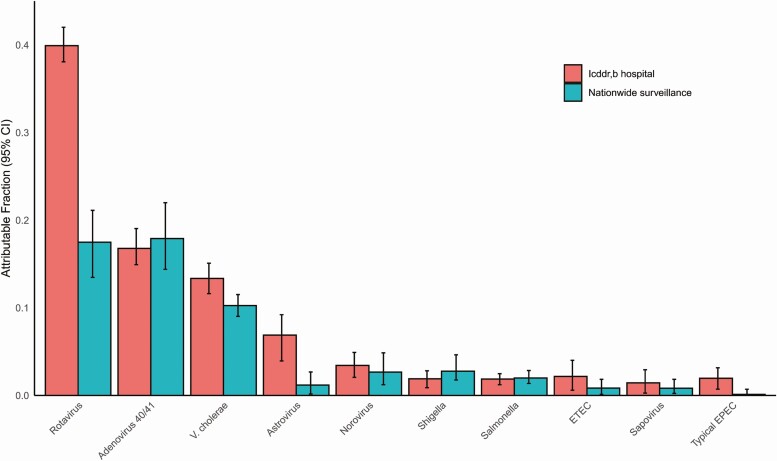
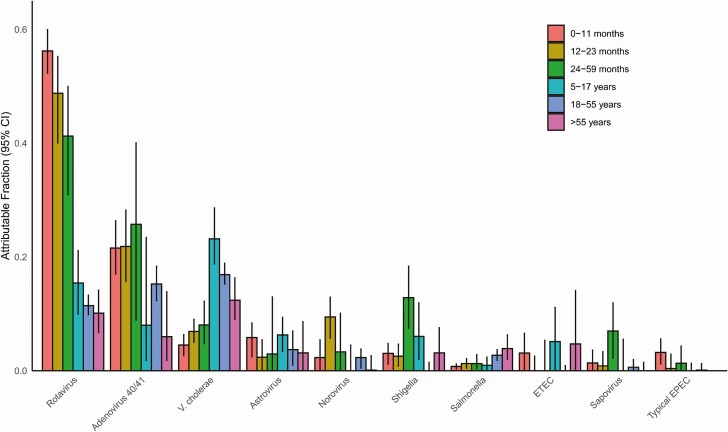
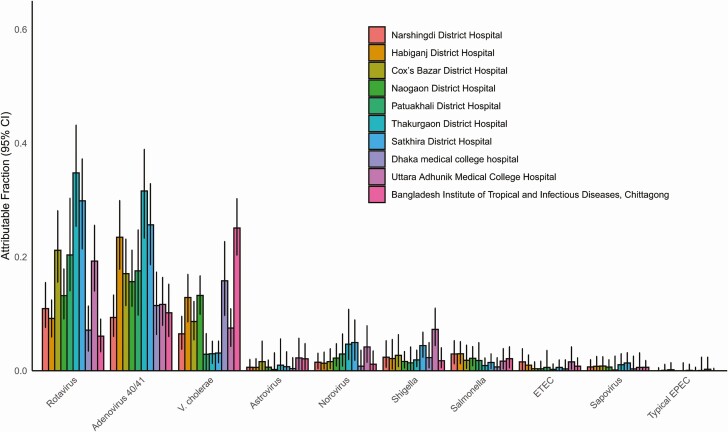
Results: We analyzed 5516 patients with diarrhea and 735 controls. Overall, rotavirus had the highest attributable burden of diarrhea (Nationwide AF, 17.7%; 95% confidence interval [CI], 14.3-20.9%; icddr,b AF, 39.9%; 38.0-41.8%), followed by adenovirus 40/41 (Nationwide AF, 17.9%; 95% CI: 13.9-21.9%; icddr,b AF, 16.6%; 95% CI, 14.4-19.4%) and Vibrio cholerae (Nationwide AF, 10.2%; 95% CI, 9.1-11.3%; icddr,b AF, 13.3%; 95% CI: 11.9-15.1%). Rotavirus was the leading pathogen in children <5 years and was consistent across the sites (coefficient of variation = 56.3%). Adenovirus 40/41 was the second leading pathogen in both children and adults. Vibrio cholerae was the leading pathogen in individuals >5 years old, but was more geographically variable (coefficient of variation = 71.5%). Other attributable pathogens included astrovirus, norovirus, Shigella, Salmonella, ETEC, sapovirus, and typical EPEC.
Conclusions: Rotavirus, adenovirus 40/41, and V. cholerae were the leading etiologies of infectious diarrhea requiring hospitalization in Bangladesh. Other pathogens were important in certain age groups or sites.
Keywords: Bangladesh; TAC; diarrheal diseases; surveillance.
© The Author(s) 2020. Published by Oxford University Press for the Infectious Diseases Society of America.
Figures
Comment in
-
Polymerase Chain Reaction Testing of Stool: Can It Improve Antibiotic Prescription Practices for Diarrhea?Clin Infect Dis. 2021 Nov 2;73(9):e2500-e2501. doi: 10.1093/cid/ciaa833. Clin Infect Dis. 2021. PMID: 32593167 No abstract available.
References
-
- Kotloff KL, Nataro JP, Blackwelder WC, et al. Burden and aetiology of diarrhoeal disease in infants and young children in developing countries (the Global Enteric Multicenter Study, GEMS): a prospective, case-control study. Lancet 2013; 382:209–22. - PubMed
-
- Platts-Mills JA, Liu J, Rogawski ET, et al. ; MAL-ED Network Investigators . Use of quantitative molecular diagnostic methods to assess the aetiology, burden, and clinical characteristics of diarrhoea in children in low-resource settings: a reanalysis of the MAL-ED cohort study. Lancet Glob Health 2018; 6:e1309–18. - PMC - PubMed
Publication types
MeSH terms
Grants and funding
LinkOut - more resources
Full Text Sources
Medical
