


Alcohol use severity, depressive symptoms, and optimism among Hispanics: Examining the immigrant paradox in a serial mediation model
- PMID: 32592612
- PMCID: PMC7777419
- DOI: 10.1002/jclp.23014
Alcohol use severity, depressive symptoms, and optimism among Hispanics: Examining the immigrant paradox in a serial mediation model
Abstract
Objective: Hispanic immigrants exhibit more positive outcomes than U.S.-born Hispanics across educational, psychological, and physical health indices, a phenomenon called the immigrant paradox. We examined the immigrant paradox in relation to alcohol use severity among Hispanic young adults while considering both positive (optimism) and negative (depressive symptoms) processes.
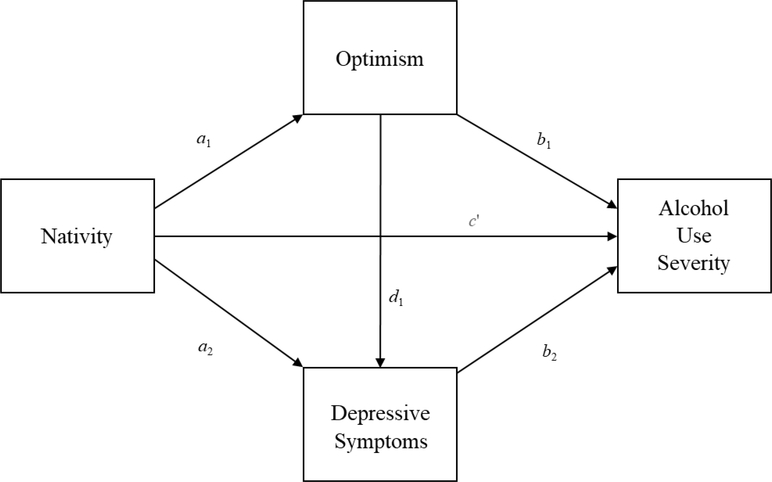
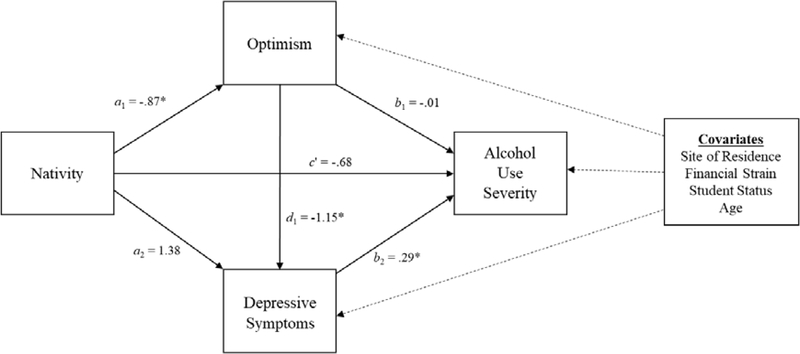
Method: Among 200 immigrant and U.S.-born Hispanic young adults (Mage = 21.30; 49% male) in Arizona and Florida, we tested whether optimism and depressive symptoms statistically mediated the relationship between nativity and alcohol use severity. Specifically, we examined whether Hispanic immigrants reported greater optimism than their U.S.-born counterparts, and whether such optimism was, in turn, associated with less depressive symptoms and thus lower alcohol use severity.
Results: Indirect effects were significant in hypothesized directions (nativity → optimism → depressive symptoms → alcohol use severity).
Conclusions: Both positive and negative psychological processes are important to consider when accounting for the immigrant paradox vis-à-vis alcohol use severity among Hispanic young adults.
Keywords: alcohol use severity; depression; immigrant paradox; optimism.
© 2020 Wiley Periodicals LLC.
Conflict of interest statement
Figures
References
-
- Alcántara C, Estevez CD, & Alegría M (2017). Latino and Asian immigrant adult health: Paradoxes and explanations In Schwartz SJ & Unger J, (Eds.), Oxford handbook of acculturation and health, (pp. 197–236). New York: Oxford University Press.
-
- Alloy LB, Abramson LY, Whitehouse WG, Hogan ME, Panzarella C, & Rose DT (2006). Prospective incidence of first onsets and recurrences of depression in individuals at high and low cognitive risk for depression. Journal of Abnormal Psychology, 115(1), 145–156. - PubMed
-
- Antonovsky A (1987). Unraveling the mystery of health: How people manage stress and stay well. San Francisco, CA, US: Jossey-Bass.
-
- Babor TF, Higgins-Biddle JC, Saunders JB, & Monteiro MG (2001). The Alcohol Use Disorders Identification Test: Guidelines for use in primary health care (2nd ed.). Geneva, CH: World Health Organization.
-
- Bacio GA, & Ray LA (2016). Patterns of drinking initiation among Latino youths: cognitive and contextual explanations of the immigrant paradox. Journal of Child & Adolescent Substance Abuse, 25, 546–556.
Publication types
MeSH terms
Grants and funding
LinkOut - more resources
Full Text Sources
Medical
