. 2020 Jul 16;79(2):268-279.e5.
doi: 10.1016/j.molcel.2020.06.011. Epub 2020 Jun 26.

An Insulin-Sensitive Circular RNA that Regulates Lifespan in Drosophila

Affiliations

An Insulin-Sensitive Circular RNA that Regulates Lifespan in Drosophila

Carina Marianne Weigelt et al. Mol Cell. .

Abstract

Circular RNAs (circRNAs) are abundant and accumulate with age in neurons of diverse species. However, only few circRNAs have been functionally characterized, and their role during aging has not been addressed. Here, we use transcriptome profiling during aging and find that accumulation of circRNAs is slowed down in long-lived insulin mutant flies. Next, we characterize the in vivo function of a circRNA generated by the sulfateless gene (circSfl), which is consistently upregulated, particularly in the brain and muscle, of diverse long-lived insulin mutants. Strikingly, lifespan extension of insulin mutants is dependent on circSfl, and overexpression of circSfl alone is sufficient to extend the lifespan. Moreover, circSfl is translated into a protein that shares the N terminus and potentially some functions with the full-length Sfl protein encoded by the host gene. Our study demonstrates that insulin signaling affects global circRNA accumulation and reveals an important role of circSfl during aging in vivo.

Keywords: Drosophila; ageing; alternative splicing; backsplicing; circRNA; heparan sulfate; insulin; longevity; non-coding RNAs; sulfateless.


Conflict of interest statement

Declaration of Interests The authors declare no competing interests.

Figures

None
Graphical abstract
Figure 1
Figure 1
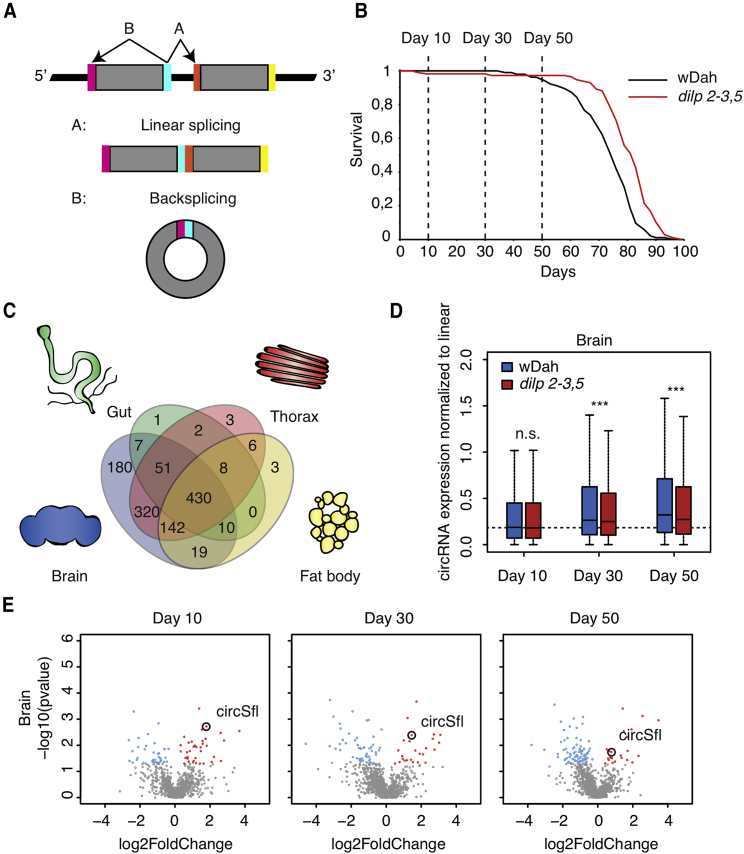
Tissue-Specific circRNA Profiling in Long-Lived Insulin Mutant Flies during Aging (A) Schematic overview of circRNA biogenesis by backsplicing. (B) For circRNA profiling, tissues of wild-type wDah flies and long-lived dilp 2-3,5 mutants were collected from young (day 10), middle-aged (day 30), and old (day 50) female flies. (C) circRNAs were highly enriched in the brain of wDah control flies compared with the thorax, gut, and fat body. (D) Global accumulation of circRNAs in the brain with age was reduced in long-lived dilp 2-3,5 mutant flies (age, p < 0.0001; genotype, p < 0.001; interaction, p < 0.05; 2-way ANOVA, n = 3, median with 25th/75th percentile [box] and minimum/maximum [error bars]). (E) Volcano plots of differentially expressed circRNAs in brains of dilp 2-3,5 mutant flies at days 10, 30, and 50. Significantly upregulated circRNAs are highlighted in red and significantly downregulated circRNAs in blue (p < 0.05, beta-binomial test, n = 3). CircRNA expression was normalized to its host gene. circSfl was consistently upregulated in dilp 2-3,5 mutant flies. See also Figure S1 and Data S1 and S2.
Figure 2
Figure 2
CircSfl Is Upregulated in Long-Lived Insulin Mutant Flies in a dFoxo-Dependent Manner (A) Scheme of the sulfateless gene locus, including primers used to differentiate between circSfl (green arrows), Sfl RA (pink arrows), and Sfl RB (blue arrows). (B) circSfl and Sfl RB, but not Sfl RA, were upregulated in all tissues of dilp 2-3,5 mutants (p < 0.05, ∗∗p < 0.01, ∗∗∗p < 0.001, Student’s t test, mean ± SEM). (C) circSfl, but not Sfl RA and RB, was upregulated in flies lacking insulin-producing cells (InsP3>UAS-rpr, whole female flies). Upregulation of circSfl was dependent on the dFoxo transcription factor (∗∗p < 0.01, ∗∗∗∗p < 0.0001; interaction MNC ablation and dFoxo, p < 0.0001; 2-way ANOVA with Bonferroni post hoc test, n = 3, mean ± SEM). (D) circSfl was upregulated in thoraces of flies overexpressing dFoxo in muscle (∗∗∗p < 0.001, 1-way ANOVA, n = 3, mean ± SEM), Sfl RA was downregulated, and expression of Sfl RB was unchanged. All flies were 10 days old. See also Figure S2.
Figure 3
Figure 3
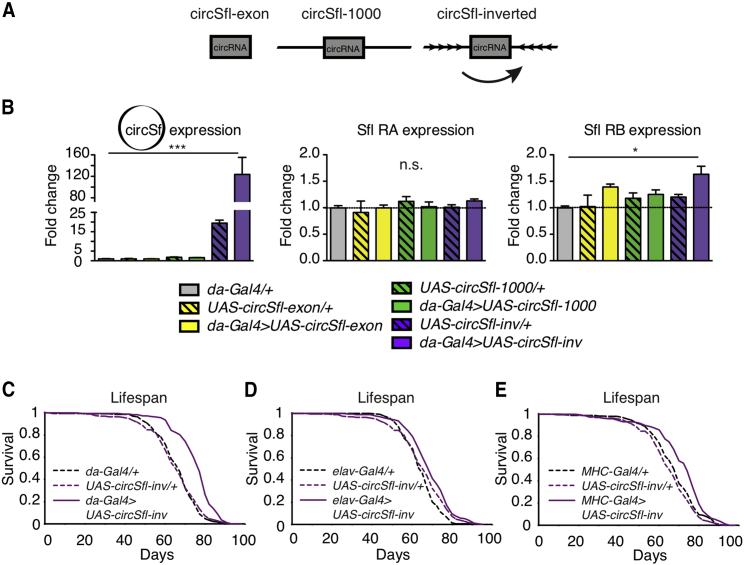
Overexpression of circSfl Extends the Lifespan (A) Three different overexpression constructs were designed to express circSfl in vivo: circSfl-exon (exon only), circSfl-1,000 (circSfl exon + 1,000-bp flanking introns upstream and downstream), and circSfl-inverted (circSfl-inv; circSfl exon + reverse complementary, inverted upstream intron). (B) circSfl expression was strongly upregulated in flies expressing circSfl-inv (p < 0.05, ∗∗∗p < 0.001, 1-way ANOVA, mean ± SEM) but not in circSfl-exon- or circSfl-1,000-expressing flies. The linear transcripts RA and RB of sfl were largely unaffected by expression of circSfl constructs. (C–E) The lifespan of female flies was extended significantly by overexpression of circSfl using the ubiquitous da-Gal4 driver (C) (overexpressor versus driver or UAS control, ****p < 0.0001), the neuron-specific elav-Gal4 driver (D) (overexpressor versus driver control, ****p < 0.0001; overexpressor versus UAS control, p < 0.05), and the muscle-specific MHC-Gal4 driver (E) (overexpressor versus driver control, p < 0.001; overexpressor versus UAS control, ****p < 0.0001) (log rank test, n = ~ 200). See also Figures S3 and S4.
Figure 4
Figure 4
Backsplicing of the sfl circRNA Depends on the Presence of an Upstream Non-coding Exon, which Is Essential for IIS-Mediated Lifespan Extension (A) Scheme of the mutated sflΔex2 gene locus. The sequence deleted by CRISPR-Cas9 in sflΔex2 mutant flies is indicated by yellow flashes. The primers used for qRT-PCR in (B) of the different sfl transcripts are indicated by arrowheads. The exon forming circSfl is indicated by a circle. (B) Total linear Sfl RNA levels were not affected by removal of sfl exon 2. As expected, Sfl RA transcripts were absent in flies containing the sflΔex2 deletion, and Sfl RB transcript levels were significantly upregulated in these flies. Importantly, circSfl expression was decreased in sflΔex2 mutant flies, and the increased expression of circSfl in dilp 2-3,5 mutants was reversed to wild-type levels in sflΔex2, dilp 2-3,5 double-mutant flies (∗∗∗p < 0.001, ∗∗∗∗p < 0.0001, 2-way-ANOVA with Bonferroni post hoc test, n = 3, mean ± SEM). (C and D) A block in circSfl upregulation upon deletion of sfl exon 2 rescued the reduced fecundity (C) and increased lifespan (D) of insulin mutant flies. (C) sflΔex2 mutants showed wild-type fecundity. The low fecundity of dilp 2-3,5 mutants was partially rescued in sflΔex2, dilp2-3,5 double mutants (∗∗∗p < 0.001; interaction, ∗∗p < 0.01; 2-way-ANOVA, Bonferroni post hoc test, n = 10, mean ± SEM). (D) Lifespan extension of dilp 2-3,5 mutants was reduced in flies carrying the sflΔex2 allele (wDah versus dilp 2-3,5: p < 0.0001, sflΔex2 versus dilp 2-3,5: p < 0.0001 log rank test; interaction between sflΔex2 and dilp2-3,5: p < 0.0001, Cox proportional hazard analysis). The sflΔex2 lifespan of sflΔex2 single mutants was not reduced. See also Figure S5.
Figure 5
Figure 5
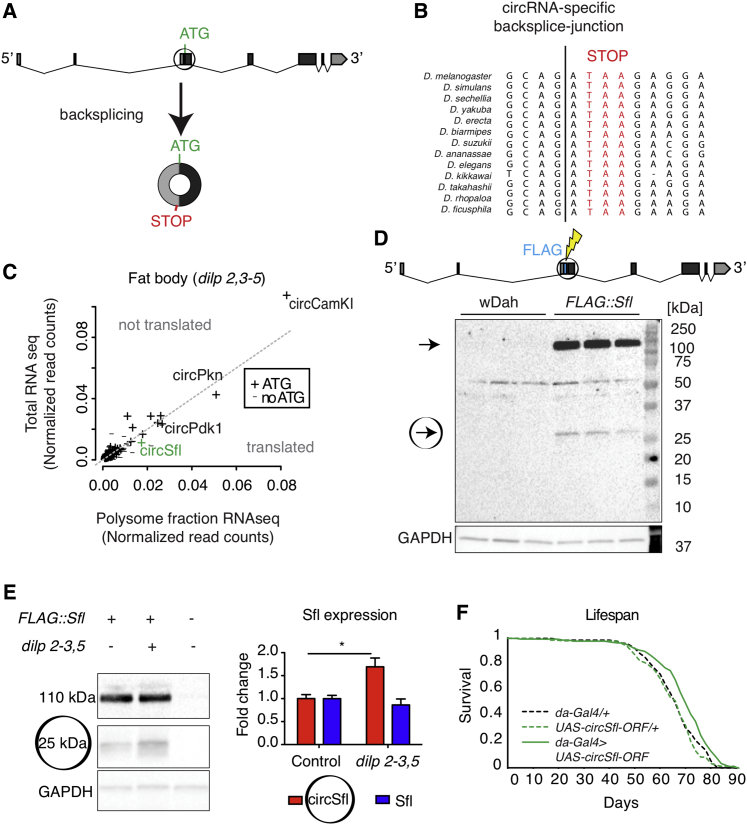
CircSfl Is Translated into a Protein that Is Upregulated in Insulin Mutant Flies (A) circSfl shares the ATG start codon with its linear RNA isoforms and encodes an in-frame stop codon directly after the backsplice junction. (B) Evolutionary conservation of the circSfl-specific stop codon among Drosophila species. (C) Polysome profiling of dilp2-3,5 mutant flies identified circSfl as a potentially translated circRNA. (+) indicates circRNAs that include the ATG start codon of their host genes. (D) CRISPR-mediated knockin of a FLAG tag to the N terminus of Sfl and circSfl (FLAG::Sfl mutants) resulted in two specific bands in a western blot analysis that were absent in wDah wild-type flies that do not carry a FLAG tag (heads, n = 3). The 110-kDa band corresponds to the Sfl full-length protein, and the 25-kDa protein corresponds to the protein size encoded by circSfl. (E) The 25-kDa protein, but not the 110 kDa Sfl protein variant, was increased in insulin mutant flies (p < 0.05, Student’s t test, n = 4, mean ± SEM). (F) Ubiquitous overexpression of the circSfl open reading frame (ORF) from a linear transcript extends the lifespan of female flies (overexpressor versus da-Gal4 driver or UAS control, ∗∗∗∗∗p < 0.0001; log-rank test, n = ~150). See also Figure S6 and Data S3.
Figure 6
Figure 6
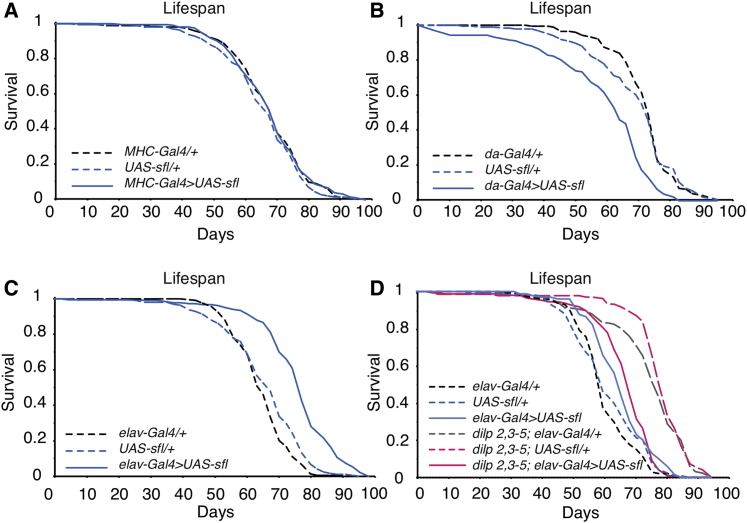
Neuron-Specific Overexpression of Sfl Extends the Lifespan of Drosophila (A) Muscle-specific overexpression of Sfl did not affect the lifespan. (B) Ubiquitous overexpression of Sfl shortened the lifespan (overexpressor versus driver or UAS control, p < 0.0001; log rank test, n = ~200). (C) Overexpression of Sfl in neurons by elav-Gal4 extended the lifespan (overexpressor versus driver or UAS control, p < 0.0001; log rank test, n = ~200). (D) Neuron-specific overexpression of Sfl in the dilp 2-3,5 mutant background shortened the dilp 2-3,5-mediated lifespan extension (interaction of Sfl overexpression with dilp 2-3,5, p < 0.0001; Cox proportional hazard analysis, n = ~80–150). Female flies were used. See also Figure S7.
Figure 7
Figure 7
The Heparan Sulfate Proteoglycan Dally Mediates Sfl-Induced Lifespan Extension (A and B) Overexpression of the heparan sulfate proteoglycans (A) Dally-like protein (Dlp) and (B) Syndecan (Sdc) did not extend the lifespan compared with the elav-Gal4/+ driver control. (C) Overexpression of Dally extended the lifespan (Dally overexpressor versus Gal4 control, p < 0.05; Dally overexpressor versus UAS control, p < 0.01; log rank test, n = ~150) to a similar extent as overexpression of Sfl. (D) Lifespan extension mediated by Sfl overexpression was partially rescued by Dally RNAi (elav-Gal4>UAS-sfl versus elav-Gal4>UAS-sfl, dally RNAi: p < 0.001; elav-Gal4/+ versus elav-Gal4>UAS-sfl, dally RNAi: p < 0.001, log rank test; interaction between Sfl overexpression and Dally RNAi: p < 0.0001, Cox proportional hazard analysis; n = ~150). The lifespans shown in (A)–(C) were determined in parallel, and the same elav-Gal4/+, UAS-sfl/+ and elav-Gal4>UAS-sfl control lifespans are shown in (A)–(C) to allow direct comparison.

Comment in

  • CircRNAs in lifespan.
    Baumann K. Baumann K. Nat Rev Mol Cell Biol. 2020 Aug;21(8):420. doi: 10.1038/s41580-020-0269-1. Nat Rev Mol Cell Biol. 2020. PMID: 32616909 No abstract available.

References

    1. Ashwal-Fluss R., Meyer M., Pamudurti N.R., Ivanov A., Bartok O., Hanan M., Evantal N., Memczak S., Rajewsky N., Kadener S. circRNA biogenesis competes with pre-mRNA splicing. Mol. Cell. 2014;56:55–66. - PubMed
    1. Austad S.N., Fischer K.E. Sex Differences in Lifespan. Cell Metab. 2016;23:1022–1033. - PMC - PubMed
    1. Baeg G.H., Selva E.M., Goodman R.M., Dasgupta R., Perrimon N. The Wingless morphogen gradient is established by the cooperative action of Frizzled and Heparan Sulfate Proteoglycan receptors. Dev. Biol. 2004;276:89–100. - PubMed
    1. Bass T.M., Grandison R.C., Wong R., Martinez P., Partridge L., Piper M.D. Optimization of dietary restriction protocols in Drosophila. J. Gerontol. A Biol. Sci. Med. Sci. 2007;62:1071–1081. - PMC - PubMed
    1. Bischof J., Maeda R.K., Hediger M., Karch F., Basler K. An optimized transgenesis system for Drosophila using germ-line-specific phiC31 integrases. Proc. Natl. Acad. Sci. USA. 2007;104:3312–3317. - PMC - PubMed

Publication types