Review
. 2020 Sep;25(9):1693-1701.
doi: 10.1016/j.drudis.2020.06.023. Epub 2020 Jun 25.

The rise of molecular simulations in fragment-based drug design (FBDD): an overview

Affiliations
Review

The rise of molecular simulations in fragment-based drug design (FBDD): an overview

Maicol Bissaro et al. Drug Discov Today. 2020 Sep.

Abstract

Fragment-based drug discovery (FBDD) is an innovative approach, progressively more applied in the academic and industrial context, to enhance hit identification for previously considered undruggable biological targets. In particular, FBDD discovers low-molecular-weight (LMW) ligands (<300Da) able to bind to therapeutically relevant macromolecules in an affinity range from the micromolar (μM) to millimolar (mM). X-ray crystallography (XRC) and nuclear magnetic resonance (NMR) spectroscopy are commonly the methods of choice to obtain 3D information about the bound ligand-protein complex, but this can occasionally be problematic, mainly for early, low-affinity fragments. The recent development of computational fragment-based approaches provides a further strategy for improving the identification of fragment hits. In this review, we summarize the state of the art of molecular dynamics simulations approaches used in FBDD, and discuss limitations and future perspectives for these approaches.


Figures

Figure 1
Figure 1
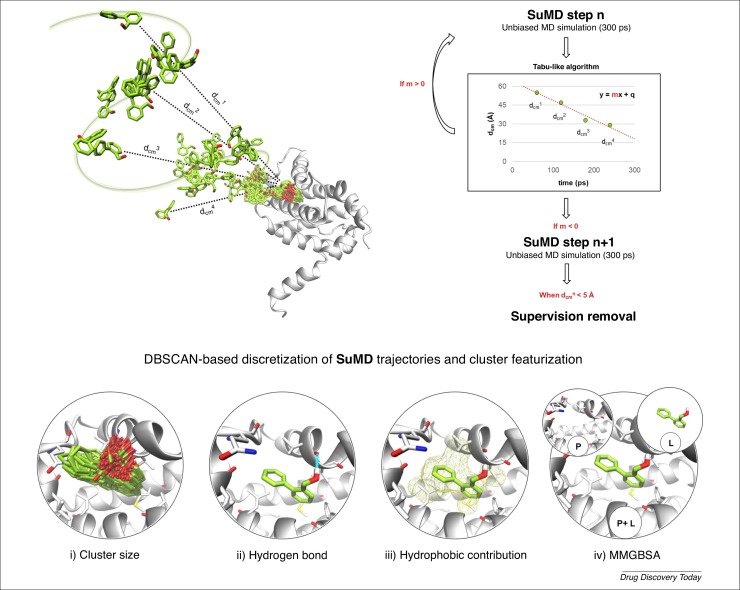
High-throughput supervised molecular dynamics (HT-SuMD), an automated protocol exploiting molecular simulation to perform fragment screening. The SuMD methodology is summarized with a specific focus on the tabu-like algorithm controlling acceptance or rejection of short unbiased MD simulations, depending on how the distance between the fragment under investigation and the binding site center of mass (dcmn) changes during the trajectory. A density-based clustering algorithm (DBSCAN) clustering algorithm is used to perform a geometrical discretization of SuMD trajectories and identify relevant fragment conformations. Each cluster is then characterized based on four geometric and energetic indicators: (i) cluster size; (ii) hydrogen bond presence; (iii) hydrophobic contribution of binding; and (iv) protein–ligand MMGBSA binding interaction energy. Once all clusters have been characterized, a consensus scoring filter is applied to identify hit fragment molecules.
Figure 2
Figure 2
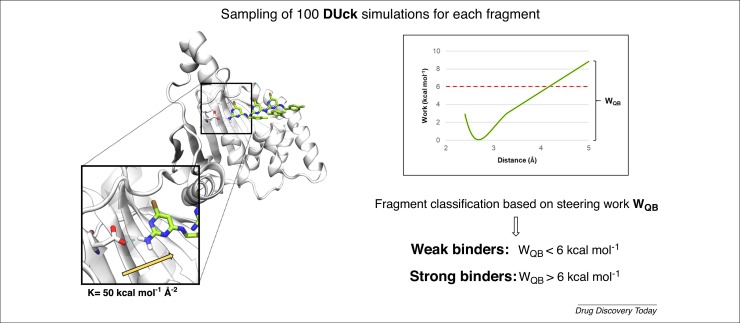
Dynamic undocking (DUck) is a steered molecular dynamics (SMD)-based protocol in which a fragment unbinding pathway is sampled by pulling a key stabilizing hydrogen bond interaction through the application of a directional force vector. The maximum amount of steering work required for the contact rupture is exploited as a nonequilibrium property differentiating strong from weak fragment binding molecules.
Figure 3
Figure 3
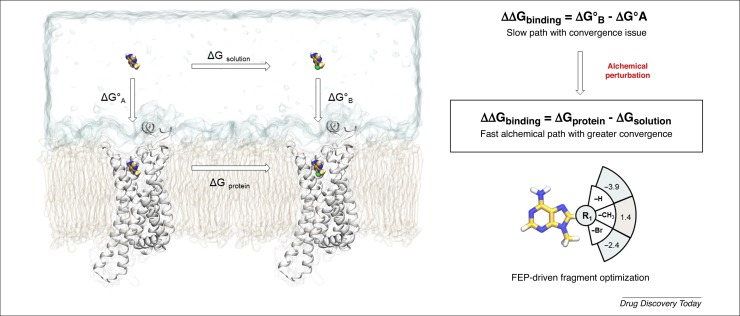
Relative binding free energy calculation as a valuable tool for driving fragment optimization campaigns. On the left side of the panel, the traditional thermodynamics cycle for ΔΔG calculation exploiting molecular simulation is depicted. The physical path (vertical arrows) describing the absolute free energy of binding (ΔG°) are affected by convergence because of the massive system perturbation sampled, making the calculation inefficient. On the right side, the nonphysical alchemical path (horizontal arrow) is shown, in which a ligand is perturbed into another both in the bound and unbound state, providing greater convergence. Abbreviation: FEP, free energy perturbation.
Figure 4
Figure 4
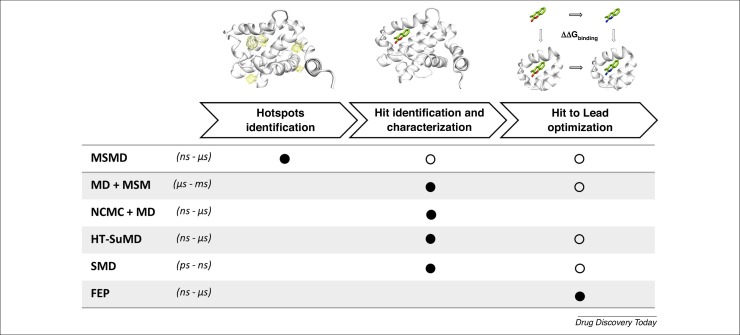
Summary of a canonical in silico fragment-based drug discovery (FBDD) pipeline, highlighting the applicability of different molecular simulation-based approaches. For each computational methodology, the simulation timescale that is required is reported, as well as the main (black dot) or secondary (white dots) applications. The table highlights the differences between approaches that can provide cross-cutting support to many FBDD phases (e.g., Markov state models; MSMs) from those that, because of their specificity and complexity, have a more focused use (e.g., free energy perturbation; FEP). Abbreviations: HT-SuMD, high-throughput supervised molecular dynamics; MSMD, mixed-solvent molecular dynamics; NCMC, nonequilibrium candidate Monte Carlo; SMD, steered molecular dynamics.

References

    1. MacArron R. Impact of high-throughput screening in biomedical research. Nat. Rev. Drug Discov. 2011;10:188–195. - PubMed
    1. Lyu J. Ultra-large library docking for discovering new chemotypes. Nature. 2019;566:224–229. - PMC - PubMed
    1. Reymond J.L. The Chemical Space Project. ACC Chem. Res. 2015;48:722–730. - PubMed
    1. Hall R.J. Efficient exploration of chemical space by fragment-based screening. Prog. Biophys. Mol. Biol. 2014;116:82–91. - PubMed
    1. Jacquemard C., Kellenberger E. A bright future for fragment-based drug discovery: what does it hold? Expert Opin. Drug. Discov. 2019;14:413–416. - PubMed

Publication types

LinkOut - more resources