


Establishing reliability and validity for mental health screening instruments in resource-constrained settings: Systematic review of the PHQ-9 and key recommendations
- PMID: 32593853
- PMCID: PMC7484202
- DOI: 10.1016/j.psychres.2020.113236
Establishing reliability and validity for mental health screening instruments in resource-constrained settings: Systematic review of the PHQ-9 and key recommendations
Abstract
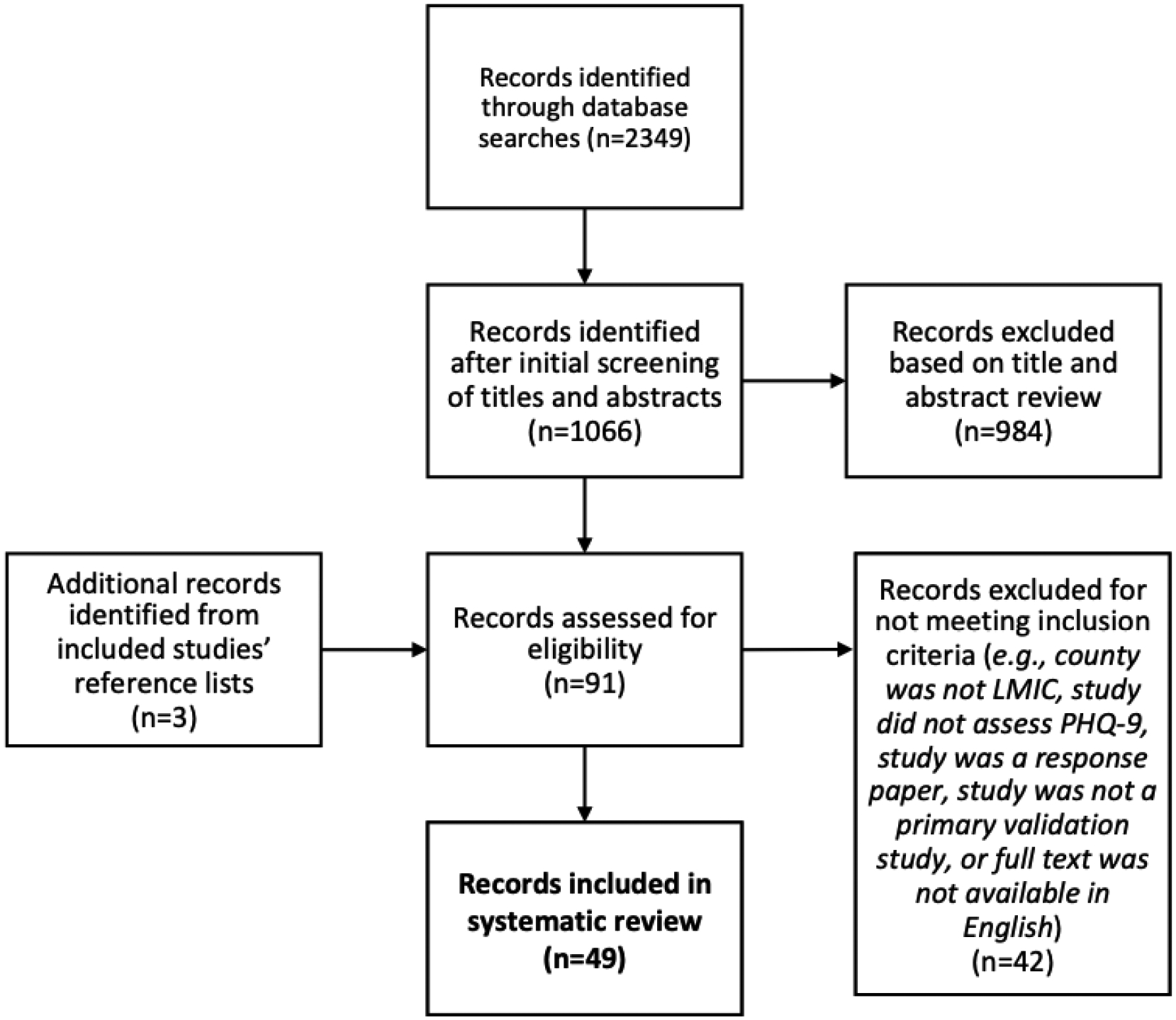
Mental illness is one of the largest contributors to the global disease burden. The importance of valid and reliable mental health measures is crucial in order to accurately measure said burden, to capture symptom improvement, and to ensure that symptoms are appropriately identified and quantified. This is of particular importance in low and middle-income countries (LMICs), where the burden of mental illness is relatively high, and there is heterogeneity in linguistic, racial, and ethnic groups. Using the PHQ-9 as an illustrative example, this systematic review aims to provide an overview of existing work and highlight common validation and reporting practices. A systematic review of published literature validating the use of the PHQ-9 in LMICs as indexed in the PubMed and PsychInfo databases was conducted. The review included n = 49 articles (reduced from n = 2,349). This manuscript summarizes these results in terms of the frequency of reporting on important procedures and in regards to the types of reliability and validity measured. Then, building off of the existing literature, we provide key recommendations for measure validation in LMICs, which can be generalized for any type of measure used in a setting in which it was not initially developed.
Keywords: Global mental health; Low- and middle-income countries; Psychometrics.
Copyright © 2020 Elsevier B.V. All rights reserved.
Conflict of interest statement
Declaration of Competing Interest The authors declare that they have no known competing financial interests or personal relationships that could have appeared to influence the work reported in this paper.
References
-
- Abedi J 2002. Standardized achievement tests and English language learners: Psychometrics issues. Educational Assessment, 8(3), 231–257. doi: 10.1207/s15326977ea0803_02 - DOI
-
- American Psychiatric Association, 2000. Diagnostic and statistical manual of mental disorders: DSM-IV-TR. American Psychiatric Association; Washington, DC: 2000.
Publication types
MeSH terms
Grants and funding
LinkOut - more resources
Full Text Sources
Medical
