


Ingredients of 'rituals' and their cognitive underpinnings
- PMID: 32594867
- PMCID: PMC7423267
- DOI: 10.1098/rstb.2019.0439
Ingredients of 'rituals' and their cognitive underpinnings
Abstract
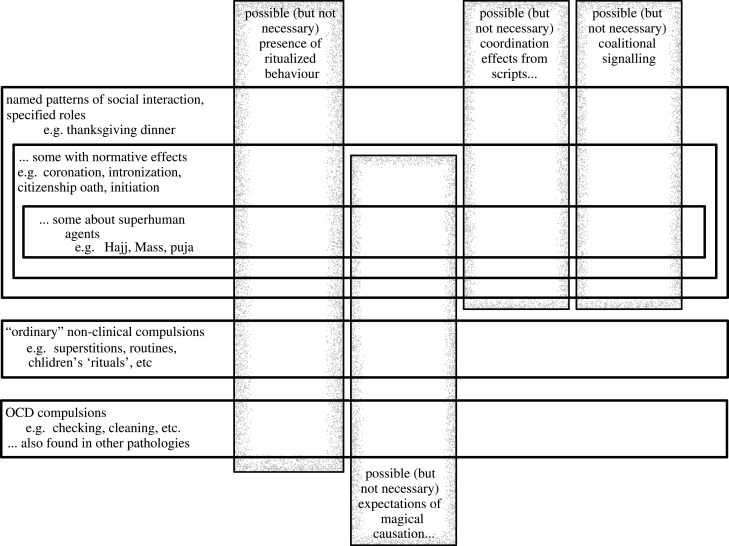
Ritual is not a proper scientific object, as the term is used to denote disparate forms of behaviour, on the basis of a faint family resemblance. Indeed, a variety of distinct cognitive mechanisms are engaged, in various combinations, in the diverse interactions called 'rituals' - and each of these mechanisms deserves study, in terms of its evolutionary underpinnings and cultural consequences. We identify four such mechanisms that each appear in some 'rituals', namely (i) the normative scripting of actions; (ii) the use of interactions to signal coalitional identity, affiliation, cohesiveness; (iii) magical claims based on intuitive expectations of contagion; and (iv) ritualized behaviour based on a specific handling of the flow of behaviour. We describe the cognitive and evolutionary background to each of these potential components of 'rituals', and their effects on cultural transmission. This article is part of the theme issue 'Ritual renaissance: new insights into the most human of behaviours'.
Keywords: conventions; cultural evolution; evolutionary psychology; magic; rituals.
Conflict of interest statement
We declare we have no competing interests.
Figures
References
-
- Sperber D. 1996. Explaining culture: a naturalistic approach. Oxford, UK: Blackwell.
-
- Claidière N, Sperber D. 2007. The role of attraction in cultural evolution. J. Cogn. Cult. 7, 89–111. ( 10.1163/156853707X171829) - DOI
-
- Kuper H. 2018[1947] An African aristocracy: rank Among the swazi (reprint). London, UK: Taylor & Francis.
-
- Gluckman M. 1955. Rituals of rebellion in south-east Africa. Manchester, UK: Manchester University Press.
MeSH terms
LinkOut - more resources
Full Text Sources
