


Polyunsaturated Fatty Acids as Modulators of KV7 Channels
- PMID: 32595524
- PMCID: PMC7300222
- DOI: 10.3389/fphys.2020.00641
Polyunsaturated Fatty Acids as Modulators of KV7 Channels
Abstract
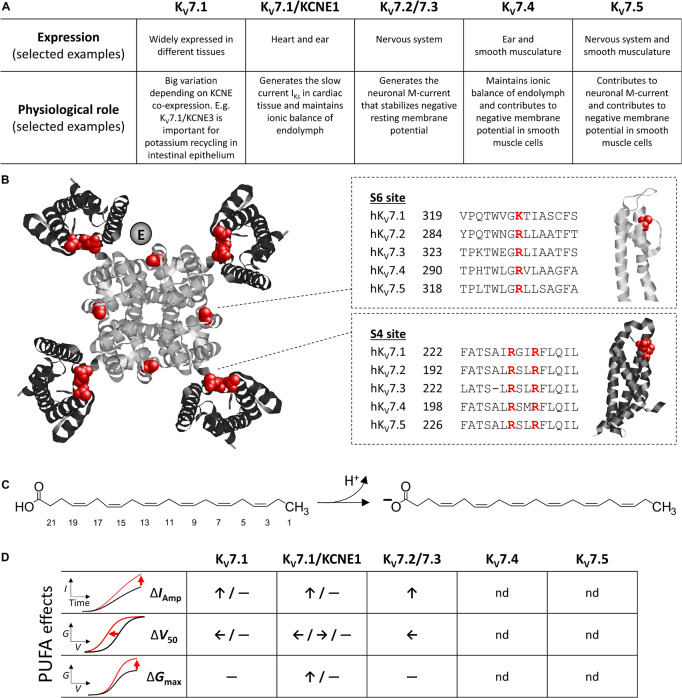
Voltage-gated potassium channels of the KV7 family are expressed in many tissues. The physiological importance of KV7 channels is evident from specific forms of disorders linked to dysfunctional KV7 channels, including variants of epilepsy, cardiac arrhythmia and hearing impairment. Thus, understanding how KV7 channels are regulated in the body is of great interest. This Mini Review focuses on the effects of polyunsaturated fatty acids (PUFAs) on KV7 channel activity and possible underlying mechanisms of action. By summarizing reported effects of PUFAs on KV7 channels and native KV7-mediated currents, we conclude that the generally observed effect is a PUFA-induced increase in current amplitude. The increase in current is commonly associated with a shift in the voltage-dependence of channel opening and in some cases with increased maximum conductance. Auxiliary KCNE subunits, which associate with KV7 channels in certain tissues, may influence PUFA effects, though findings are conflicting. Both direct and indirect activating PUFA effects have been described, direct effects having been most extensively studied on KV7.1. The negative charge of the PUFA head-group has been identified as critical for electrostatic interaction with conserved positively charged amino acids in transmembrane segments 4 and 6. Additionally, the localization of double bonds in the PUFA tail tunes the apparent affinity of PUFAs to KV7.1. Indirect effects include those mediated by PUFA metabolites. Indirect inhibitory effects involve KV7 channel degradation and re-distribution from lipid rafts. Understanding how PUFAs regulate KV7 channels may provide insight into physiological regulation of KV7 channels and bring forth new therapeutic strategies.
Keywords: KCNE; KCNQ; KV7; docosahexaenoic acid; lipid; polyunsaturated fatty acid; voltage-gated potassium channel.
Copyright © 2020 Larsson, Frampton and Liin.
Figures
References
-
- Abbott G. W. (2016). “Chapter 1 - The KCNE family of ion channel regulatory subunits,” Ion Channels in Health and Disease. Pitt G. S. (Boston, MA: Academic Press), 1–24. 10.1016/b978-0-12-802002-9.00001-7 - DOI
Publication types
LinkOut - more resources
Full Text Sources
Molecular Biology Databases
