


Tensile strength, growth factor content and proliferation activities for two platelet concentrates of platelet-rich fibrin and concentrated growth factor
- PMID: 32595893
- PMCID: PMC7305442
- DOI: 10.1016/j.jds.2020.03.011
Tensile strength, growth factor content and proliferation activities for two platelet concentrates of platelet-rich fibrin and concentrated growth factor
Abstract
Background/purpose: Platelet-rich fibrin (PRF) can be obtained by centrifuging fresh blood in the absence of anticoagulants. Varying the centrifugation speeds may produce tougher and richer concentrated growth factors (CGF). This study examines tensile strength, growth factor content, and the potential of CGF and PRF in promoting periodontal cell proliferation.
Materials and methods: Blood (40 mL/subject) was collected from 44 healthy subjects. PRF and CGF were prepared by centrifuging at 3000 rpm and switching speeds ranging within 3000 rpm, respectively. Fibrin strip was prepared and its tensile strength was measured. Transforming growth factor beta 1 (TGF-β1), platelet-derived growth factor BB (PDGF-BB), and epidermal growth factor (EGF) in the residual serum and fibrin clots were determined by enzyme-linked immunosorbent assay, and their effects on the proliferation of hFOB1.19 osteoblasts and human gingival fibroblasts were evaluated by 3-(4,5-dimethylthiazol-2-yl)-2,5-diphenyl tetrazolium bromide assay.
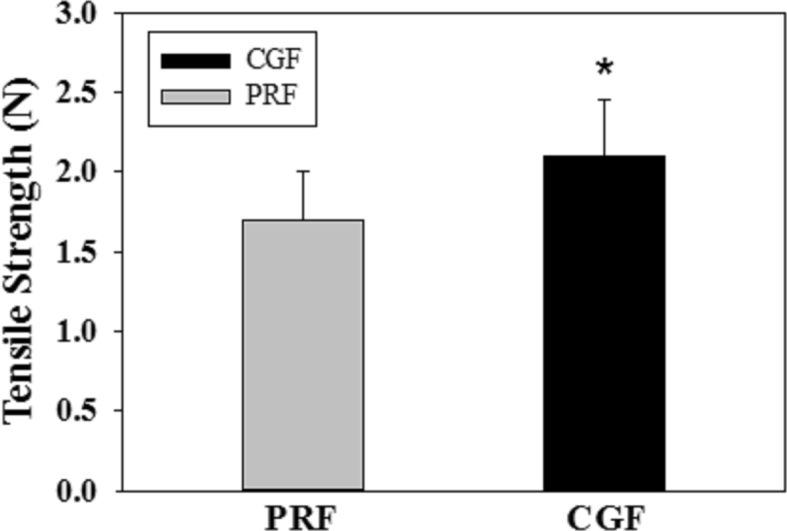
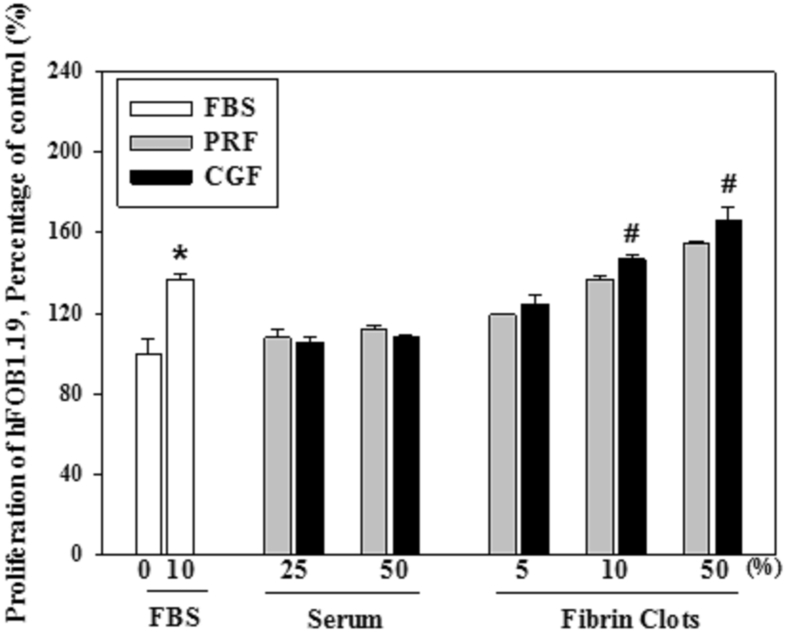
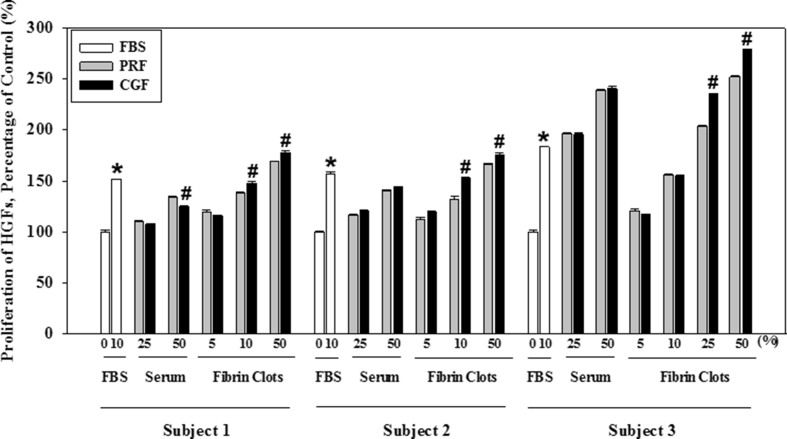
Results: Compared with PRF, tensile strength of CGF was significantly higher. Concentrations and amounts of PDGF-BB and EGF in CGF were significantly higher than those in PRF. Osteoblast number was significantly higher in the cultures with fetal bovine serum (FBS, 10%) and with PRF or CGF fibrin clots (5%, 10%, and 50%) compared to that without FBS. Moreover, osteoblast number in CGF, regardless of the preparation of 10% and 50%, was significantly greater than that in PRF. Similar findings were also observed for gingival fibroblasts among the various subjects.
Conclusion: Varying centrifugation speeds can modify the tensile strength and biological activities of platelet fibrin clots.
Keywords: Concentrated growth factor; Growth factors; Periodontal cell proliferation; Platelet-rich fibrin; Tensile strength.
© 2020 Association for Dental Sciences of the Republic of China. Publishing services by Elsevier B.V.
Conflict of interest statement
The authors report no conflicts of interest related to this study.
Figures
References
-
- Kawase T. Platelet-rich plasma and its derivatives as promising bioactive materials for regenerative medicine: basic principles and concepts underlying recent advances. Odontology. 2015;103:126–135. - PubMed
-
- Dohan D.M., Choukroun J., Diss A. Platelet-rich fibrin (PRF): a second-generation platelet concentrate. Part I: technological concepts and evolution. Oral Surg Oral Med Oral Pathol Oral Radiol Endod. 2006;101:e37–e44. - PubMed
-
- Panda S., Doraiswamy J., Malaiappan S., Varghese S.S., Del Fabbro M. Additive effect of autologous platelet concentrates in treatment of intrabony defects: a systematic review and meta-analysis. J Investig Clin Dent. 2016;7:13–26. - PubMed
LinkOut - more resources
Full Text Sources
