Prognostic Accuracy of the SIRS, qSOFA, and NEWS for Early Detection of Clinical Deterioration in SARS-CoV-2 Infected Patients
- PMID: 32597046
- PMCID: PMC7324266
- DOI: 10.3346/jkms.2020.35.e234
Prognostic Accuracy of the SIRS, qSOFA, and NEWS for Early Detection of Clinical Deterioration in SARS-CoV-2 Infected Patients
Abstract
Background: The case fatality rate of coronavirus disease 2019 (COVID-19) is estimated to be between 4.3% and 11.0%. Currently there is no effective antiviral treatment for COVID-19. Thus, early recognition of patients at high risk is important.
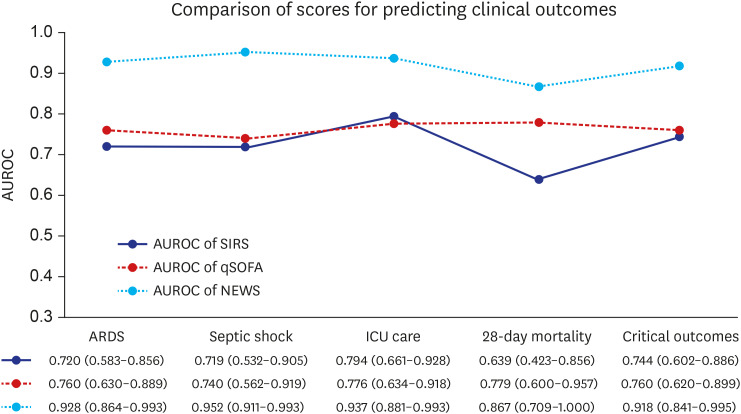
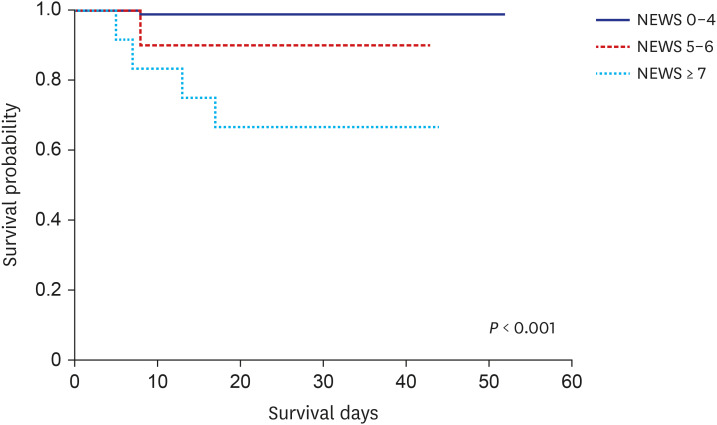
Methods: We performed a retrospective observational study of 110 patients with severe acute respiratory syndrome coronavirus 2 infection. We compared the effectiveness of three scoring systems: the Systemic Inflammatory Response Syndrome (SIRS), quick Sequential Organ Failure Assessment (qSOFA), and National Early Warning Score (NEWS) systems, for predicting the prognosis of COVID-19. The area under the receiver operating characteristic curve (AUROC) was used for these assessments, and Kaplan-Meier survival curves were used to identify the cumulative risk for 28-day mortality according to the NEWS stratification.
Results: For predicting 28-day mortality, NEWS was superior to qSOFA (AUROC, 0.867 vs. 0.779, P < 0.001), while there was no significant difference between NEWS and SIRS (AUROC, 0.867 vs. 0.639, P = 0.100). For predicting critical outcomes, NEWS was superior to both SIRS (AUROC, 0.918 vs. 0.744, P = 0.032) and qSOFA (AUROC, 0.918 vs. 0.760, P = 0.012). Survival time was significantly shorter for patients with NEWS ≥ 7 than for patients with NEWS < 7.
Conclusion: Calculation of the NEWS at the time of hospital admission can predict critical outcomes in patients with COVID-19. Early intervention for high-risk patients can thereby improve clinical outcomes in COVID-19 patients.
Keywords: COVID-19; NEWS; Outcome; Prediction.
© 2020 The Korean Academy of Medical Sciences.
Conflict of interest statement
The authors have no potential conflicts of interest to disclose.
Figures
Comment in
-
Letter to the Editor: Discussion of the Article "Prognostic Accuracy of the SIRS, qSOFA, and NEWS for Early Detection of Clinical Deterioration in SARS-CoV-2 Infected Patients".J Korean Med Sci. 2020 Aug 3;35(30):e274. doi: 10.3346/jkms.2020.35.e274. J Korean Med Sci. 2020. PMID: 32743993 Free PMC article. No abstract available.
References
-
- Wu Z, McGoogan JM. Characteristics of and important lessons from the coronavirus disease 2019 (COVID-19) outbreak in China: summary of a report of 72 314 cases from the Chinese Center for Disease Control and Prevention. JAMA. 2020;323(13):1239. - PubMed
-
- Bone RC, Sibbald WJ, Sprung CL. The ACCP-SCCM consensus conference on sepsis and organ failure. Chest. 1992;101(6):1481–1483. - PubMed
-
- Raith EP, Udy AA, Bailey M, McGloughlin S, MacIsaac C, Bellomo R, et al. Prognostic accuracy of the SOFA score, SIRS criteria, and qSOFA score for in-hospital mortality among adults with suspected infection admitted to the intensive care unit. JAMA. 2017;317(3):290–300. - PubMed
Publication types
MeSH terms
LinkOut - more resources
Full Text Sources
Miscellaneous