. 2020 Jun 29;20(1):603.
doi: 10.1186/s12885-020-07072-0.

Potential enhancement of host immunity and anti-tumor efficacy of nanoscale curcumin and resveratrol in colorectal cancers by modulated electro- hyperthermia

Affiliations

Potential enhancement of host immunity and anti-tumor efficacy of nanoscale curcumin and resveratrol in colorectal cancers by modulated electro- hyperthermia

I-Ming Kuo et al. BMC Cancer. .

Abstract

Background: Modulated electro-hyperthermia (mEHT) is a form of hyperthermia used in cancer treatment. mEHT has demonstrated the ability to activate host immunity by inducing the release of heat shock proteins, triggering apoptosis, and destroying the integrity of cell membranes to enhance cellular uptake of chemo-drugs in tumor cells. Both curcumin and resveratrol are phytochemicals that function as effective antioxidants, immune activators, and potential inhibitors of tumor development. However, poor bioavailability is a major obstacle for use in clinical cancer treatment.

Methods: This purpose of this study was to investigate whether mEHT can increase anti-cancer efficacy of nanosized curcumin and resveratrol in in vitro and in vivo models. The in vitro study included cell proliferation assay, cell cycle, and apoptosis analysis. Serum concentration was analyzed for the absorption of curcumin and resveratrol in SD rat model. The in vivo CT26/BALB/c animal tumor model was used for validating the safety, tumor growth curve, and immune cell infiltration within tumor tissues after combined mEHT/curcumin/resveratrol treatment.

Results: The results indicate co-treatment of mEHT with nano-curcumin and resveratrol significantly induced cell cycle arrest and apoptosis of CT26 cells. The serum concentrations of curcumin and resveratrol were significantly elevated when mEHT was applied. The combination also inhibited the growth of CT26 colon cancer by inducing apoptosis and HSP70 expression of tumor cells while recruiting CD3+ T-cells and F4/80+ macrophages.

Conclusions: The results of this study have suggested that this natural, non-toxic compound can be an effective anti-tumor strategy for clinical cancer therapy. mEHT can enable cellular uptake of potential anti-tumor materials and create a favorable tumor microenvironment for an immunological chain reaction that improves the success of combined treatments of curcumin and resveratrol.

Keywords: Apoptosis; Curcumin; Modulated electro-hyperthermia (mEHT); Nanosized; Resveratrol; Tumor microenvironment.


Conflict of interest statement

The authors declare that they have no competing interests.

Figures
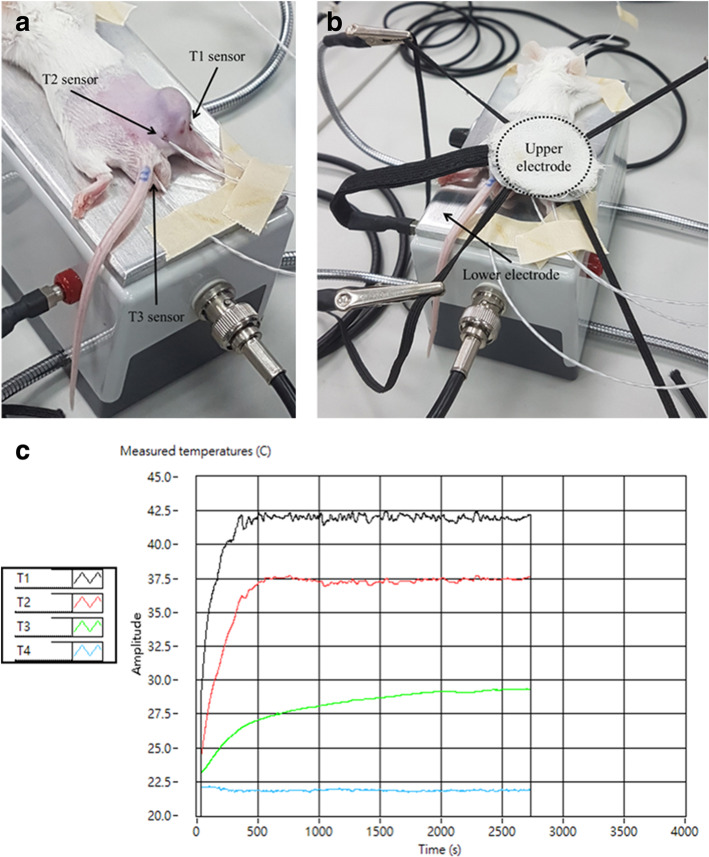
Fig. 1
Fig. 1
In vivo mEHT instrument. (a) The mouse was sedated and fixed on the mEHT instrument. The optical sensors were used to detect the temperature within the various body sites. The T1 sensor inserted into the tumor; T2 sensor inserted into the subcutaneous site; T3 sensor inserted within the rectum. (b) The upper electrode was covered on the tumor, which was on the wet pad to prevent from overheated. (c) The measured temperature curves of T1 ~ T3, T4: room temperature
Fig. 2
Fig. 2
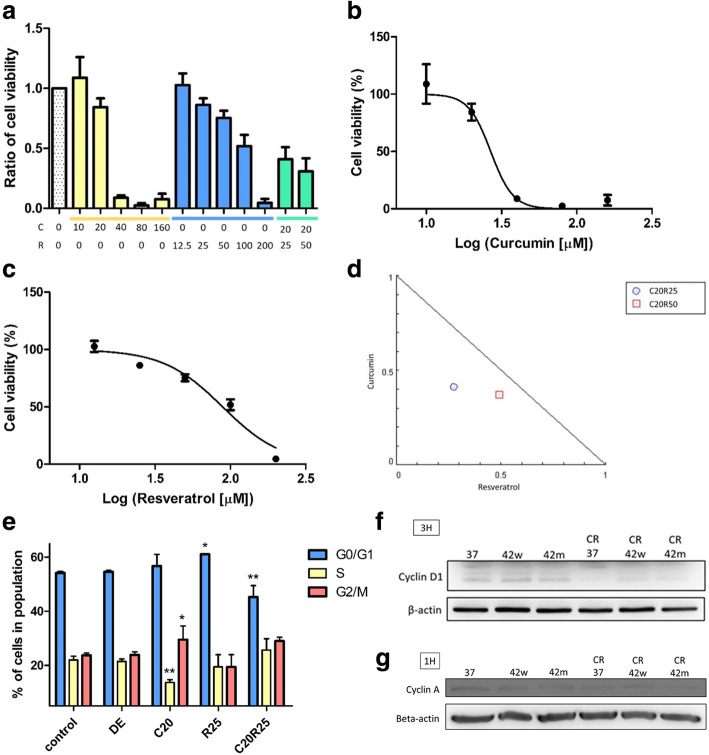
Effects of curcumin and resveratrol on the cell viability and cell cycle analysis of CT26 cells. (a) Cells were treated with curcumin (c), resveratrol (R), and the combined (C20 + R25, C20 + R50 μM) at the indicated concentration for 24 h. Cell viability was detected through WST1 assay. The results were represented the mean ± S.D. of three independent experiments. DMSO and EtOH served as the solvent control. (b) The cell viability of CT26 cells treated with curcumin. The IC50 of curcumin was 26.76 ± 1.06 μM. (c) The cell viability of CT26 cells treated with resveratrol. The IC50 of resveratrol was 88.76 ± 1.07 μM. d. Curcumin and resveratrol combination showed synergistically anti-tumor efficacy. (e) CT26 cells were treated with curcumin (20 μM) and resveratrol (25 μM) for 24 h and the cell cycle was analyzed by PI staining and flow cytometry. (f) Cyclin D1 and (g) Cyclin A expressions of CT26 cells treated by the indicated curcumin and resveratrol treatments with or w/o the 42 °C water bath (42w) and 42 °C mEHT (42 m) were analyzed by the western blot. Treating groups: DMSO + EtOH (DE, vehicle control), curcumin 20 μM (C20), resveratrol 25 μM (R25), curcumin 20 μM combined resveratrol 25 μM (C20R25). *P < 0.05, **P < 0.01 as compared to the control group. The full-length blots were presented in Supplementary Figure 2
Fig. 3
Fig. 3
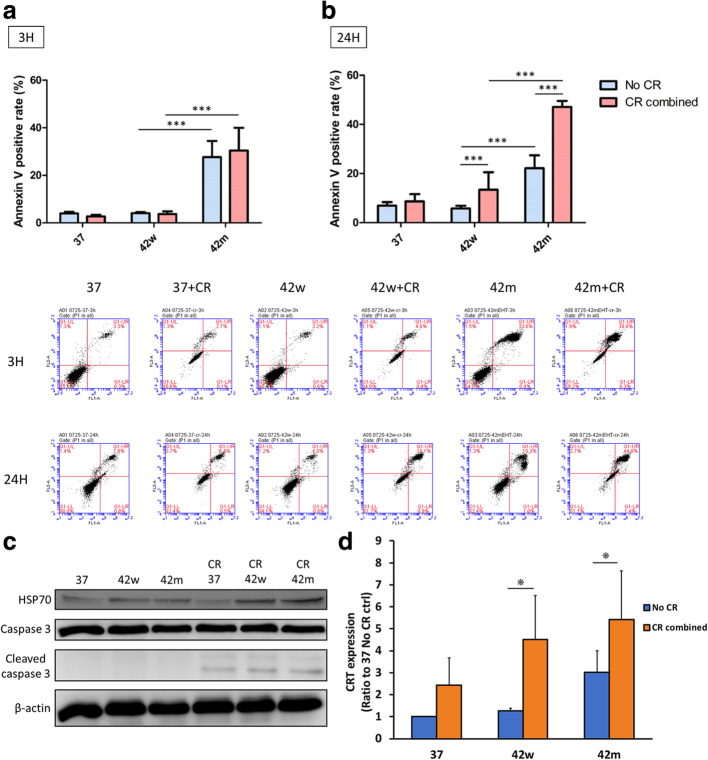
Apoptosis and immunogenic cell death of the CT26 cells treated with curcumin, resveratrol and mEHT. (a) CT26 cells were treated with 37 °C (37), water bath (42w), mEHT (42 m), 37 °C (37) + curcumin (C, 20 μM) and resveratrol (R, 25 μM), water bath + CR (42w + CR), and mEHT + CR (42 m + CR) for 3 or (b) 24 h. The apoptotic effects of these treatments were measured by annexin V/propidium iodide staining and flow cytometry. The results were represented the mean ± S.D. of three independent experiments. *P < 0.05, ***P < 0.001. (c) The expressions of HSP70 and caspase 3 were analyzed by western blot after CT26 cells incubated with the indicated treatments for 3 h. The full-length blots were presented in Supplementary Figure 2. (d) The expressions of CRT were detected by flow cytometry after CT26 cells incubated with the indicated treatments for 24 h. The results were represented the mean ± S.D. of three independent experiments. *P < 0.05
Fig. 4
Fig. 4
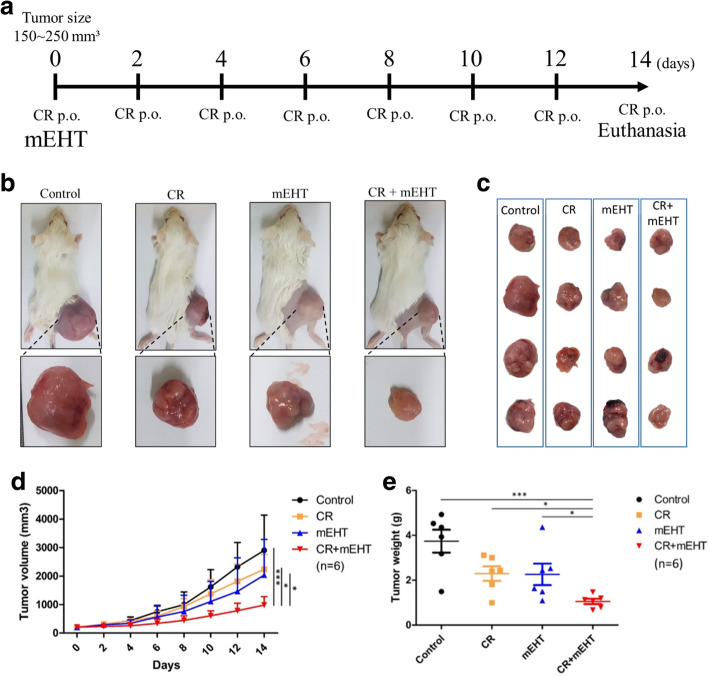
In vivo anti-tumor effect of the combined mEHT treatment with curcumin and resveratrol. (a) The schematic illustration of the combined treatment protocol. The tumor-bearing mice (b) and the tumor samples (c) obtained from the different treatments. The tumor growth curve (d) and tumor weight (e) of the CT26 tumors received the treatments of vehicle control (Control), curcumin (c), resveratrol (R), mEHT, and combined all (CR + mEHT). *P < 0.05, **P < 0.01, ***P < 0.001
Fig. 5
Fig. 5
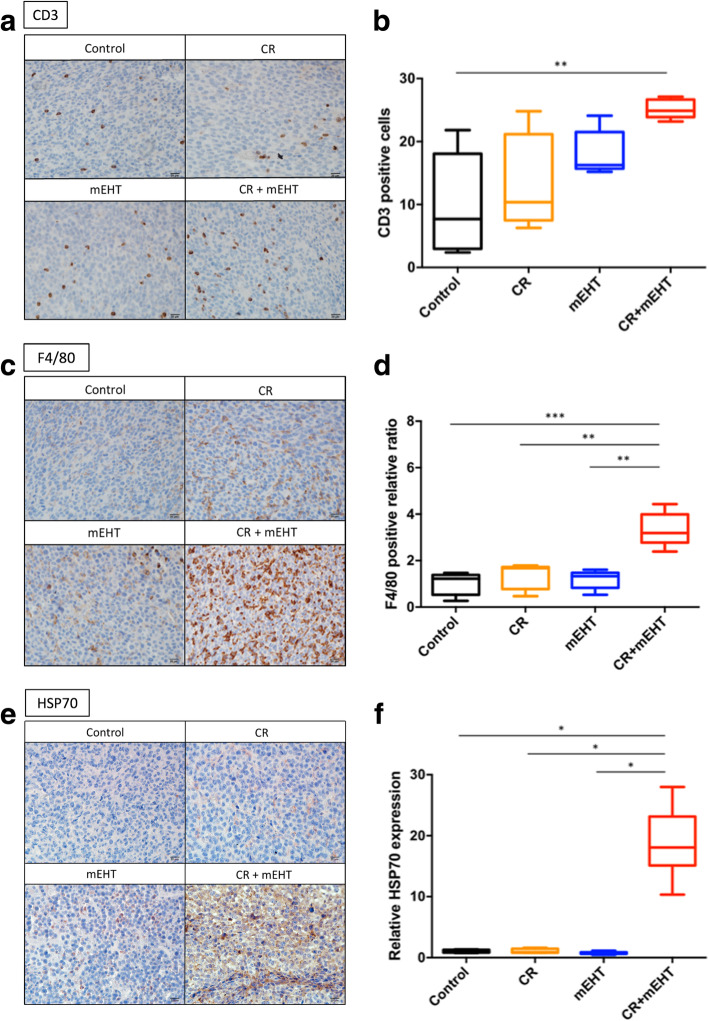
Immunohistochemical analysis of CD3, F4/80 and HSP70 expressions in tumor tissues with CR + mEHT treatment. CD3 (a & b), and F4/80 (c & d)-positive cells and HSP70 expression (e & f) within the tumor tissues treated with the indicated treatments were detected by immunohistochemistry (IHC). Vehicle control (Control), curcumin (C), resveratrol (R), mEHT, and combined all (CR + mEHT). **P < 0.01, ***P < 0.001 as compared to control group

References

    1. Andocs G, Renner H, Balogh L, Fonyad L, Jakab C, Szasz A. Strong synergy of heat and modulated electromagnetic field in tumor cell killing. Strahlenther Onkol. 2009;185(2):120–126. - PubMed
    1. Andocs G, Szasz O, Szasz A. Oncothermia treatment of cancer: from the laboratory to clinic. Electromagn Biol Med. 2009;28(2):148–165. - PubMed
    1. Szasz A, Vincze G, Szasz O, Szasz N. An energy analysis of extracellular hyperthermia. Electromagn Biol Med. 2003;22(2–3):103–115.
    1. Dicheva BM, Koning GA. Targeted thermosensitive liposomes: an attractive novel approach for increased drug delivery to solid tumors. Expert Opin Drug Deliv. 2014;11(1):83–100. - PubMed
    1. Tsang Y-W, Chi K-H, Huang C-C, Chi M-S, Chiang H-C, Yang K-L, Li W-T, Wang Y-S. Modulated electro-hyperthermia-enhanced liposomal drug uptake by cancer cells. Int J Nanomedicine. 2019;14:1269–1279. - PMC - PubMed

MeSH terms