


Referrals of Infection Control Breaches to Public Health Authorities: Ambulatory Care Settings Experience, 2017
- PMID: 32600952
- PMCID: PMC7876613
- DOI: 10.1016/j.jcjq.2020.05.005
Referrals of Infection Control Breaches to Public Health Authorities: Ambulatory Care Settings Experience, 2017
Abstract
Background: Beginning in October 2016, the Centers for Medicare & Medicaid Services (CMS) issued expanded guidance requiring accrediting organizations and state survey agencies to report serious infection control breaches to relevant state health departments. This project sought to characterize and summarize The Joint Commission's early experiences and findings in applying this guidance to facilities accredited under the ambulatory and office-based surgery programs in 2017.
Methods: Surveyor notes were retrospectively reviewed to identify individual breaches, and then the Centers for Disease Control and Prevention's Infection Prevention Checklist for Outpatient Settings was used to categorize and code documented breaches.
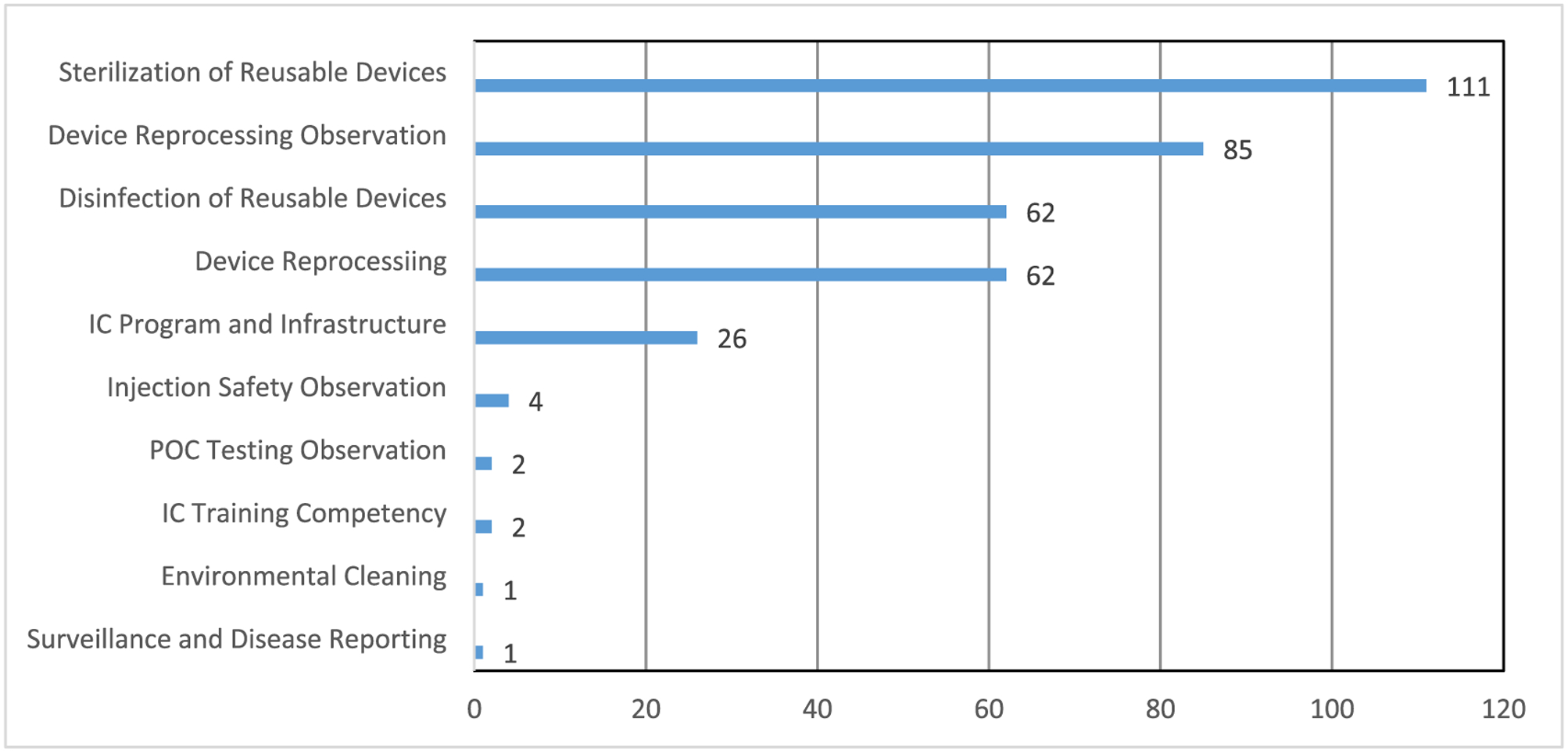
Results: Of 845 ambulatory organizations, 39 (4.6%) had breaches observed during the survey process and reported to health departments. Within these organizations, surveyors documented 356 breaches, representing 52 different breach codes. Common breach domains were sterilization of reusable devices, device reprocessing observation, device reprocessing, disinfection of reusable devices, and infection control program and infrastructure. Eight of the 39 facilities (20.5%) were cited for not performing the minimum level of reprocessing based on the items' intended use, reusing single-use devices, and/or not using aseptic technique to prepare injections.
Conclusion: The CMS infection control breach reporting requirement has helped highlight some of the challenges faced by ambulatory facilities in providing a safe care environment for their patients. This analysis identified numerous opportunities for improved staff training and competencies as well as leadership oversight and investment in necessary resources. More systematic assessments of infection control practices, extending to both accredited and nonaccredited ambulatory facilities, are needed to inform oversight and prevention efforts.
Copyright © 2020 The Joint Commission. All rights reserved.
Conflict of interest statement
Figures
References
-
- Centers for Disease Control and Prevention. One & Only Campaign. (Updated: Dec 3, 2019.) Accessed May 27, 2020 https://www.cdc.gov/injectionsafety/one-and-only.html.
-
- Centers for Disease Control and Prevention, Health Alert Network. Immediate Need for Healthcare Facilities to Review Procedures for Cleaning, Disinfecting, and Sterilizing Reusable Medical Devices, Sep 11 2015. Accessed May 27, 2020 https://emergency.cdc.gov/han/han00382.asp .
-
- Schaefer MK, et al. Infection control assessment of ambulatory surgical centers. JAMA. 2010. Jun 9;303:2273–2279 . - PubMed
Publication types
MeSH terms
Grants and funding
LinkOut - more resources
Full Text Sources
Medical
