Review
. 2020 Jun 29:369:m2511.
doi: 10.1136/bmj.m2511.

Health effects of vitamin and mineral supplements

Affiliations
Review

Health effects of vitamin and mineral supplements

Fang Fang Zhang et al. BMJ. .

Abstract

Growing numbers of healthy people are taking dietary supplements but there is little evidence that they protect against non-communicable diseases, say Fang Fang Zhang and colleagues


Conflict of interest statement

Competing interests: All authors have read and understood BMJ policy on declaration of interests and declared the following: FFZ declares funding from the National Institutes of Health, NIMHD (R01 MD 011501) and the Bristol Mayer Squibb Foundation (Bridging Cancer Care Programme). DL declares funding from the National Natural Science Foundation of China (NSFC 81773433) and Key Scientific Research Projects in Shandong Providence China (2017YYSP007). JBB declares funding from Danone. HM declares funding from DSM Nutritional Products, Switzerland. The funders had no role in the design or conduct of the study, collection, management, analysis, or the interpretation of the data. JBB reports service on scientific advisory boards of AdvoCare International, California Prune Board, California Walnut Commission, Church and Dwight, Cranberry Marketing Committee, Guiding Stars, Quaker Oats, Segterra, and SmartyPants, not related to this work.

Figures

Fig 1
Fig 1
Proportion of US adults taking commonly vitamin, mineral, and fish oil supplements, National Health and Nutrition Examination Survey 1999-2014
Fig 2
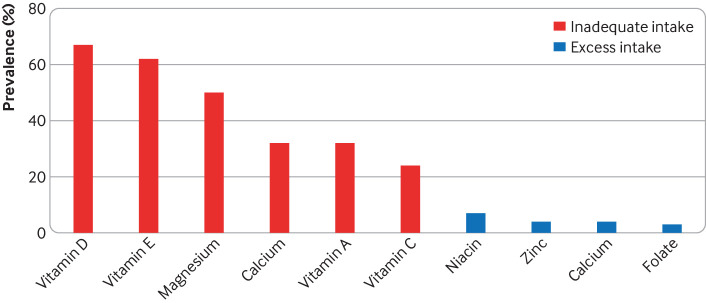
Fig 2
Prevalence of inadequate and excess nutrient intake among US Adults, National Health and Nutrition Examination Survey 1999-2014

References

    1. Ford JA, MacLennan GS, Avenell A, Bolland M, Grey A, Witham M, RECORD Trial Group Cardiovascular disease and vitamin D supplementation: trial analysis, systematic review, and meta-analysis. Am J Clin Nutr 2014;100:746-55. 10.3945/ajcn.113.082602 - DOI - PubMed
    1. Skeie G, Braaten T, Hjartåker A, et al. Use of dietary supplements in the European Prospective Investigation into Cancer and Nutrition calibration study. Eur J Clin Nutr 2009;63(Suppl 4):S226-38. 10.1038/ejcn.2009.83 - DOI - PubMed
    1. O’Brien SK, Malacova E, Sherriff JL, Black LJ. The prevalence and predictors of dietary supplement use in the Australian population. Nutrients 2017;9:E1154. 10.3390/nu9101154 - DOI - PMC - PubMed
    1. Kang M, Kim DW, Baek YJ, et al. Dietary supplement use and its effect on nutrient intake in Korean adult population in the Korea National Health and Nutrition Examination Survey IV (2007-2009) data Eur J Clin Nutr 2014;68:804-10. 10.1038/ejcn.2014.77 - DOI - PubMed
    1. Black LI, Clarke TC, Barnes PM, Stussman BJ, Nahin RL. Use of complementary health approaches among children aged 4-17 years in the United States: national health interview survey, 2007-2012. Natl Health Stat Report 2015;(78):1-19. - PMC - PubMed

MeSH terms