. 2020 Jun 29;10(1):10516.
doi: 10.1038/s41598-020-67477-6.

Sleep in honey bees is affected by the herbicide glyphosate

Affiliations

Sleep in honey bees is affected by the herbicide glyphosate

Diego E Vázquez et al. Sci Rep. .

Abstract

Sleep plays an essential role in both neural and energetic homeostasis of animals. Honey bees (Apis mellifera) manifest the sleep state as a reduction in muscle tone and antennal movements, which is susceptible to physical or chemical disturbances. This social insect is one of the most important pollinators in agricultural ecosystems, being exposed to a great variety of agrochemicals, which might affect its sleep behaviour. The intake of glyphosate (GLY), the herbicide most widely used worldwide, impairs learning, gustatory responsiveness and navigation in honey bees. In general, these cognitive abilities are linked with the amount and quality of sleep. Furthermore, it has been reported that animals exposed to sleep disturbances show impairments in both metabolism and memory consolidation. Consequently, we assessed the sleep pattern of bees fed with a sugar solution containing GLY (0, 25, 50 and 100 ng) by quantifying their antennal activity during the scotophase. We found that the ingestion of 50 ng of GLY decreased both antennal activity and sleep bout frequency. This sleep deepening after GLY intake could be explained as a consequence of the regenerative function of sleep and the metabolic stress induced by the herbicide.


Conflict of interest statement

The authors declare no competing interests.

Figures

Figure 1
Figure 1
Glyphosate does not affect the proportion of time invested in rest. Dispersion of proportions of time invested per forager bee in each stage of the resting–awakening cycle (wakefulness/W: white, light sleep/LS: grey, and deep sleep/DS: black) during scotophase (18:00–6:00) according to GLY exposure. Acute exposure to contaminated food with the following doses of GLY per group: 0, 25, 50 and 100 ng. The number of assessed bees per group is shown in brackets. Different letters indicate significant differences among cycle stages (P < 0.05) (GLMM model: prop. of time ~ [GLY] + cycle stage + (1|day/bee), Tukey test in Supplementary Table S3).
Figure 2
Figure 2
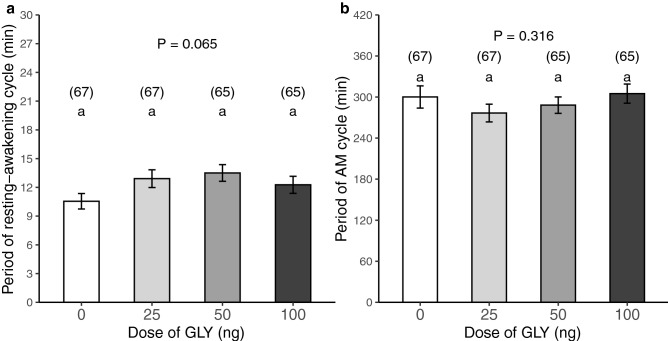
Glyphosate slightly affects sleep frequency. (a) Average dominant duration of each stage (wakefulness or sleep) in the resting–awakening cycle displayed in forager bees during scotophase (18:00–6:00) according to GLY exposure (mean ± SEM). (b) Average dominant duration of the amplitude modulation (AM) in the resting–awakening cycle. Acute exposure to contaminated food with the following doses of GLY per group: 0, 25, 50 and 100 ng. The bars are plotted with a greyscale gradient for increasing doses of GLY. The number of assessed bees per group is shown in brackets. Groups with different letters have significantly different means (P < 0.05) (GLMM model: dominant period ~ [GLY] + (1|day), Tukey test in SI Table S4).
Figure 3
Figure 3
Glyphosate affects antennal activity during the wakefulness. (a) Average cumulative intensity rate (total antennal activity/lifetime) during the resting–awakening cycle (predominantly wakefulness stage) displayed during scotophase (18:00–6:00) according to GLY exposure (mean ± SEM). (b) Average signal–noise ratio 1 (Eq. 1) and (c) average signal–noise ratio 2 (Eq. 2) calculated for the biological signals recorded in the forager bees during the experiment (mean ± SEM). Acute exposure to contaminated food with the following doses of GLY per group: 0, 25, 50 and 100 ng. The bars are plotted with a greyscale gradient for increasing doses of GLY. The number of assessed bees per group is shown in brackets. Groups with different letters have significantly different means (P < 0.05) (GLMM model: CIR or SNR ~ [GLY] + (1|day), Tukey test in SI Tables S5, S6 and S7).

References

    1. Vorster AP, Born J. Sleep and memory in mammals, birds and invertebrates. Neurosci. Biobehav. Rev. 2015;50:103–119. - PubMed
    1. Helfrich-Foerster C. Sleep in insects. Annu. Rev. Entomol. 2018;63:69–86. - PubMed
    1. Berger RJ, Phillips NH. Energy conservation and sleep. Behav. Brain Res. 1995;69(1–2):65–73. - PubMed
    1. Cirelli C, Tononi G. Is sleep essential? PLoS Bio. 2008;6(8):e216. - PMC - PubMed
    1. Bloch G, Hazan E, Rafaeli A. Circadian rhythms and endocrine functions in adult insects. J. Insect Physiol. 2013;59(1):56–69. - PubMed

Publication types