


Defining a Centiloid scale threshold predicting long-term progression to dementia in patients attending the memory clinic: an [18F] flutemetamol amyloid PET study
- PMID: 32601802
- PMCID: PMC7835306
- DOI: 10.1007/s00259-020-04942-4
Defining a Centiloid scale threshold predicting long-term progression to dementia in patients attending the memory clinic: an [18F] flutemetamol amyloid PET study
Abstract
Purpose: To evaluate cerebral amyloid-β(Aβ) pathology in older adults with cognitive complaints, visual assessment of PET images is approved as the routine method for image interpretation. In research studies however, Aβ-PET semi-quantitative measures are associated with greater risk of progression to dementia; but until recently, these measures lacked standardization. Therefore, the Centiloid scale, providing standardized Aβ-PET semi-quantitation, was recently validated. We aimed to determine the predictive values of visual assessments and Centiloids in non-demented patients, using long-term progression to dementia as our standard of truth.
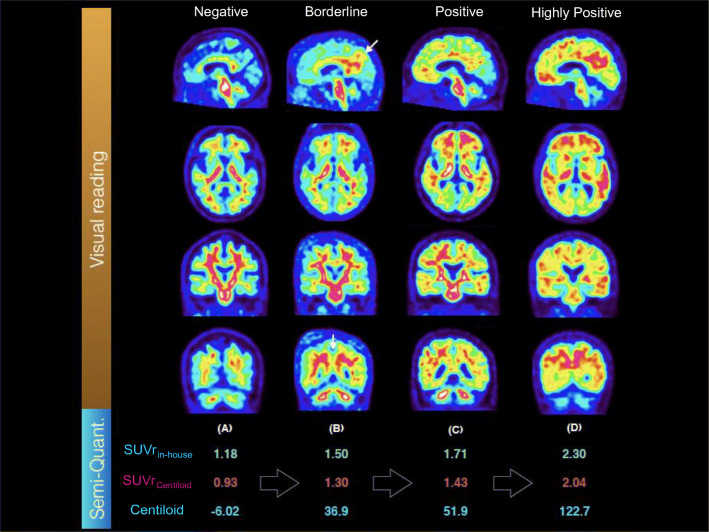
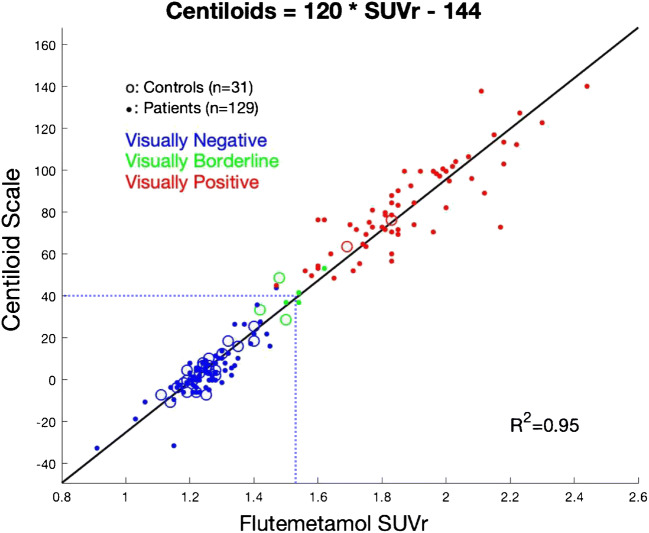
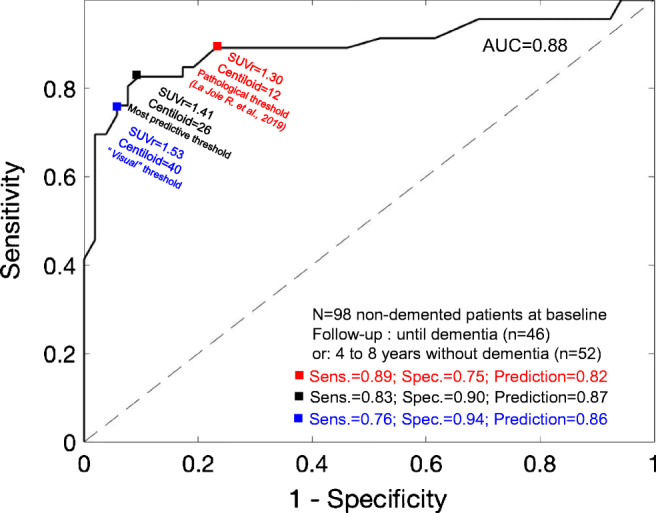
Methods: One hundred sixty non-demented participants (age, 54-86) were enrolled in a monocentric [18F] flutemetamol Aβ-PET study. Flutemetamol images were interpreted visually following the manufacturers recommendations. SUVr values were converted to the Centiloid scale using the GAAIN guidelines. Ninety-eight persons were followed until dementia diagnosis or were clinically stable for a median of 6 years (min = 4.0; max = 8.0). Twenty-five patients with short follow-up (median = 2.0 years; min = 0.8; max = 3.9) and 37 patients with no follow-up were excluded. We computed ROC curves predicting subsequent dementia using baseline PET data and calculated negative (NPV) and positive (PPV) predictive values.
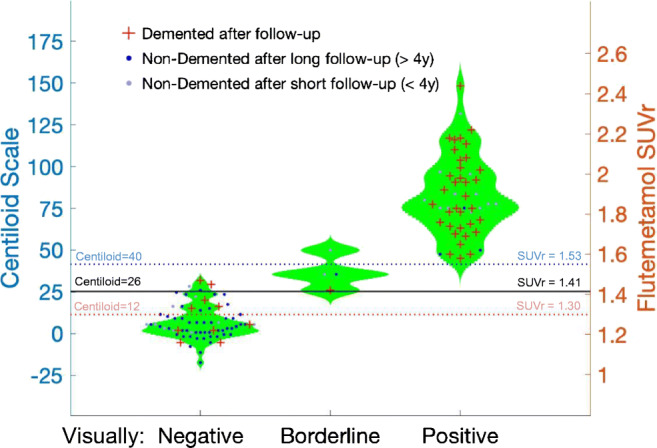
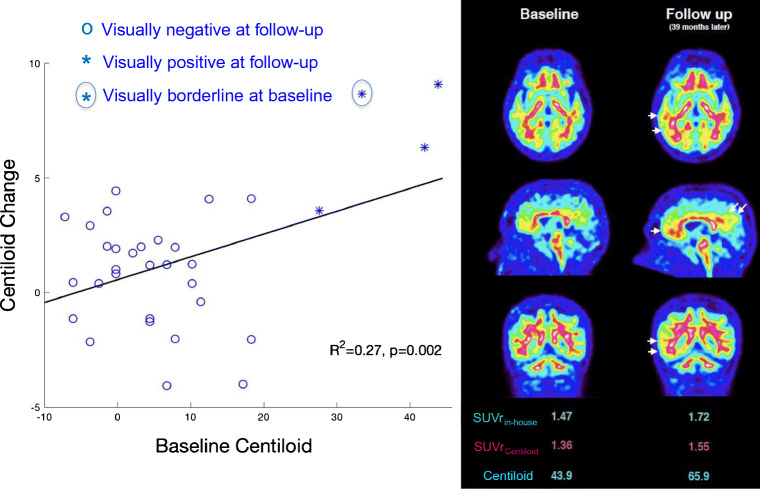
Results: In the 98 participants with long follow-up, Centiloid = 26 provided the highest overall predictive value = 87% (NPV = 85%, PPV = 88%). Visual assessment corresponded to Centiloid = 40, which predicted dementia with an overall predictive value = 86% (NPV = 81%, PPV = 92%). Inclusion of the 25 patients who only had a 2-year follow-up decreased the PPV = 67% (NPV = 88%), reflecting the many positive cases that did not progress to dementia after short follow-ups.
Conclusion: A Centiloid threshold = 26 optimally predicts progression to dementia 6 years after PET. Visual assessment provides similar predictive value, with higher specificity and lower sensitivity.
Trial registration: Eudra-CT number: 2011-001756-12.
Keywords: AD dementia; Amyloid PET; Centiloids; Diagnostic accuracy; Mild cognitive impairment.
Conflict of interest statement
The firm GE Healthcare supplied the [18F] Flutemetamol tracer for acquiring the PET images analyzed in this manuscript. Profs. Hanseeuw, Ivanoiu, and Lhommel disclose receiving consultant fees from GE Healthcare during the course of the project. The amount of the fees received is below 2500€. Dr. G. Farrar and C. Buckley are employees of GE Healthcare. V. Malotaux, Drs. Dricot, Quenon, Sznajer, Cerman, and Woodard report no conflicts of interest.
Figures
References
Publication types
MeSH terms
Substances
Grants and funding
LinkOut - more resources
Full Text Sources
Medical
