


Iodine status during pregnancy and at 6 weeks, 6, 12 and 18 months post-partum
- PMID: 32602197
- PMCID: PMC7729798
- DOI: 10.1111/mcn.13050
Iodine status during pregnancy and at 6 weeks, 6, 12 and 18 months post-partum
Abstract
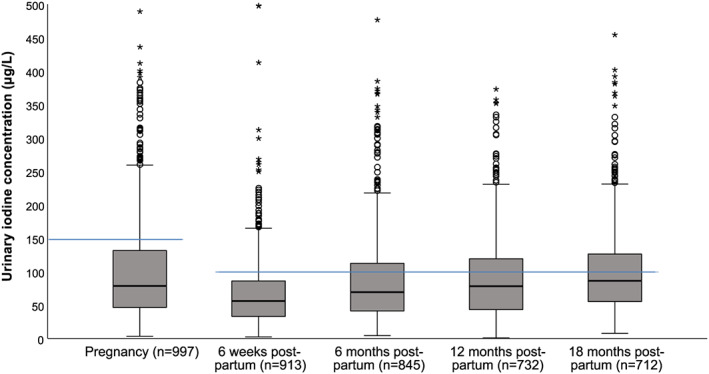
Iodine deficiency during pregnancy and in the post-partum period may lead to impaired child development. Our aim is to describe iodine status longitudinally in women from pregnancy until 18 months post-partum. Furthermore, we explore whether iodine status is associated with dietary intake, iodine-containing supplement use and breastfeeding status from pregnancy until 18 months post-partum. We also assess the correlation between maternal iodine status 18 months post-partum and child iodine status at 18 months of age. Iodine status was measured by urinary iodine concentration (UIC) during pregnancy (n = 1,004), 6 weeks post-partum (n = 915), 6 months post-partum (n = 849), 12 months post-partum (n = 733) and 18 months post-partum (n = 714). The toddlers' UIC was assessed at 18 months of age (n = 416). Demographic variables and dietary data (food frequency questionnaire) were collected during pregnancy, and dietary data and breastfeeding practices were collected at all time points post-partum. We found that iodine status was insufficient in both pregnant and post-partum women. The UIC was at its lowermost 6 weeks post-partum and gradually improved with increasing time post-partum. Intake of milk and use of iodine-containing supplements significantly increased the odds of having a UIC above 100 μg/L. Neither the mothers' UIC, vegetarian practice, nor exclusion of milk and dairy products were associated with the toddlers UIC 18 months post-partum. Women who exclude milk and dairy products from their diets and/or do not use iodine-containing supplements may be at risk of iodine deficiency. The women possibly also have an increased risk of thyroid dysfunction and for conceiving children with nonoptimal developmental status.
Keywords: breast feeding; iodine intake; post-partum period; pregnancy; toddlers; urinary iodine concentration.
© 2020 The Authors. Maternal & Child Nutrition published by John Wiley & Sons, Ltd.
Conflict of interest statement
The authors declare that they have no conflicts of interest.
Figures
References
-
- Abel, M. H. , Caspersen, I. H. , Meltzer, H. M. , Haugen, M. , Brandlistuen, R. E. , Aase, H. , … Brantsæter, A.‐L. (2017). Suboptimal maternal iodine intake is associated with impaired child neurodevelopment at 3 years of age in the Norwegian Mother and Child Cohort Study. The Journal of Nutrition, 147(7), 1314–1324. 10.3945/jn.117.250456 - DOI - PubMed
-
- Abel, M. H. , Korevaar, T. I. , Erlund, I. , Villanger, G. D. , Caspersen, I. H. , Arohonka, P. , … Brantsæter, A.‐L. (2018). Iodine intake is associated with thyroid function in mild to moderately iodine deficient pregnant women. Thyroid, 28(10), 1359–1371. 10.1089/thy.2018.0305 - DOI - PMC - PubMed
-
- Andersson, M. , De Benoist, B. , Delange, F. , & Zupan, J. (2007). Prevention and control of iodine deficiency in pregnant and lactating women and in children less than 2‐years‐old: Conclusions and recommendations of the Technical Consultation. Public Health Nutrition, 10(12), 1606–1611. 10.1017/S1368980007361004 - DOI - PubMed
Publication types
MeSH terms
Substances
LinkOut - more resources
Full Text Sources
