


Using a HIV prevention cascade for identifying missed opportunities in PrEP delivery in Kenya: results from a programmatic surveillance study
- PMID: 32602658
- PMCID: PMC7325512
- DOI: 10.1002/jia2.25537
Using a HIV prevention cascade for identifying missed opportunities in PrEP delivery in Kenya: results from a programmatic surveillance study
Abstract
Introduction: HIV prevention cascades have been systematically evaluated in high-income countries, but steps in the pre-exposure prophylaxis (PrEP) service delivery cascade have not been systematically quantified in sub-Saharan Africa. We analysed missed opportunities in the PrEP cascade in a large-scale project serving female sex workers (FSW), men who have sex with men (MSM) and adolescent girls and young women (AGYW) in Kenya.
Methods: Programmatic surveillance was conducted using routine programme data from 89 project-supported sites from February 2017 to December 2019, and complemented by qualitative data. Healthcare providers used nationally approved tools to document service statistics. The analyses examined proportions of people moving onto the next step in the PrEP continuum, and identified missed opportunities. Missed opportunities were defined as implementation gaps exemplified by the proportion of individuals who could have potentially accessed each step of the PrEP cascade and did not. We also assessed trends in the cascade indicators at monthly intervals. Qualitative data were collected through 28 focus group discussions with 241 FSW, MSM, AGYW and healthcare providers, and analysed thematically to identify reasons underpinning the missed opportunities.
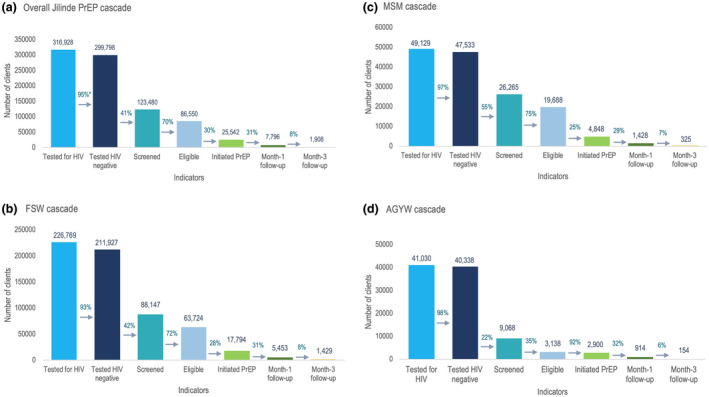
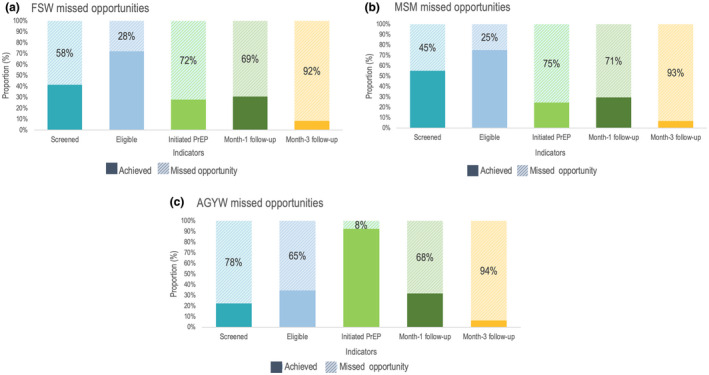
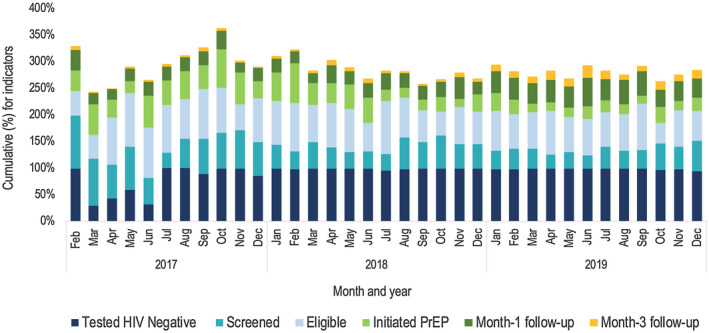
Results: During the study period, 299,798 individuals tested HIV negative (211,927 FSW, 47,533 MSM and 40,338 AGYW). Missed opportunities in screening for PrEP eligibility was 58% for FSW, 45% for MSM and 78% for AGYW. Of those screened, 28% FSW, 25% MSM and 65% AGYW were ineligible. Missed opportunities for PrEP initiation were lower among AGYW (8%) compared to FSW (72%) and MSM (75%). Continuation rates were low across all populations at Month-1 (ranging from 29% to 32%) and Month-3 (6% to 8%). Improvements in average annual Month-1 (from 26% to 41%) and Month-3 (from 4% to 15%) continuation rates were observed between 2017 and 2019. While initiation rates were better among younger FSW, MSM and AGYW (<30 years), the reverse was true for continuation.
Conclusions: The application of a PrEP cascade framework facilitated this large-scale oral PrEP programme to conduct granular programmatic analysis, detecting "leaks" in the cascade. These informed programme adjustments to mitigate identified gaps resulting in improvement of selected programmatic outcomes. PrEP programmes are encouraged to introduce the cascade analysis framework into new and existing programming to optimize HIV prevention outcomes.
Keywords: HIV prevention; PrEP; cascades; key and vulnerable populations; missed opportunities; sub-Saharan Africa.
© 2020 The Authors. Journal of the International AIDS Society published by John Wiley & Sons Ltd on behalf of the International AIDS Society.
Figures

References
-
- UNAIDS . UNAIDS DATA 2019. Geneva: UNAIDS; 2019.
-
- National AIDS and STI Control Programme (NASCOP) . Preliminary KENPHIA 2018 report. Nairobi: NASCOP;2020. p. 1–27.
-
- National AIDS Control Council. Kenya: HIV prevention response and modes of transmission analysis. Kenya National AIDS Control Council. 2009;83.
-
- UNAIDS . We’ve got the power: Women, adolescent girls and the HIV response. Geneva: UNAIDS; 2020. p. 1‐51
-
- UNAIDS . Women and HIV: A spotlight on adolescent girls and young. women.. 2019;1–20.
Publication types
MeSH terms
Substances
Grants and funding
LinkOut - more resources
Full Text Sources
Medical
Miscellaneous
