


Genetic diversity, SNP-trait associations and genomic selection accuracy in a west African collection of Kersting's groundnut [Macrotyloma geocarpum(Harms) Maréchal & Baudet]
- PMID: 32603370
- PMCID: PMC7326195
- DOI: 10.1371/journal.pone.0234769
Genetic diversity, SNP-trait associations and genomic selection accuracy in a west African collection of Kersting's groundnut [Macrotyloma geocarpum(Harms) Maréchal & Baudet]
Abstract
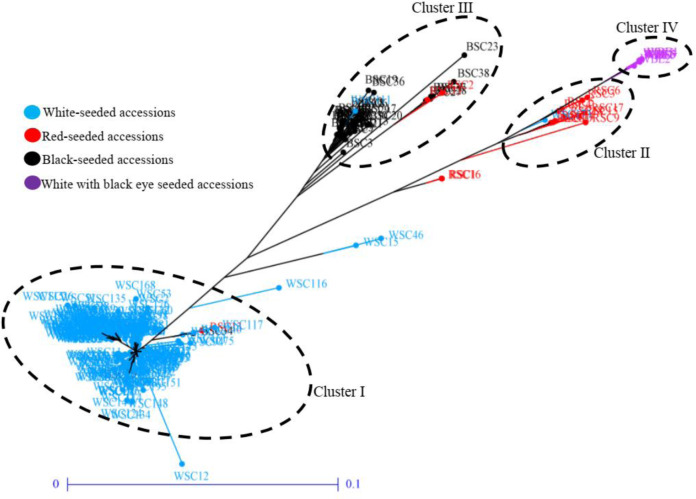
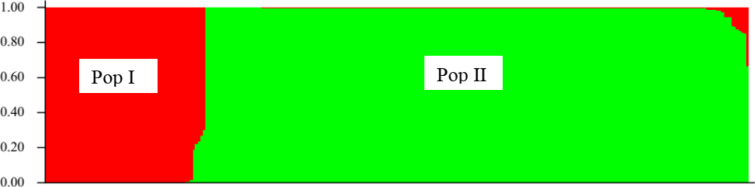
Understanding the mechanisms governing complex traits variation is a requirement for efficient crop improvement. In this study, the molecular characterization, marker-trait associations and the possibility for genomic selection in a collection of 281 Kersting's groundnut accessions were carried out. The diversity panel was phenotyped using an Alpha lattice design with two replicates in two contrasting environments. Accessions were genotyped using genotyping by sequencing technology. Genome-wide association analyses were performed between single nucleotide polymorphism markers and yield-related traits across tested environments. SNP markers were used to calculate the observed (Ho) and expected heterozygosity (He), and the total gene diversity (Ht). Genetic differentiation among accessions across ecological regions of origin was analysed. Our results revealed 493 quality SNPs of which 113 had a minor allele frequency>0.05, a total gene diversity of 0.43 and average Ho and He values of 0.04 and 0.22, respectively. Four clusters, highly differentiated by seed coat colour (Fst = 0.79), were identified. The population structure analysis showed two subpopulations with high differentiation across ecological regions (Fst = 0.37). The GWAS revealed 10 significant marker-trait associations, of which six SNPs were consistent across environments. The genomic selection through cross-validation showed moderate to high prediction accuracies for leaflet length, seed dimension traits, 100 seed weight, days to 50% flowering and days to maturity. This demonstrates the existence of genetic variability within Kersting's groundnut and shows the potential for the improvement of the species. The findings also provide a first insight into the phenotype-to-genotype relationships in Kersting's groundnut, using SNP markers.
Conflict of interest statement
The authors have declared that no competing interests exist.
Figures
References
-
- Acquaah G. Principles of Plant Genetics and Breeding. UK: John Wiley & Sons; 2012. 740 p.
-
- Ceccarelli S, Grando S, Maatougui M, Michael M, Slash M, Haghparast R, et al. Plant breeding and climate changes. J Agr Sci. 2010;148(6):627–37.
Publication types
MeSH terms
LinkOut - more resources
Full Text Sources
Miscellaneous
